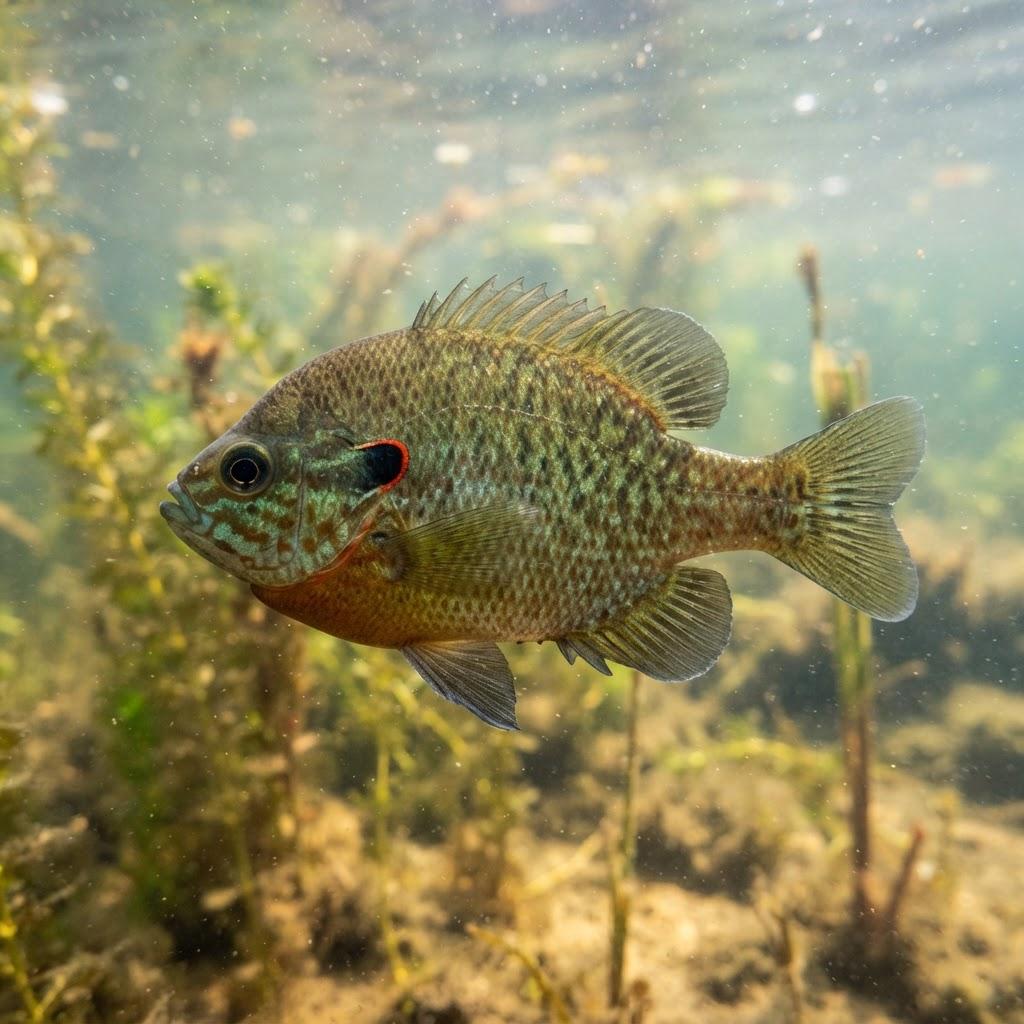
Lepomis microlophus
Redear Sunfish (Shellcracker)
Meet the Redear Sunfish, the neighborhood tough guy who treats hard-shelled snails like jaw-breaking jawbreakers. This underwater crusader brings a whole new meaning to the term 'shell-shocked' with its specialized tooth-plates.
Meet the Fish
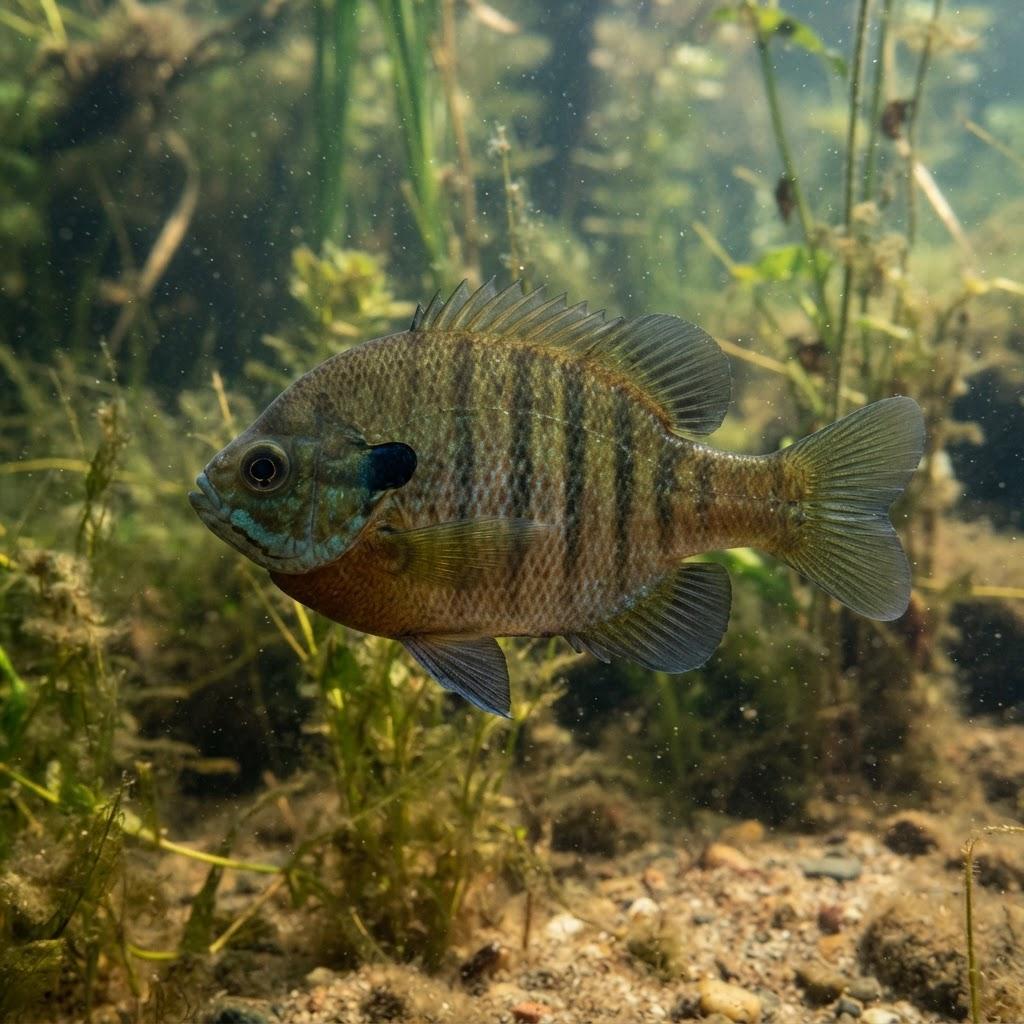
Imagine a fish that spends its entire life walking around with a built-in heavy-duty nutcracker in its throat. That is the Redear Sunfish, a creature that could easily be the protagonist of an underwater heist movie where the safe is a stubborn snail and the loot is pure protein. While other fish are busy chasing flashy flies or shimmering minnows, the Redear is down in the basement of the pond, grinding away at the toughest snacks in the neighborhood. They have a certain rugged elegance to them, sporting a vibrant crimson or bright orange spot on the back edge of their gill covers—a fancy little accessory that looks like they are wearing a permanent, fashionable badge of honor. Their vibe is strictly 'blue-collar professional' mixed with 'secretly the strongest guy in the room.' They are not the largest predators in the murky depths, but they possess a level of grit and persistence that makes them a legendary character in the world of freshwater angling. If you are looking for a fish that prefers a calculated, crunchy meal over a chaotic chase, you have found your champion. They do not just swim; they prowl the bottom, scanning for mollusks like a detective looking for clues, ready to deliver a crushing blow to anything that dares to hide inside a calcium fortress.
Weird Biological Superpowers Explained Simply
The Redear Sunfish has a superpower that sounds like something a mad scientist would dream up to win an engineering award. It is called the pharyngeal tooth-plate, and it is essentially a pair of specialized, grinding teeth located deep inside the fish’s throat. Think of it like having a granite-crushing mortar and pestle built directly into your esophagus. While most fish just swallow their meals whole or tear at them with their exterior teeth, the Redear takes a more sophisticated, brutal approach. When it finds a snail—a creature that thinks it is safe behind its impenetrable limestone armor—the Redear slurps it up and sends it down to the basement. There, those heavy-duty, rounded plates clamp down with incredible pressure, shattering the shell into tiny, useless fragments. It is basically the biological equivalent of a professional hydraulic press. This adaptation allows the Redear to tap into a massive, underutilized food source that would be far too much work for other fish to handle. By mastering the art of the 'crunch,' the Redear secures high-quality nutrients, leaving its neighbors to fight over the scraps while it enjoys a hearty meal of escargot that it processed entirely on its own, without even needing a fork or a napkin.
Absurd Self-Defense Mechanisms
When you are a medium-sized fish in a pond full of hungry bass, herons, and anglers, you need to be a bit scrappy. The Redear Sunfish does not rely on toxic slime or inflatable spikes to keep predators at bay. Instead, it masters the art of the 'sharp surprise.' If you have ever accidentally poked yourself on a fish fin, you know that these animals are not just soft scales; they have rigid, spiny rays that act like a picket fence designed to hurt anyone who gets too close. The Redear is particularly well-endowed with these prickly defenses, especially around its dorsal and anal fins. When a predator tries to grab a Redear, the fish immediately flares its fins wide, turning itself into a spiky, geometric nightmare that is essentially impossible to swallow comfortably. It is the fish equivalent of a hedgehog realizing that curling into a ball is not enough and deciding to also shoot out tiny, painful needles. Couple this with their tendency to hang out in dense, tangled vegetation where it is hard for larger, bulkier predators to maneuver, and you have a fish that knows how to turn its home into a fortress. It does not need to run away; it just makes itself so incredibly uncomfortable to eat that even the hungriest bass decides it would rather go find a nice, smooth-scaled minnow instead.
Fish Drama and Gossip
If you could peek inside a Redear Sunfish colony, you would quickly realize that their social life is essentially an episode of a high-stakes, underwater reality show. During the breeding season, the male Redear becomes the neighborhood’s most aggressive real estate mogul. They are notoriously territorial, setting up what are known as 'nesting beds' in the shallow sand. Imagine a school dance where everyone is trying to build the best corner of the room to impress their date, only the dance floor is a muddy bank and the construction involves moving pebbles with their mouths. The males will patrol their little patches of sand with an intensity that would put a security guard to shame, constantly chasing off other males who get too close to their claimed territory. It is all posturing, fin-flaring, and side-swimming displays designed to prove that they have the best dirt, the best view, and the most stamina. If a neighbor dares to hover a bit too long near the property line, it is 'on.' The fish engage in frantic, high-speed chases, turning the otherwise peaceful pond bed into a whirlwind of splashes and flared gills. It is pure, unfiltered drama where the stakes are high, and the winner gets to host the next big event in his sand-filled bachelor pad.
The "Wait, That's Real?!" Deep-Sea Oddities
While the Redear Sunfish lives in the relatively cozy, sun-drenched shallows of your local pond, its deep-sea cousins are living in an environment that is essentially an alien planet. Think about the barreleye fish, a creature with a transparent, fluid-filled dome on its head that lets it look through its own skull to see what is happening above it. Now, compare that to the Redear. While the Redear is busy crunching shells in the mud, those deep-sea weirdos are dealing with crushing pressures that would turn a human into a pancake in seconds, and they are doing it while glowing in the dark thanks to bacteria they keep in their own bodies. In the deep sea, there is no 'sunlight,' so if you want to find a date or lure in dinner, you have to make your own light show. It is a world of bioluminescent zombies and creatures with teeth that are literally bigger than their own heads. The Redear is practically a suburban accountant compared to these deep-sea rockstars, but that is actually a good thing. The Redear has mastered the 'safe and reliable' lifestyle, finding plenty of food in the light where it can see its surroundings, rather than floating in the pitch black waiting for a glowing tentacle to come waving in its general direction.
Myth Busting
There is an old, persistent myth that fish are nothing more than simple, mindless automatons that forget everything they have done in the last ten seconds. Well, tell that to a Redear Sunfish. These guys are actually incredibly observant and display a level of environmental memory that makes them surprisingly hard to fool. For years, anglers believed that you could just drop a hook anywhere and the fish would bite out of pure, dumb luck. In reality, the Redear is a deliberate feeder, learning exactly where the best patches of snails are located and returning to them repeatedly. They also possess an uncanny ability to recognize patterns in their environment, including those caused by human activity. They are not wandering aimlessly; they are patrolling, monitoring, and adapting. Furthermore, people often claim that all sunfish are essentially the same. That is like saying every human is the same because we all have two eyes. Each species of sunfish has evolved for a specific 'job' in the water ecosystem. The Redear is the specialist, the snail-crushing engineer, while others might be the acrobatic hunters or the bottom-feeding scavengers. Dismissing them as 'just another small fish' misses the entire point of their sophisticated, specialized survival strategy that has kept them thriving for millennia.
Humorous Historical Tales or Folklore
History is filled with strange beliefs about fish, and the Redear Sunfish is no exception. Because of their unique habit of crushing shells, early settlers in the American South often called them 'shellcrackers.' Some local folklore suggested that if you carried a dried-out shellcracker tooth in your pocket, you would have good luck when hunting for pearls or navigating the riverboats. While that sounds like the kind of tall tale a fisherman makes up to impress a young nephew, it speaks to how much these fish stood out. They were the fish that changed how people interacted with the water. Before the arrival of modern fishing gear, catching a fish that ate mostly snails was a rare event, leading to stories about 'the fish with the marble throat' that could crack rocks. In some regions, they were even used as a benchmark for the health of a body of water—if the shellcrackers were doing well, it meant the mollusk population was healthy and the water was clean. They became the quiet, reliable stewards of the riverbed, the silent partners in the health of the ecosystem that human beings started to respect, if only because they were so oddly specific about what they chose to eat for dinner.
Underwater Love Stories and Bizarre Romances
Love in the world of the Redear Sunfish is less about chocolates and flowers and more about intense, rhythmic construction and high-octane performance art. When the water temperature hits that sweet spot in the spring, the male begins his courtship ritual. He clears a depression in the sand or gravel, meticulously removing every piece of debris until the nest is perfect. Once his 'home' is ready, the real show begins. He starts a series of complex 'dances' and displays, vibrating his body and showing off his vibrant gill covers to catch the eye of a passing female. If she is impressed by his house-keeping skills and his display of vitality, she will move in to investigate the nest. The male then leads her into the center of the bed, where they perform a synchronized spin, releasing eggs and milt into the water simultaneously. It is an efficient, no-nonsense, but highly theatrical performance. The female doesn't stick around to help with the chores—she has places to be and more eggs to lay—leaving the male behind to guard the nest with the ferocity of a dragon protecting a pile of gold. It is a short, sharp romance that results in a new generation of shell-crushing specialists.
Underwater Architecture and DIY Nesting
If you look down into the shallow, sandy edges of a quiet lake, you might see what looks like a series of strange, round craters or sunken circles. You have stumbled upon a Redear Sunfish construction site. These are not just random holes; they are meticulously planned nests. The male Redear is essentially the lead contractor of the pond, spending days clearing away silt and moving larger pebbles with his mouth to create a clean, hard surface where eggs can safely incubate. He is looking for a substrate that will keep the eggs from sinking into the muck, where they might suffocate or be eaten by hungry insects. By choosing the right gravel, he is providing a clean environment with high oxygen flow. It is a fascinating bit of architectural engineering done entirely by instinct. He is building a nursery that needs to be defended, maintained, and kept free of debris for the days or weeks it takes for the fry to hatch. While other animals build complicated structures to attract mates or hide from predators, the Redear’s nest is purely functional: a clean, safe, and oxygenated cradle for the next generation, showing that even a fish can be a master of home improvement.
The Chaos of Raising Tiny Swimmers
Once the eggs hatch, the real insanity begins. The father doesn't just walk away; he stays, hovering over the nest, batting away any curious creature that wanders too close to his brood. The tiny, newly hatched fry are basically microscopic specks with eyes, and they have to learn how to exist in a world that is trying to eat them from every direction. For a few days, they stay close to the nest, feeding off their yolk sacs, but eventually, they have to strike out on their own. This is the 'chaotic swarm' phase. Thousands of tiny fish suddenly burst forth from the nest, turning the water column into a shimmering cloud of potential. It is a numbers game; the vast majority will be eaten by larger fish, insects, or even birds, but the sheer quantity ensures that some will survive to become the next generation of mollusk-hunters. The father eventually stops guarding them as they disperse into the thick weeds, leaving them to navigate the dangerous, big-kid world. It is a high-stakes, frantic start to life that perfectly encapsulates the survival-of-the-fittest reality of the pond, where life is short, fast, and remarkably productive.
How to Spot One & How It Is Doing
If you want to spot a Redear Sunfish, head to a lake with plenty of vegetation and look for those clear, circular patches on the sandy bottom, especially during the spring. Look for the 'red ear'—that bright, distinct spot on the gill cover that acts as their calling card. They are not shy, but they are smart; use light tackle and look for areas with lots of snails on the rocks or logs. Conservation-wise, the Redear is doing quite well. Unlike many species struggling with habitat loss, these fish have proven to be remarkably adaptable to human-made lakes and reservoirs. They are a success story in the world of freshwater biodiversity, thriving where other species might fail. To help them, simply keep the water clean—avoid dumping chemicals or trash into local ponds and support wetland protection initiatives. By protecting the health of the aquatic vegetation, we ensure there is plenty of cover for young fish and plenty of surfaces for snails to grow. It is an easy way to ensure that this fascinating, shell-crushing character continues to haunt the pond floors, keeping the ecosystem in balance and providing an entertaining mystery for the next generation of nature lovers to discover.