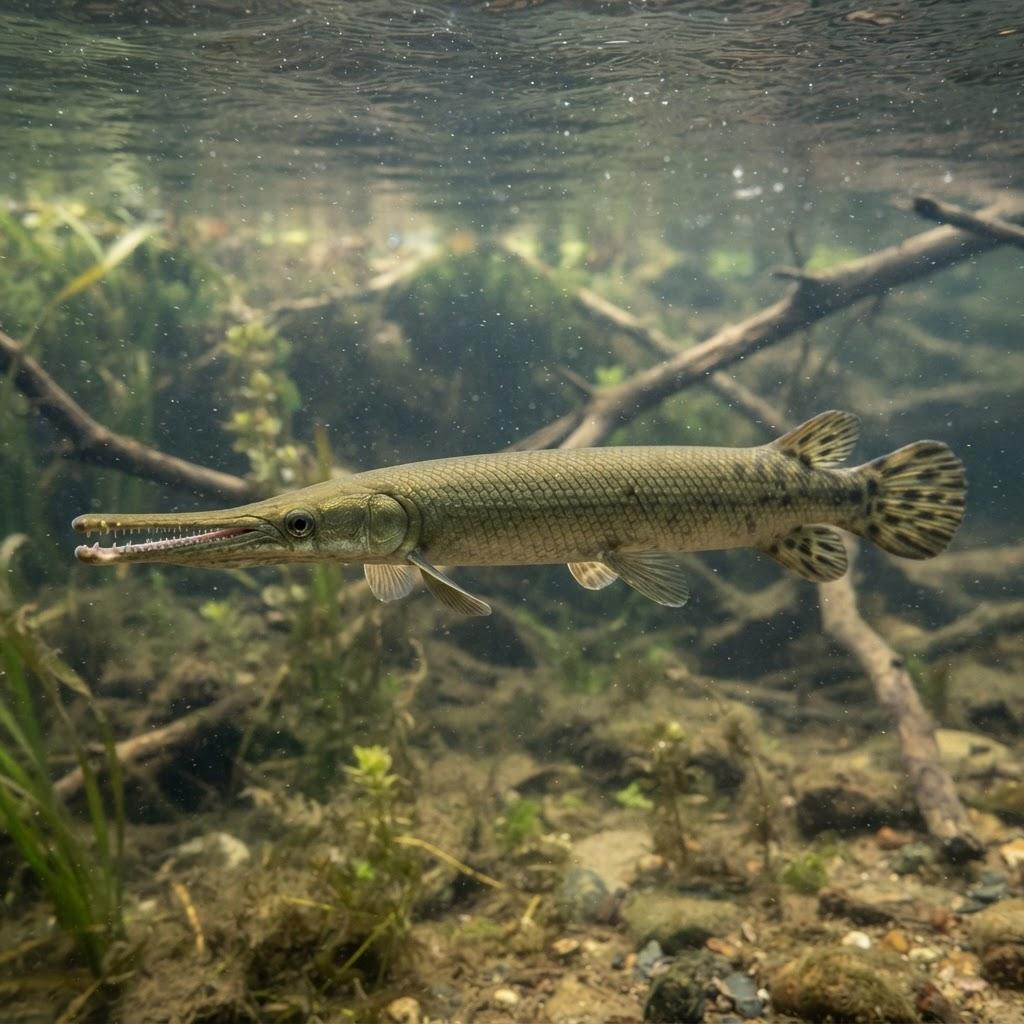
Lepisosteus osseus
Longnose Gar
Meet the Longnose Gar, a prehistoric river monster that has survived since the age of the dinosaurs without changing a single thing about its style. With a face like a needle and an attitude that says 'don't touch my marsh,' this bony brawler is the coolest living fossil in your local lake.
Meet the Fish
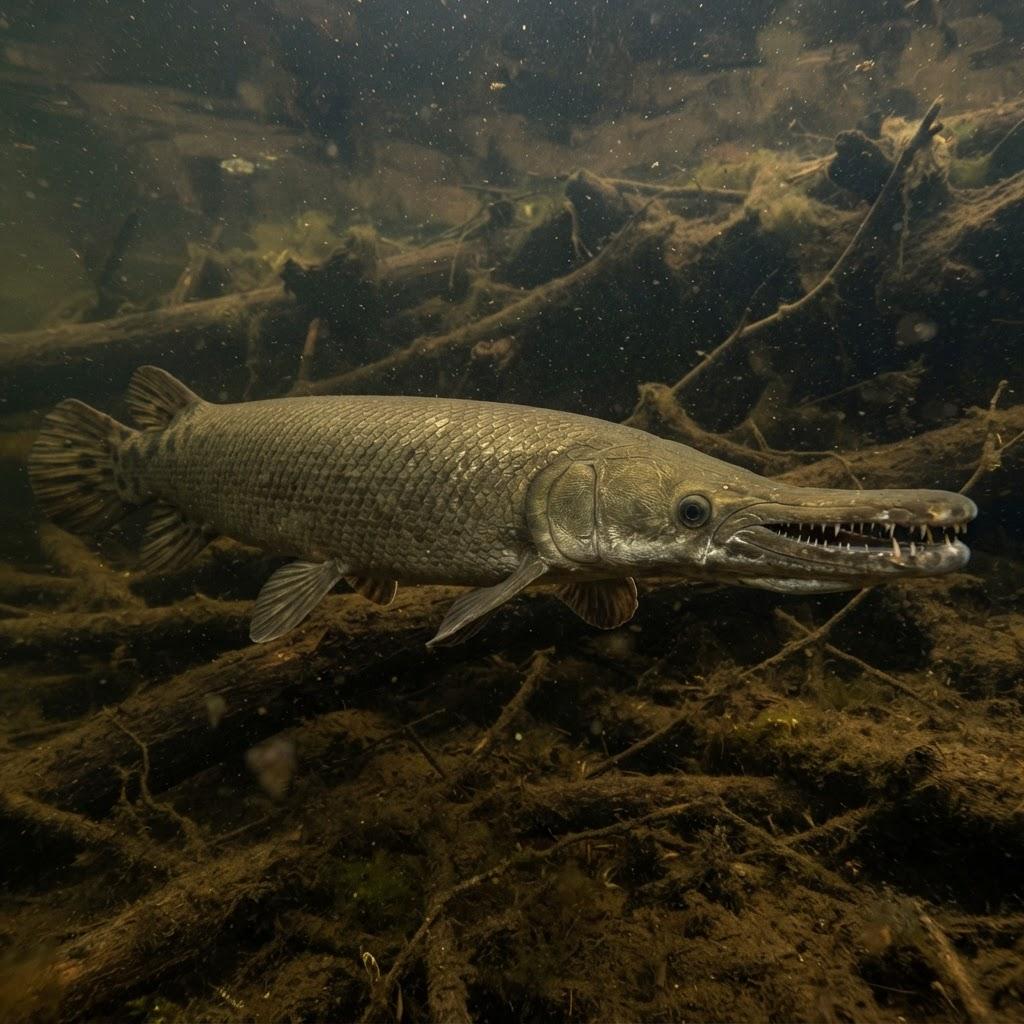
Imagine if a crocodile and a needle decided to go on a blind date and had a baby that lived exclusively in the freshwater rivers of North America. That, my friends, is the Longnose Gar. This fish is essentially the punk rock star of the river world. It has been cruising through the water for nearly 100 million years, which means it was hanging out while T-Rex was still trying to figure out how to scratch its own nose. Its vibe is pure, unadulterated 'I don’t care.' While other fish have evolved fancy, flashy fins or round, cute bodies, the gar decided that being a long, thin, toothy cylinder was the peak of fashion. They look like they are constantly in a hurry to get to an appointment, but then they just float there, motionless, staring at you with those judgmental, beady eyes. They are the living definition of 'if it ain't broke, don't fix it,' and their persistence through extinction events makes them the ultimate survivors of the aquatic neighborhood.
Weird Biological Superpowers Explained Simply
The Longnose Gar has a party trick that would make a marathon runner jealous: it can breathe air. That is right, when the oxygen levels in the water get a little low—or if the gar just feels like living life on the edge—it floats up to the surface and takes a big, gasping gulp of air. It does this thanks to a specialized swim bladder that functions essentially like a primitive lung. Think of it as a built-in scuba tank that they refill whenever they feel like it. While your average goldfish would be gasping for dear life if it couldn't find enough oxygen in the water, the gar is just chilling, watching the sunset and grabbing a breath of fresh air. It is a biological superpower that allows them to thrive in muddy, stagnant swamps where other fish would just pass out. It is basically the aquatic equivalent of having a built-in oxygen mask for whenever the local atmosphere gets a little too thin for comfort.
Absurd Self-Defense Mechanisms
If you are a predator thinking about grabbing a quick snack, you might want to reconsider when you spot a Longnose Gar. This fish is wearing a suit of armor that would make a medieval knight feel insecure. They are covered in ganoid scales, which are thick, diamond-shaped, and essentially made of bone and enamel. These aren't like the flimsy, papery scales you find on a typical trout; these are literal plates. If a bigger fish tries to take a bite, it is like trying to chew through a set of ceramic floor tiles. It is a brilliant defensive strategy that screams, 'Go bother the soft-skinned fish, buddy.' Between their tank-like armor and a row of teeth that look like a misplaced collection of sewing needles, they are effectively untouchable for most river dwellers. They don't run away when they feel threatened because they don't have to—they just sit there and let their natural body armor take the hit while they contemplate their next move.
Fish Drama and Gossip
The social life of a Longnose Gar is not exactly high-drama, but it is certainly filled with awkward silences. They aren't the type to congregate in large, chatty schools like sardines or perform intricate synchronised swimming routines. Instead, they prefer to be the loners at the back of the party. However, when spring rolls around, the drama heats up fast. Large groups gather in shallow waters, and the air is thick with tension. It’s like the worst high school reunion ever, but with more splashing and less awkward small talk. They push and shove each other with their long snouts in a display that is less about violence and more about saying, 'I was here first.' It is a clumsy, splashing, high-stakes game of bumper cars where the goal is to stake out a claim in the shallows before the competition gets too intense. It is the kind of drama that you watch from a distance with a bucket of popcorn, mostly because you don't want to get splashed by a five-foot-long fish with an attitude problem.
The "Wait, That's Real?!" Deep-Sea Oddities
While the Longnose Gar isn't a deep-sea creature, it shares a weird, prehistoric energy with the monsters of the midnight zone. If you were to drop a gar into the pitch-black depths of the ocean, it would look like it belonged right alongside the bioluminescent horrors and the giant squids. The gar has that same 'alien visitor' aesthetic that deep-sea dwellers possess. While deep-sea fish have evolved to create their own light shows or use transparent bodies to avoid being seen, the gar has chosen the path of the rugged survivor. It doesn't need to glow in the dark when it has those needle-teeth and iron-clad scales. Think of the gar as the 'country cousin' to the bizarre, lantern-headed wonders of the deep. It is a reminder that you don't need to live five miles underwater to look like a creature from a science fiction movie; sometimes, you just need to stick to the same design plan for a hundred million years until you start looking like a relic from another dimension.
Myth Busting
There is a long-standing rumor that the Longnose Gar is a 'trash fish' or a 'river menace' that destroys everything in its path. People used to think they were mindless killing machines that would eat every single game fish in a lake until nothing was left but water. That is total nonsense. While they are definitely predators—they have those teeth for a reason—they actually play a vital role in keeping river ecosystems balanced by targeting sick or weak fish. They aren't the villains of the story; they are the janitors. Another common myth is that their meat is poisonous. While the eggs of the gar are definitely toxic to humans, the fish itself is perfectly fine to eat, though you might need a pair of tin snips to get through the scales. People have spent generations spreading horror stories about the gar just because they look a little intimidating. It is time we give these misunderstood, long-nosed champions the respect they deserve for just doing their own thing in the muck.
Humorous Historical Tales or Folklore
Historically, the gar has been treated with a mix of fear and sheer annoyance by anglers. There are countless tall tales from the 1800s about river monsters that were actually just giant gar that snapped a fisherman's line. The gar's scales were once used by Native American tribes to make arrowheads and tools because they are so incredibly tough. Imagine that—a fish so durable that its skin becomes your weapon. There is also a bizarre historical belief that if you dried out a gar skin, you could use it to sharpen a knife or scrape wood, which sounds like something out of a medieval fairy tale but is actually true. These fish have been embedded in the folklore of the Mississippi River basin for centuries, usually as the protagonist of stories involving 'the one that got away' or 'the weirdest thing I have ever pulled out of the water.' They are the ghosts of the river, always lurking, always watching, and always ready to make a local legend out of a simple fishing trip.
Underwater Love Stories and Bizarre Romances
When it comes to romance, the Longnose Gar keeps things messy. During the spawning season, the females, who are typically larger than the males, are surrounded by a group of eager suitors. It is not exactly a graceful waltz. It is more of a chaotic mosh pit. The male gar nudges the female, swimming alongside her in a display of persistence that would be charming if it weren't so splashy. They release their eggs and sperm in a sort of frenzy that turns the calm water into a churning whirlpool of fish activity. There are no fancy nests or elaborate courtship dances here. It is all about numbers and timing. Once the romance is done, the parents just swim off, leaving the future of their offspring to fate. It is the ultimate 'love them and leave them' scenario, a stark reminder that in the world of the gar, reproduction is less about romance and more about making sure there are enough long-nosed babies to carry on the family legacy.
Underwater Architecture and DIY Nesting
Don't expect the Longnose Gar to build a sandcastle or a cozy little cave for their family. They are the definition of 'minimalist.' They don't bother with architectural feats or interior decorating. Instead, they choose the most chaotic location possible—shallow, rocky, or weedy areas that provide just enough cover to hide the eggs from predators. They effectively scatter their eggs over the substrate and hope for the best. While other fish might spend weeks meticulously cleaning a stone or building an intricate nest out of kelp, the gar thinks that is all a bit too much work. Their strategy is quantity over quality. By scattering their eggs across the vegetation, they ensure that if a predator finds one spot, they won't find them all. It is not an architectural marvel, but it is a masterclass in risk management. Who needs a house when the entire riverbed is your backyard, and you can just move on to the next patch of weeds?
The Chaos of Raising Tiny Swimmers
Raising tiny gar fry is an absolute disaster in the best way possible. When the eggs hatch, the little ones have a sticky disc on their heads that they use to attach themselves to plants, hanging there like tiny, confused pendulums. They look like little green pieces of string with eyeballs, waiting for the world to come to them. Once they break free, they immediately start acting like miniature versions of their parents—snapping at anything that moves. They have to deal with every hungry fish in the river, and the mortality rate is high. But that is the point! The gar strategy is to flood the market with so many tiny, needle-toothed babies that some are bound to survive. It is total aquatic chaos, with thousands of little swimmers trying to figure out how to be a top-tier predator while dodging everything from sunfish to their own aunts and uncles. Watching them grow is like watching a nature documentary version of a survival video game, where everything is out to get you.
How to Spot One & How It Is Doing
If you want to spot a Longnose Gar, look for a long, thin, wooden-looking log floating just below the surface of a quiet river. If that 'log' suddenly moves or has an eye that follows you, congratulations, you found a gar! Look for that iconic long snout, which looks like a pair of tooth-lined tweezers. They love slow, warm water where they can bask in the sun. As for how they are doing, they are in pretty good shape. They are listed as 'Least Concern' because they are tough as nails and not very picky about where they live. To help them, just make sure you aren't dumping chemicals or trash into their home. They are a sign of a healthy, functioning waterway. If you see one, appreciate it for what it is: a living, breathing piece of history that has survived the rise and fall of empires just by keeping its head down and its armor up. They are the survivors we should all aspire to be.