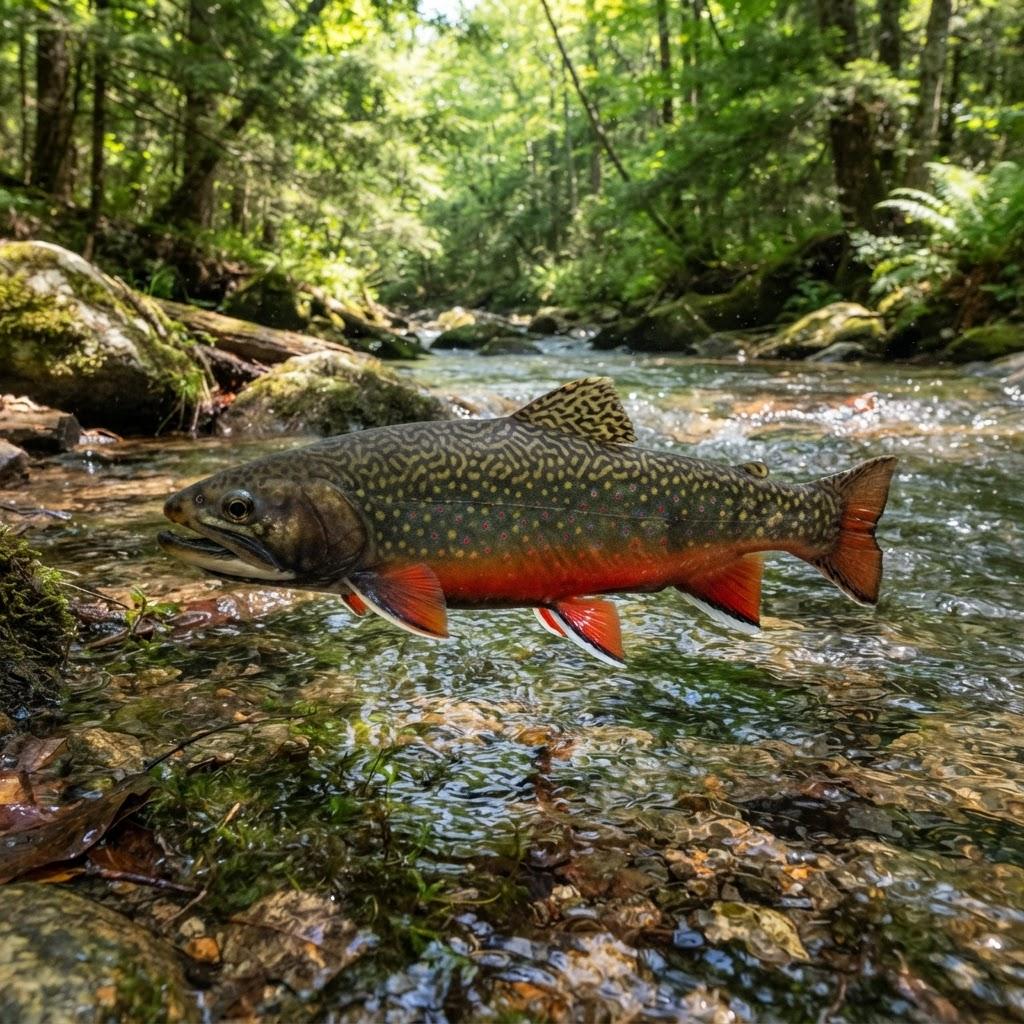
Salvelinus fontinalis
Brook Trout
Meet the Brook Trout, the tuxedo-wearing dandy of the mountain stream. With a flair for style and a taste for icy perfection, this colorful char is the ultimate trout-about-town.
Meet the Fish
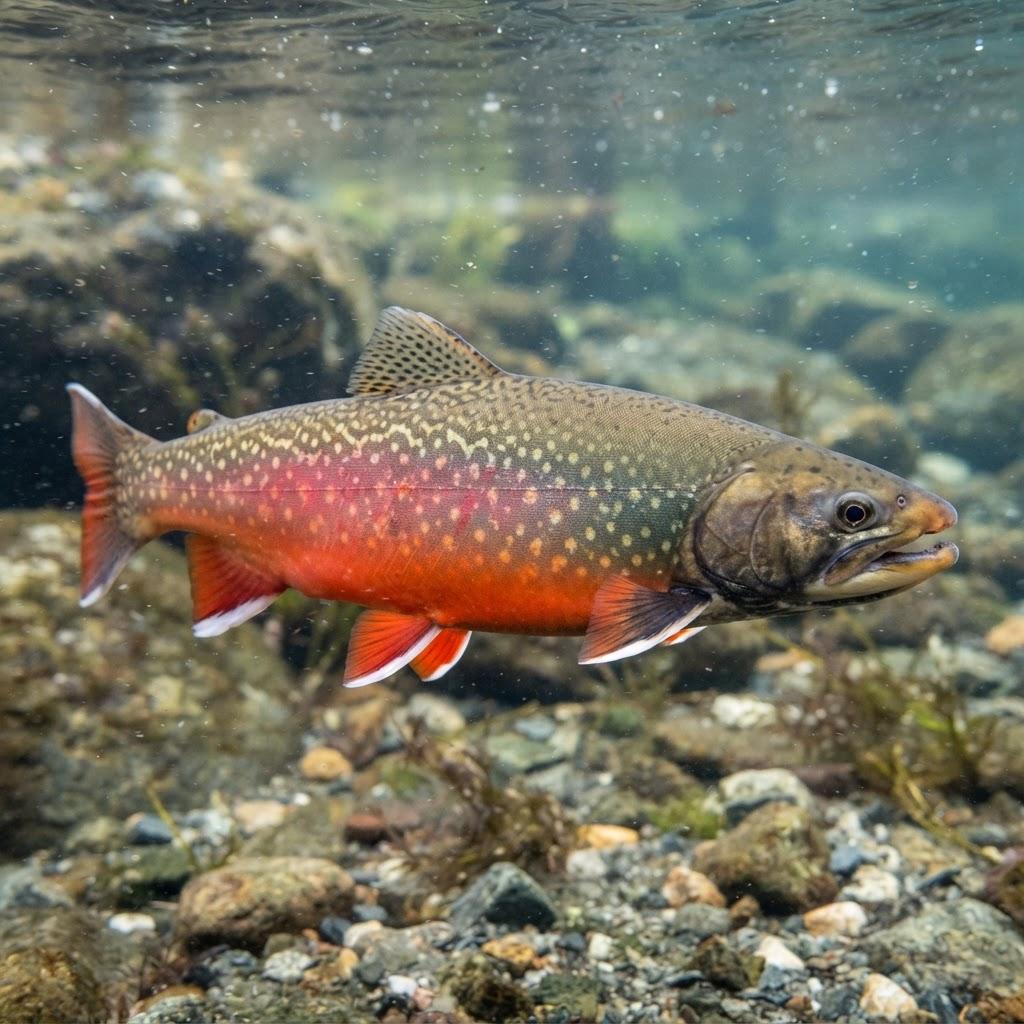
If the Brook Trout were a character in a high-stakes teen drama, he would definitely be the one wearing the custom-made designer jacket while everyone else is in sweatpants. Known affectionately as the 'brookie,' this fish isn't actually a true trout at all, but rather a member of the char family—the cool, rebellious cousins of the trout world. They are the absolute darlings of the Appalachian highlands, flashing vibrant orange bellies and worm-like markings on their backs that look like someone spilled a bowl of spaghetti on a camouflage rug. They are the quintessential mountain snobs, refusing to live anywhere that doesn't have water crisp enough to make your teeth ache. While other fish might settle for a murky pond, the brookie demands the high-end real estate of crystal-clear, bubbling mountain springs. They are energetic, slightly vain, and undeniably the most fashionable residents of any cold-water stream you will ever encounter in the wild.
Weird Biological Superpowers Explained Simply
The Brook Trout operates like a high-performance sports car powered by pure adrenaline and cold-water physics. Their superpower is a finely tuned internal compass that allows them to detect tiny electrical signals in the water. Think of it as having a built-in metal detector for finding delicious snacks like mayflies or unsuspecting minnows hiding under rocks. They also possess something called a lateral line, which is essentially a sensory strip along their sides that feels vibrations. Imagine if you could 'hear' the footsteps of a predator three streets away just by feeling the air pressure change on your skin; that is how the brookie experiences its daily life. They are essentially biological sonar systems, constantly processing a 3D map of their surroundings to avoid being eaten while simultaneously scanning the menu for the next aquatic bug to inhale. They are the masters of reading the room, even if the room is a freezing, rushing waterfall.
Absurd Self-Defense Mechanisms
When a predator shows up, the Brook Trout doesn't have spikes or toxic slime, so it relies on the oldest trick in the book: the art of disappearing. They are the Houdinis of the creek. Because they live in water that is often dappled by sunlight and swaying aquatic weeds, their colorful markings actually function as 'disruptive coloration.' This is nature’s version of a blurry Instagram filter; when light hits their patterned backs, they blend perfectly into the rocky, shifting bottom of the stream. If they feel threatened, they don't fight—they bolt into the nearest shadowy crevice like a teenager ducking into a bedroom when their parents come home. They can pivot on a dime, using their powerful tails to go from zero to sixty in a blink, leaving predators staring at a patch of empty water while the brookie is already three rocks downstream, probably rolling its eyes at the entire ordeal.
Fish Drama and Gossip
If you set up a hidden camera in a spawning creek, you would witness a soap opera that would put any reality TV show to shame. Brookies are incredibly territorial, and they take their personal space very seriously. Male Brook Trout are essentially the grumpy neighbors of the stream who scream 'Get off my lawn!' at anyone who drifts too close. During the breeding season, the males don their brightest outfits and strut around, puffing out their chests and chasing off rival suitors in a flurry of splashes and gnashing teeth. It is a constant cycle of posturing, intimidation, and dramatic chases. They have these elaborate 'threat displays' where they swim side-by-side just to show off who is bigger and badder, rarely actually fighting but always looking for a reason to throw a tantrum. It is petty, it is loud, and it is the most exciting thing to happen in the forest that day.
The "Wait, That's Real?!" Deep-Sea Oddities
While our dapper friend the Brook Trout prefers the shallow, sunny excitement of a stream, he has some truly bizarre cousins living in the deep abyss that would make him blush. Imagine living in a place so dark that you have to grow your own flashlight just to find dinner—that is the life of the anglerfish, a creature that looks like it was designed by someone who fell asleep watching horror movies. Unlike the brookie, which relies on sunlight and clear vision to navigate its day, deep-sea dwellers deal with crushing pressure and absolute blackness. Comparing the two is like comparing a luxury hotel on a sunny beach to a submarine at the bottom of the Mariana Trench. The brookie thrives on the simplicity of oxygen-rich, fast-moving water, whereas its deep-sea relatives deal with 'alien' conditions where food is scarce and you might go months without seeing another living soul. It makes the brookie's stream look like a busy downtown subway station.
Myth Busting
There is a persistent myth that Brook Trout are 'dumb' fish that will bite anything shiny, but this is a massive insult to their intellect. Fishermen often boast about 'tricking' a trout, but the reality is that these fish are incredibly observant. They can distinguish between the natural movement of a fly and the awkward twitch of a fake plastic imitation from a mile away. If the light is wrong or the water is too still, they will ignore the best lure in the world with the icy indifference of a celebrity avoiding a paparazzi. Another myth is that they can't survive in anything but the coldest ice water. While they do prefer it, they are actually quite adaptable and have been known to survive in waters that would make other trout curl up and quit. They are intelligent, discerning, and definitely not the simple-minded snack-seekers that folklore often portrays them to be.
Humorous Historical Tales or Folklore
Throughout history, the Brook Trout has been the obsession of writers, poets, and eccentric mountain folk. In the early American frontier, it was whispered that if you caught a brookie with a certain type of worm, you could read the future of the harvest in the patterns on its skin. There were old wives' tales claiming that Brook Trout were the spirits of lost travelers, meant to guide fishermen toward hidden gold, which explains why so many people spent decades wading through icy water looking for fish instead of a job. Even the famous naturalist Henry David Thoreau spoke of them with a reverence usually reserved for royalty. They have been the subject of countless tall tales involving record-breaking fish that grew to the size of alligators, though we know that is just classic fisherman exaggeration. History treats the brook trout not as a mere animal, but as a legendary local deity of the mountain springs.
Underwater Love Stories and Bizarre Romances
When romance is in the air—or rather, in the current—the Brook Trout engages in a courtship ritual that is surprisingly elegant. Once the water cools down in the autumn, the males start their 'dance,' which consists of shimmering displays meant to catch the female's eye. It is essentially a high-stakes version of a ballroom dance, except everyone is vibrating their fins and hoping not to get eaten by a passing bear. The female is the one who holds all the cards, scouting out the perfect patch of gravelly substrate for her future family. She performs a series of tail-flicks to test the quality of the 'nursery' site, while the male hovers nearby, looking supportive but slightly nervous. It is a slow, rhythmic affair of gentle nudges and synchronized swimming that would make any romantic movie director weep with jealousy, assuming they could fit into a wetsuit and hold their breath long enough to film it.
Underwater Architecture and DIY Nesting
Forget the fancy blueprints or the interior design magazines; the Brook Trout is the ultimate DIY architect of the stream. The female trout takes on the role of site foreman, using her tail to excavate a depression in the gravel known as a 'redd.' She works tirelessly, flipping her tail to clear away sand and silt until she has crafted the perfect, clean stone cradle for her future children. It is hard labor, and she makes it look like a workout routine from the future. Once the redd is ready, it is a masterpiece of hydraulic engineering, designed to keep water flowing over the eggs to ensure they get plenty of oxygen while staying tucked away from hungry neighbors. This isn't just a pile of rocks; it is a meticulously constructed, current-defying nursery built with nothing but pure muscle and instinct. It is a testament to the idea that sometimes the best homes are the ones you dig yourself.
The Chaos of Raising Tiny Swimmers
Once the eggs are safely tucked into the redd, the parents essentially turn into overprotective security guards. After the tiny fry hatch, they are on their own in a world that is essentially one giant obstacle course of predators and fast currents. It is pure, unfiltered chaos. The young fish have to learn how to hunt for microscopic organisms before they are even the size of a paperclip. Many don't make it, but the ones that do are basically the survivalist experts of the aquatic world. They drift with the current, hiding under pebbles and dodging anything with a mouth bigger than theirs. It is a high-speed, high-stakes game of hide-and-seek where the prize is growing up to be as dapper and stubborn as their parents. There is no daycare here, just a lot of grit and a very healthy dose of luck, which is honestly the most endearing thing about their life cycle.
How to Spot One & How It Is Doing
If you want to spot a Brook Trout, put on your most adventurous hiking boots and head to the cleanest, coldest mountain stream you can find. Look for shallow areas where the water runs over gravelly patches. You aren't looking for a giant; you are looking for that flash of orange and the intricate, mottled pattern on the back that blends into the rocks. They are notoriously shy, so move like a ninja and don't shadow the water. Regarding their status, these fish are a bellwether for the health of our planet; they are 'Least Concern' for now, but they are extremely sensitive to pollution and rising water temperatures. They are basically the 'canary in the coal mine' for our freshwater ecosystems. To help them out, focus on supporting clean water initiatives and being a conscious hiker who doesn't leave trash behind. Keep the streams cool and the water clear, and the dapper brookie will keep on looking fancy for generations to come.