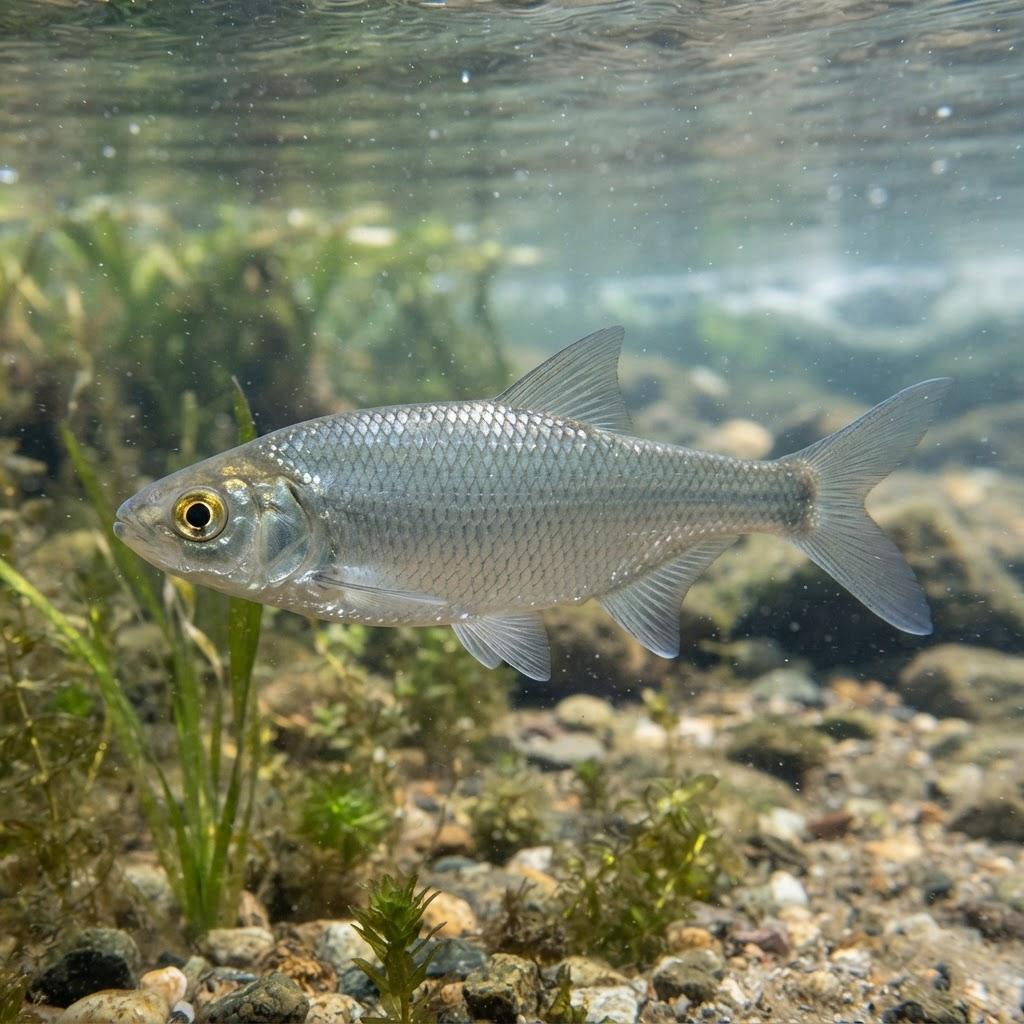
Hiodon tergisus
Mooneye
Meet the Mooneye, a shiny, bug-eyed brawler of the river that looks like it just stepped out of a retro sci-fi movie. This silver-scaled survivor is essentially the energetic, high-speed athlete of the freshwater world.
Meet the Fish
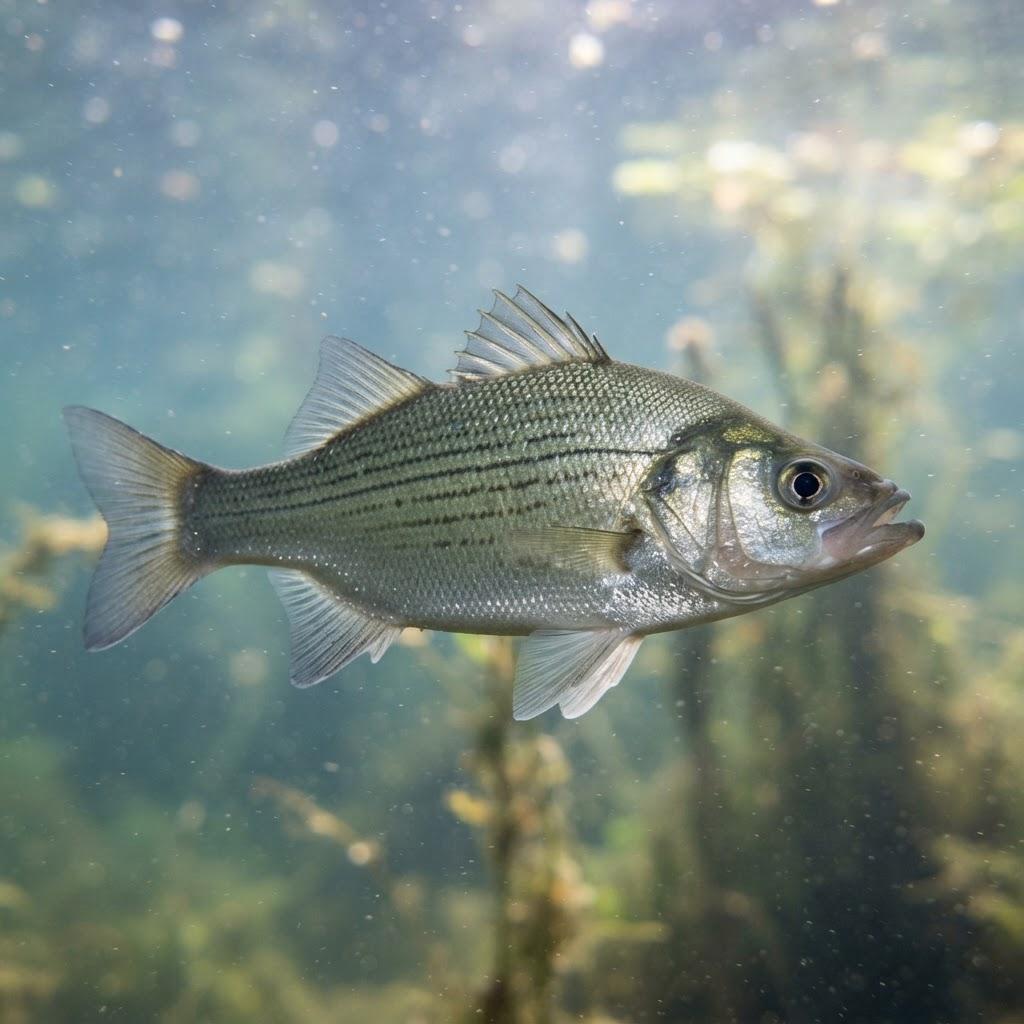
Imagine you are at a high-stakes poker game, and every single player is wearing oversized, reflective disco-ball sunglasses. That is the Mooneye. This fish possesses eyes so disproportionately massive and reflective that it looks like it is permanently surprised or perhaps just staring into the literal soul of the universe. With a body built like a streamlined silver torpedo, the Mooneye is the kind of fish that does not just swim; it vibrates with potential energy. It is a creature of the currents, favoring large, clear, flowing rivers where it can hang out in the deep pockets and wait for a snack to drift by. Unlike the sluggish carp that might spend its afternoon lazily nudging mud, the Mooneye is a high-octane predator with a mouth full of sharp, needle-like teeth that suggest it is not interested in salads. Its scales possess a brilliant, iridescent sheen that acts like a camouflage mirror, making it hard for predators looking up from below to spot its silhouette against the sparkling water surface above. It is the river equivalent of a high-speed sports car that actually enjoys the winding backroads of the Great Lakes.
Weird Biological Superpowers Explained Simply
The Mooneye’s claim to fame is not necessarily a radioactive mutation, but rather an optical masterpiece. Those giant, bulbous peepers are highly adapted to low-light conditions, functioning like a pair of high-end night-vision goggles. Because they live in deep, sometimes murky, or shaded river water, the Mooneye has developed a reflective layer behind the retina called the tapetum lucidum. You might have seen this in a cat’s eyes when a flashlight catches them at night. This layer acts like a mirror, giving the light a second chance to be absorbed by the sensory cells in the eye. Essentially, the Mooneye is recycling photons. While other fish are bumping into rocks in the twilight hours, the Mooneye is watching the river like a hawk, picking off insects and smaller fish with terrifying precision. It is not just seeing; it is calculating. This superpower allows it to dominate the water column during dusk and dawn, times when most other fish are struggling to adjust to the shifting light levels. It is the ultimate biological hack for a species that refuses to clock out just because the sun goes down.
Absurd Self-Defense Mechanisms
When you are a shiny, delicious-looking snack for larger predators like Northern Pike or Musky, you have to be fast or you have to be a ghost. The Mooneye has opted for the 'blur' technique. Its body is compressed from side to side, creating a profile so thin that if it turns sideways, it practically vanishes into a flash of reflected light. When a predator lunges, the Mooneye uses its powerful, deeply forked tail to accelerate with the force of a sudden cannon blast. It doesn't use poison or slime; it uses pure physics and speed. Think of it like trying to grab a greased-up lightning bolt. Furthermore, the Mooneye lives in schools that are less of a 'cooperative team' and more of a 'chaotic cloud.' By hanging out in loose groups, the Mooneye uses the confusion effect, where a predator becomes overwhelmed by the sudden movement of dozens of silver flashes. It is a brilliant display of 'I don't have to be faster than the predator, I just have to make sure the predator can't track which one of us is which' strategy. It turns the river into a strobe light of confusion.
Fish Drama and Gossip
If the Mooneye were featured on a reality television show, the episode title would undoubtedly be 'Who Invited the Shiny Guy?' While they aren't necessarily fighting over prom kings or queens, their social life is a constant, low-stakes shuffle for territory and optimal current lanes. You will often see them drifting in the current, maintaining a very specific distance from one another. If one fish tries to dart forward to grab a particularly juicy dragonfly, you can almost sense the collective side-eye from the rest of the school. They aren't particularly aggressive in a 'let's fight to the death' sort of way, but they are intensely protective of their personal space. They move like a synchronized swim team that is constantly on the verge of breaking up. They have to deal with the social pressure of being highly mobile; if you stop swimming, you start falling behind, and nobody wants to be the fish that falls behind the school during a feeding frenzy. It is a high-pressure environment where popularity is determined by your ability to keep up and stay shiny.
The "Wait, That's Real?!" Deep-Sea Oddities
While the Mooneye is a freshwater hero, it shares a certain 'alien-adjacent' vibe with its distant cousins in the deep sea, like the spookily transparent barreleye fish. The barreleye has a head that looks like a literal bubble with eyes inside, which sounds like something a kindergartner drew while eating too much sugar. Compared to that, the Mooneye’s giant eyes seem almost normal, but in the freshwater world, they are a significant oddity. Deep-sea creatures often utilize bioluminescence to create light in the eternal darkness of the midnight zone, using bacteria to generate a glow that mimics the surface light. The Mooneye doesn't have the internal glow-stick technology, but it does have the 'mirror' technology that reflects existing light so efficiently that it might as well be glowing. Both the deep-sea monsters and the Mooneye are playing the same game: manipulating light to survive. They are both biological engineers of the optical spectrum, proving that if you live in a place where light is hard to come by, you better get creative with how you use what little you have.
Myth Busting
Let’s clear the air: the Mooneye is not a 'trash fish' and it is not a 'bony terror.' A common myth is that because they have many small bones, they are impossible to eat and therefore useless. This is pure culinary propaganda! Just because a fish is not a fillet of salmon does not mean it lacks value. Another pervasive myth is that these fish are simple-minded bottom-dwellers. People often assume that because they have big eyes, they must be clumsy, but nothing could be further from the truth. These fish are highly intelligent, capable of learning patterns in the river's flow and recognizing potential food sources from a distance. They are the tactical geniuses of the stream, not the mindless vacuum cleaners that some anglers suggest. People also claim they are 'boring' because they don't grow to the size of a minivan like a sturgeon, but they provide one of the most intense, high-energy battles for their size. If you think they are just 'river filler,' you’ve clearly never had one put up a fight on a lightweight rod. The Mooneye is a champion in a weight class that is often overlooked.
Humorous Historical Tales or Folklore
Historically, the Mooneye has been the silent observer of human expansion across North America. Native American tribes recognized the fish for its abundance and used them as a reliable source of protein, but the Mooneye never quite got the 'glory' of the salmon or the 'legendary' status of the giant sturgeon. There are stories among old-time river guides about 'The Silver Ghost,' a mythical fish that was said to guide canoes through treacherous, shallow rapids during the full moon. While scientists would roll their eyes and point to the fish’s biological need to see in low light, the legend persists that if you see a flicker of silver in the dark, the Mooneye is showing you the way. It’s a nice thought, even if the fish is likely just looking for a moth to snack on. People used to believe that the shiny scales could be used as mirrors for small signaling devices, which, while probably an exaggeration, speaks to just how incredibly reflective these fish actually are. They have been the unsung heroes of the riverbanks for centuries, witnessing the rise and fall of civilizations while just trying to catch a fly.
Underwater Love Stories and Bizarre Romances
Love in the river is a messy, energetic affair for the Mooneye. When springtime rolls around, the Mooneye switches from 'chill river cruiser' to 'frantic dance instructor.' They don't have slow, romantic ballads; they have high-speed, synchronized swimming events. During spawning season, groups of Mooneyes gather in the swiftest parts of the river. It’s not an elaborate courtship with gifts of seaweed; it is a chaotic, collective effort. Females release their eggs into the current, and males are right there behind them, fertilizing the cloud of eggs as they drift downstream. It is the aquatic equivalent of a mosh pit where the end goal is the continuation of the species. There is no jealousy, no 'waiting for the right partner,' just a massive, silver-scaled party where everyone is invited to participate in the dispersal of the next generation. It is efficient, it is fast, and it happens with such speed that if you blinked, you would miss the entire romance. They essentially 'set it and forget it' when it comes to their love lives, trusting the river to do the rest.
Underwater Architecture and DIY Nesting
You might expect a fish to build a fancy nest, but the Mooneye is the ultimate minimalist. While other fish spend weeks moving rocks and clearing sand to build elaborate castles or 'cradles' for their offspring, the Mooneye looks at the current and says, 'Nah, the river will do it.' They don't build nests at all. They are what we call 'broadcast spawners.' They realize that the river itself is the best nursery because the flowing water provides the constant oxygen that developing eggs need. By releasing their eggs into the current, they are outsourcing the work. The eggs drift, bounce along the riverbed, and eventually settle into little nooks and crannies between rocks or vegetation. It’s not lazy; it’s a stroke of genius. Why spend energy building a home that might get washed away by a summer storm when you can let the mighty river carry your legacy to the best possible spots? They are the ultimate 'digital nomads' of the fish world, traveling light and trusting the environment to take care of their children.
The Chaos of Raising Tiny Swimmers
Raising a brood of Mooneyes is less of a 'parenting' situation and more of a 'good luck, you're on your own' strategy. Once those eggs are released into the current, the parents are long gone. They are not the 'helicopter parents' of the fish world. The fry hatch in the river's chaotic, fast-moving nursery, where they immediately have to learn how to dodge everything from a hungry minnow to a stray twig. It is a harsh world, but it is an effective one. Thousands of eggs are released, and while the majority don't make it to adulthood, the ones that do are the toughest, fastest, and most observant little silver bullets in the water. They learn to hunt, navigate currents, and hide from predators without a single lesson. It’s a sink-or-swim reality, quite literally, and the Mooneye produces enough offspring that even with the high odds against them, the species thrives. They don't need to carry their young in their mouths or build forts; they just rely on the sheer, unstoppable force of numbers and the innate survival instincts of the fish itself.
How to Spot One & How It Is Doing
If you want to catch a glimpse of this silver phantom, you need to head to a clear, large river and keep your eyes on the surface during the magical hour of dusk. Look for a flash of silver that looks like someone tossed a quarter into the water. If you are fishing, use a small fly or a spinner; these guys are hunters and love anything that looks like a struggling insect. As for their status, the Mooneye is doing quite well! They are categorized as 'Least Concern' globally. They are hearty survivors who have adapted well to the changing landscapes of North American rivers. However, they are sensitive to water pollution, so keeping our rivers clean is the best thing you can do to ensure they keep dancing in the currents. Protecting the health of our watersheds doesn't just help the fish; it keeps the entire river ecosystem humming. Next time you are by a river, take a moment to watch the water. If you see a flash of silver, you’ve just spotted one of the most underrated, resilient, and cool characters in the underwater world. Give them a nod; they’ve earned it.