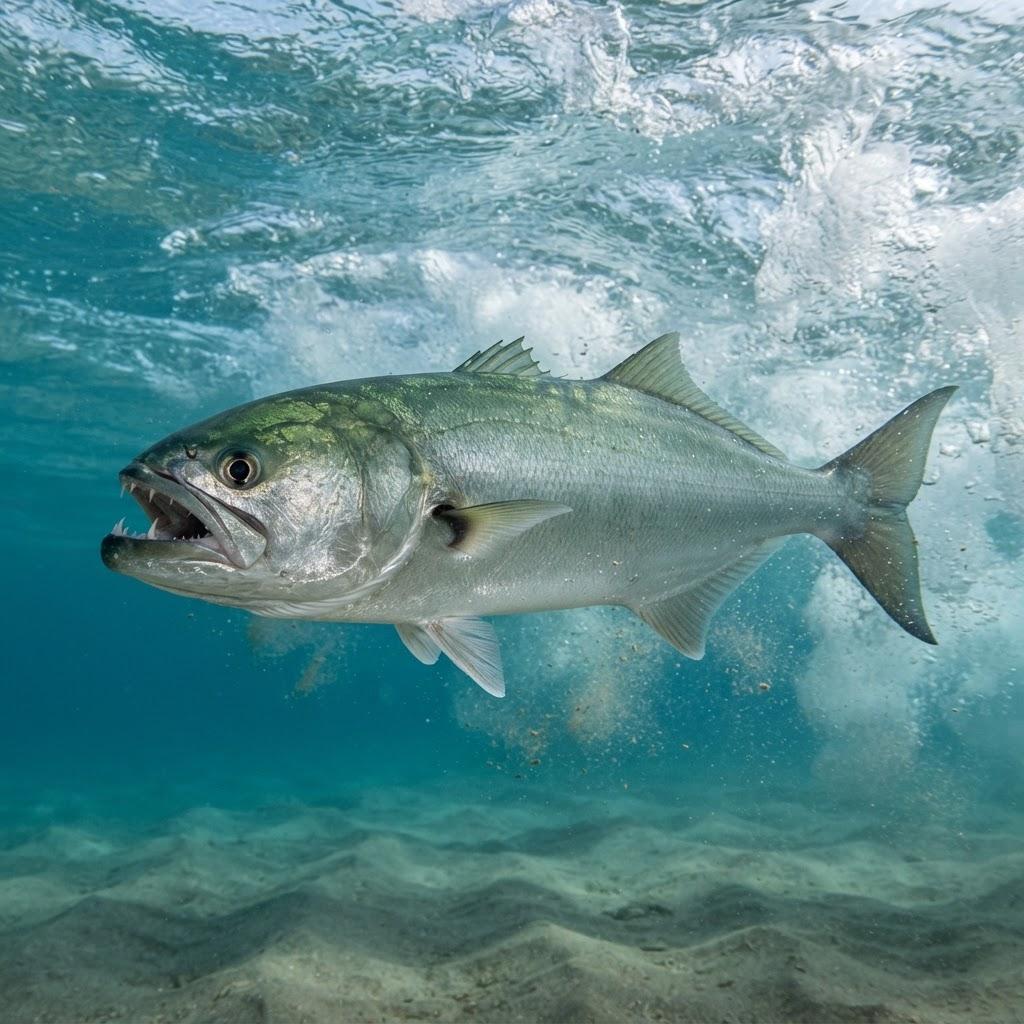
Pomatomus saltatrix
Bluefish
Meet the Bluefish, the ocean's undisputed king of chaos and the only fish that treats every meal like a high-stakes action movie. With a jaw full of razor blades and a temperament to match, this silver-scaled bandit is the ultimate party crasher of the Atlantic coast.
Meet the Fish
If the ocean had a neighborhood watch, the Bluefish would be the person moving out of the house because they were banned from every block party in the city. Imagine a torpedo made entirely of muscle, bad attitude, and teeth sharper than a brand new set of steak knives. That is your Bluefish. They are the quintessential 'eat first, ask questions later' species, swimming with a frantic, twitchy energy that makes them look like they have had seventeen cups of espresso before breakfast. They are silver, sleek, and streamlined, looking like a high-performance sports car, but if that sports car also had a habit of snapping its doors off just to see if it could. While other fish might enjoy a leisurely cruise through a seagrass meadow, Bluefish are constantly on the move, patrolling the water column like they are looking for a fight. They do not just hunt; they wreak havoc, moving in schools that act less like a coordinated team and more like a rowdy group of tourists looking for the nearest buffet.
Weird Biological Superpowers Explained Simply
The Bluefish has a metabolism that makes a humming-bird look like it is napping. Because they are constantly sprinting through the ocean at top speed, they require massive amounts of energy. Their superpower is essentially a biological furnace. They have a specialized system for extracting oxygen from the water so efficiently that they can sustain burst speeds that would leave most other fish gasping for air. Think of it like a turbocharger on a car engine; when the Bluefish decides it needs to catch a meal, its body shunts oxygenated blood straight to the muscles, allowing it to turn from a cruiser into a heat-seeking missile in milliseconds. Furthermore, their eyes are perfectly calibrated for the twilight hours, allowing them to hunt during dawn and dusk with the precision of a night-vision scope. They are essentially biological machines optimized for one thing: high-speed, high-intensity hunting that would literally cause an average fish to collapse from exhaustion.
Absurd Self-Defense Mechanisms
You might think a fish with a face full of fangs would have plenty of friends, but in the ocean, even the bully has to watch his back. When a Bluefish feels threatened, it does not hide in a cave or inflate like a pufferfish, because that would be too polite. Instead, the Bluefish relies on the classic 'offense is the best defense' strategy. They are simply too fast, too aggressive, and too twitchy to be an easy target for larger predators like sharks or billfish. Their primary defense is their speed and their habit of swimming in tight, chaotic formations. Imagine trying to catch a single specific marble out of a bag of a thousand bouncing marbles while someone is shaking the bag violently; that is what trying to eat a Bluefish feels like to a shark. If a larger predator makes a lunge, the entire school breaks into a disorganized, panicked explosion of silver scales, leaving the predator confused and hungry while the Bluefish use their lateral lines—sensors along their sides—to detect movement and scatter in the blink of an eye.
Fish Drama and Gossip
If you want the real tea, look no further than a Bluefish school. This is not a polite social club; it is a cutthroat reality show where every fish is competing for the lead role. They are incredibly territorial and possessive, which is saying something for an animal that does not own anything. If a school of Bluefish finds a pod of baitfish, they do not share. In fact, they have been known to engage in 'feeding frenzies' that are essentially underwater brawls. They will nip at each other, steal food right out of their neighbor's mouth, and constantly shove their way to the front of the line. There is no hierarchy here, just pure, unadulterated selfishness. They are the definition of 'every fish for themselves,' and if a friend happens to be smaller or slower, they might just find themselves getting pushed out of the buffet line. It is a world of constant, low-stakes bickering that would make a soap opera writer proud, all centered around who gets the next bite of herring.
The "Wait, That's Real?!" Deep-Sea Oddities
Bluefish live in the shallow lanes, but their cousins in the deep sea are basically living in a sci-fi horror movie. While our buddy the Bluefish is busy racing around the surface, down in the dark, fish are evolving heads that are entirely transparent so they can look up through their own skulls, or using bioluminescence to dangle glowing lures in front of unsuspecting prey. The deep sea is a place of such immense pressure and darkness that animals have had to get creative with their biology. If a Bluefish were dropped into the midnight zone, it would be hopelessly lost without its sunlight and high-speed energy. The contrast is stark: Bluefish are the fast-food junkies of the surface, burning through calories at an alarming rate, while deep-sea dwellers are the ultra-slow-mo masters of energy conservation, waiting weeks for a single snack to drift down from above. It is two completely different philosophies of existence: live fast and die loud, or sit still in the dark and wait for a miracle.
Myth Busting
There is a long-standing rumor that Bluefish are so evil they will kill fish just for the sake of killing, even when they are not hungry. Let us clear this up: the Bluefish is not an underwater serial killer with a grudge against society. They are just incredibly efficient predators with a 'trigger-happy' instinct. When they enter a school of baitfish, their movement sensors go into overdrive, and they react to every single flash of silver. They do not know how to stop the feeding cycle once it starts because their biology is hard-wired to keep grabbing prey. It is not malice; it is just a biological glitch. Another myth is that they are impossible to catch because they are too smart; in reality, they are just extremely reactive. They will strike at almost anything that moves or reflects light. They are not masterminds; they are just high-energy predators that do not know how to say 'I'm full,' and honestly, that is a personality trait many of us can relate to.
Humorous Historical Tales or Folklore
Throughout history, the Bluefish has been both a hero and a villain to human coastal communities. In the early days of American fishing, they were often viewed with a mix of awe and annoyance. Because they move in massive, unpredictable schools, one day you might have nothing, and the next day you have a boat literally overflowing with fish. Legend has it that in some colonial fishing villages, the sudden arrival of a bluefish run was considered a divine omen, though the local fishermen who had their nets torn to shreds by those teeth likely considered it more of a curse. There are even stories of coastal towns changing their entire dinner menus overnight because a massive school of Bluefish showed up on the docks. They have been blamed for 'stealing' the catch from other species, becoming the scapegoat of the sea. Whether they were bringing a feast or causing a headache, humans have always treated the Bluefish like an unruly, loud guest who shows up uninvited to dinner but always brings the excitement.
Underwater Love Stories and Bizarre Romances
If you were hoping for a romantic, moonlit swim, you have come to the wrong species. Bluefish romance is less 'candlelight dinner' and more 'chaotic group dance in a crowded club.' They do not really have complex mating rituals or long-term partners. Instead, they choose a 'spawn-and-run' strategy. When the water temperatures are just right, they congregate in massive numbers to release their eggs and sperm into the water column simultaneously. It is basically a giant, oceanic rave. They do not build nests, they do not serenade each other, and they certainly do not stay to raise the kids. It is an exercise in pure probability: release millions of eggs, hope for the best, and get back to hunting as quickly as humanly possible. It is perhaps the most efficient, albeit the least romantic, way to ensure the future of the species. Why bother with a complicated courtship when you can just turn the entire ocean into a giant nursery and keep on moving?
Underwater Architecture and DIY Nesting
If you are looking for an architect, do not call a Bluefish. They are the 'renters' of the sea. They do not believe in home ownership, they do not bother with sand castles, and they certainly do not have a Pinterest board for nest designs. Their philosophy is simple: the entire ocean is my home, and I am only here for a few minutes. While other fish spend weeks moving pebbles, building elaborate mounds, or excavating tunnels to protect their future generations, the Bluefish spends zero minutes on real estate. Their version of 'nesting' is simply finding a current that will carry their eggs safely toward the nutrient-rich waters where their larvae can survive. It is a nomadic lifestyle that suits them perfectly. Why get tied down to one specific reef when you have the entire Atlantic to explore? They are the ultimate minimalists, valuing speed and mobility over a fancy home address, proving that you do not need four walls and a roof to be a successful fish.
The Chaos of Raising Tiny Swimmers
Parenting is not really a concept that exists in the world of the Bluefish. Once the eggs are released into the water, the parents immediately check out of the childcare business. The tiny larvae that hatch are left to fend for themselves from second one. They are basically microscopic adventurers, drifting on the currents and trying not to get eaten by everything else in the ocean. It sounds harsh, but it is actually a very successful strategy for a fish that lives in the open ocean. By not staying with their young, the parents do not accidentally lure predators to their offspring, and they do not have to spend energy protecting a stationary area. The young Bluefish grow quickly, learning the 'eat everything' lifestyle of their parents within weeks. It is a 'sink or swim' upbringing that creates a fish perfectly adapted to a life of high-speed survival. They are born into the chaos, and they learn to thrive in it before they are even big enough to be noticed.
How to Spot One & How It Is Doing
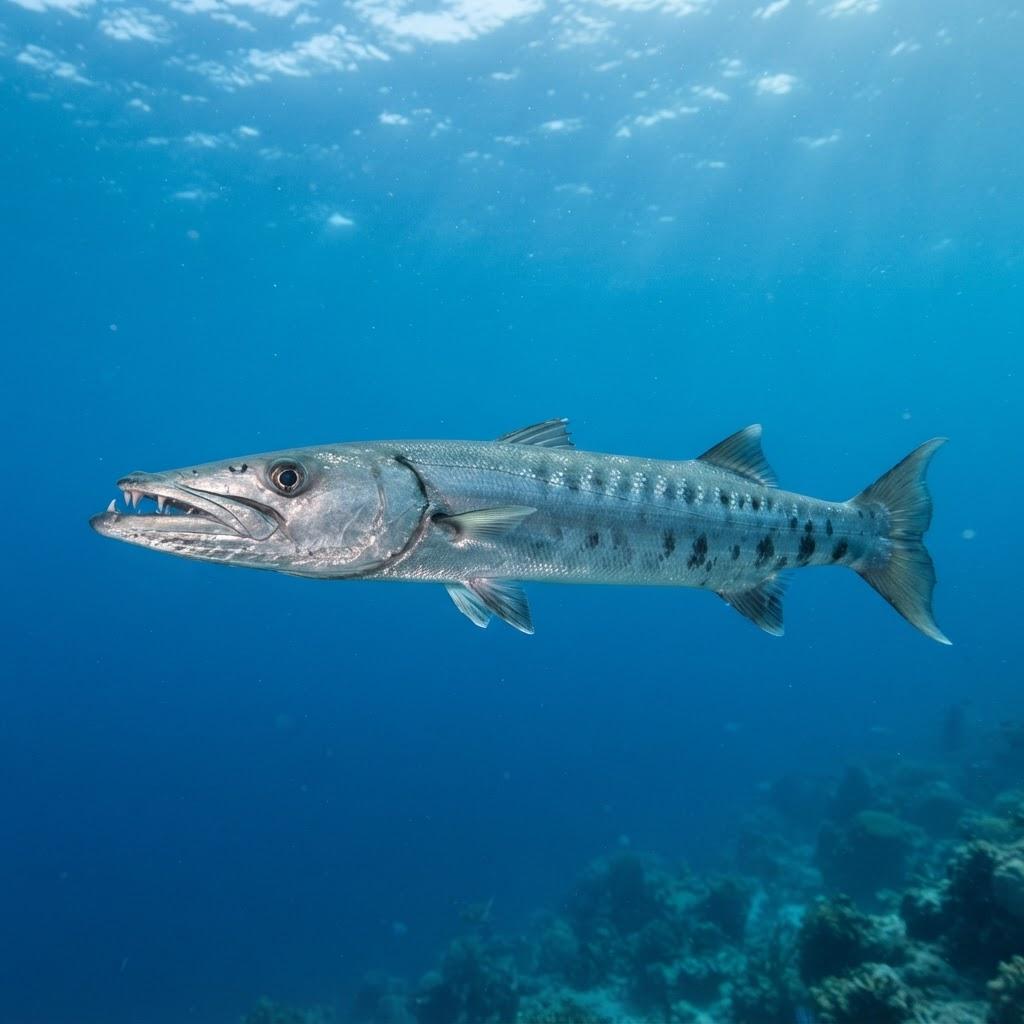
If you want to catch a glimpse of this silver streak, look for the 'white water'—areas of the surface where the water seems to be boiling with activity. That is usually a sign that a school of Bluefish is tearing through a bait school. They have a sleek, bluish-silver back that fades to a lighter belly, and their lower jaw is distinctly jutting out, giving them a permanent 'I dare you' expression. Thankfully, Bluefish populations are currently in great shape. They are managed with catch limits in many areas to ensure that these frantic, toothy speed-demons keep terrorizing the baitfish for generations to come. If you want to help, the best thing you can do is support sustainable seafood and healthy coastal habitats. Healthy oceans need predators, even the grumpy, high-speed ones like the Bluefish. So, the next time you are at the shore and see the water churning, give a little wave to the local Bluefish gang—they are probably just looking for their next lunch.