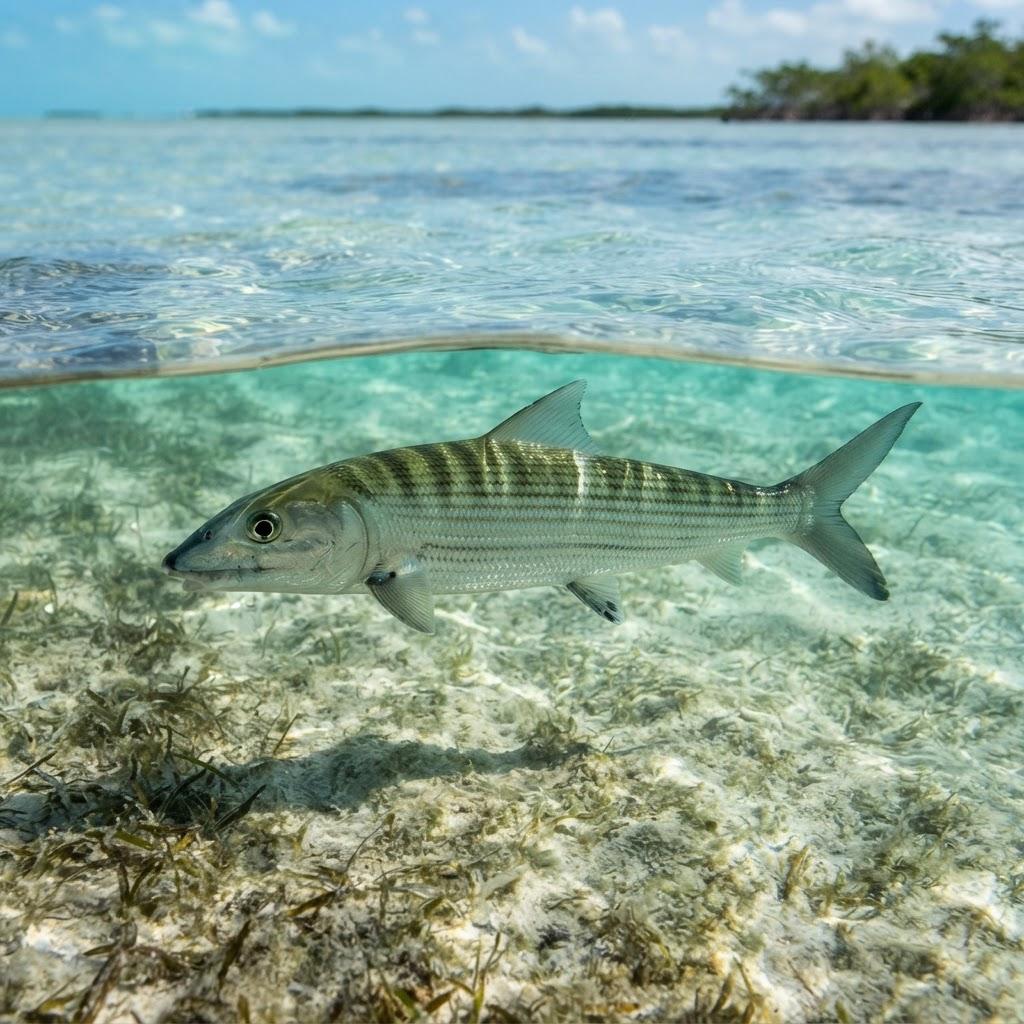
Albula vulpes
Bonefish
Meet the Bonefish, the undisputed ghost of the saltwater flats and the ultimate elusive ninja of the Caribbean. They are fast, fashionable, and possess a level of stealth that would make a secret agent blush.
Meet the Fish
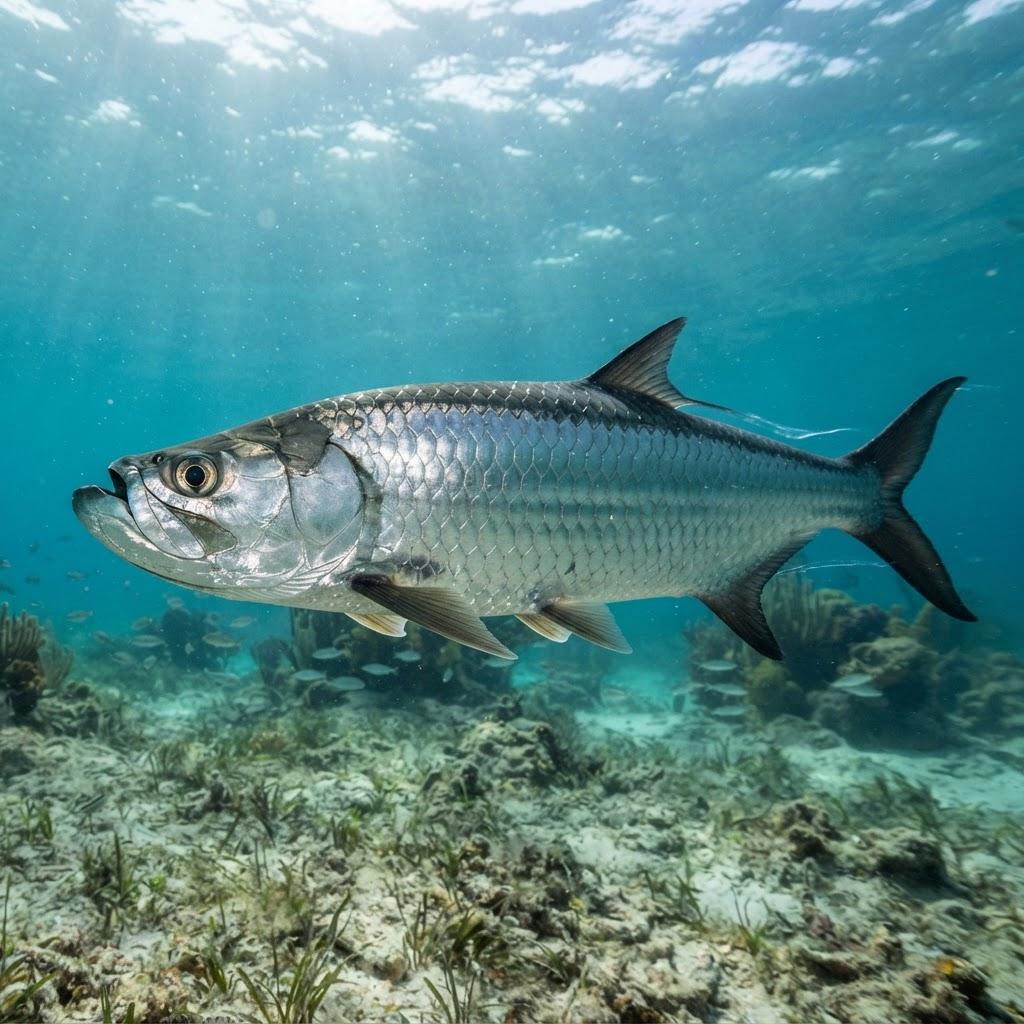
Imagine a fish that spent its entire life taking lessons from a master spy and you have the Bonefish. If the ocean had a secret agent, the Bonefish would be wearing the tuxedo, sipping a martini, and vanishing into a cloud of sand before you even reached for your camera. These fish are the absolute masters of the shallow flats, lurking in water so thin that you wonder how they don't get a sunburn on their dorsal fins. They have a sleek, silver, streamlined body that acts like a mirror, perfectly camouflaging them against the sandy sea floor. They aren't just pretty faces; they are built for speed and endurance, possessing a nervous energy that makes a hummingbird look lazy. When you encounter a Bonefish, you are not just seeing a fish; you are witnessing a creature that has perfected the art of not being seen. They possess an almost telepathic ability to detect movement, vibration, and shadow, making them the most elusive targets in the shallow world. They are the elusive ghosts of the flats, turning every fishing trip into a high-stakes game of hide-and-seek where the fish almost always wins.
Weird Biological Superpowers Explained Simply
The Bonefish is essentially a biological metal detector combined with a high-performance jet engine. Its greatest superpower is a highly specialized snout that is essentially a sophisticated vacuum cleaner for the sea floor. While many fish search for food with their eyes, the Bonefish uses its shovel-like nose to root around in the sediment for tasty snacks like crabs, shrimp, and small clams. It is like having a metal detector attached to your face that can distinguish a crunchy crab from a piece of useless gravel at ten paces. Once it detects a snack, it uses a hydraulic suction method, inhaling its prey with such force that it creates a localized vacuum. It then processes this haul with an array of bony plates in its throat—hence the name Bonefish—that act like a heavy-duty industrial crusher. This ability to sift through mud and sand to extract the good stuff makes them the elite foragers of the tidal flats, allowing them to thrive in environments where other fish would simply go hungry.
Absurd Self-Defense Mechanisms
When a Bonefish feels threatened, it does not stand and fight; it activates its afterburners and turns into a silver streak of pure adrenaline. Its primary defense mechanism is a combination of insane speed and a knack for disappearing act maneuvers that would confuse a professional magician. Because they haunt the shallowest waters imaginable, they know exactly how to use depth to their advantage. They will zip into water so shallow that their backs poke out, forcing predators to either give up or risk beaching themselves. If a shark or barracuda starts stalking them, the Bonefish uses its reflective silver scales to create a shimmering distraction, essentially acting like a living disco ball that makes it impossible for a predator to focus. They also possess an incredibly sensitive lateral line, a row of sensory organs along their sides that detect even the smallest change in water pressure, meaning they know exactly where a predator is before the attacker even realizes it has been spotted. They are basically living radar systems with a turbo boost.
Fish Drama and Gossip
Life on the flats is not all about finding tasty crabs; it is a cutthroat social scene that would put a high school cafeteria to shame. Bonefish are social butterflies but in a very suspicious, guarded way. They travel in small schools, often acting like a tight-knit clique that watches each other’s backs. There is a constant, unspoken hierarchy within these schools. If a new, younger Bonefish tries to push into a prime feeding spot, you will see a subtle display of posturing. They tilt their bodies, flicker their silver sides, and make sharp, decisive movements that essentially translate to 'back off, this crab is mine.' It is all very subtle and quiet, but for those watching, the drama is real. These groups are constantly communicating through body language, ensuring that the school moves in perfect, terrifying synchronization. If one fish gets spooked and bolts, the entire school initiates a tactical retreat instantly. They are the neighborhood watch of the sea, and everyone has a job to do, even if that job is just keeping an eye on the local barracuda.
The "Wait, That's Real?!" Deep-Sea Oddities
While Bonefish prefer the sun-drenched, shallow flats, their cousins in the deep sea are living in a world of absolute, bone-crushing darkness. In the twilight and midnight zones, fish like the Barreleye have evolved to literally see through their own heads, with upward-pointing green eyes housed behind a transparent dome. It is the kind of design you would expect from a sci-fi B-movie, yet it is standard operating procedure at a thousand meters deep. Unlike the Bonefish, which relies on sunlight and sharp vision to find crabs on a sandy bottom, deep-sea dwellers have to navigate a world of bioluminescence—a biological version of neon signage—to attract mates or lure prey. While the Bonefish uses its silver body to hide in plain sight against the bright sand, deep-sea creatures often use red light or total transparency to hide in the void. Comparing the Bonefish to its deep-sea relatives shows just how diverse fish engineering can be, ranging from the 'high-speed sport car' model of the Bonefish to the 'alien submarine' design of the abyssal zone.
Myth Busting
There is a persistent myth that Bonefish are 'dumb' because they are just fish, but anyone who has spent time on the flats knows better. People often think that fish have three-second memories and just wander around aimlessly, but the Bonefish is proof that this is complete nonsense. These fish have incredible spatial memory, recognizing specific stretches of shoreline and knowing exactly when the tide will bring in the best snacks. They are not just swimming; they are navigating a mental map of their territory that is far more complex than the average commute. Another myth is that they are impossible to catch because they are 'scared of everything.' The reality is that they are not scared; they are hyper-aware. They are constantly scanning their environment for danger, which makes them incredibly challenging to approach. They do not have the luxury of being lazy or slow in an environment where predators lurk behind every mangrove root. They are calculated, alert, and smarter than the average angler gives them credit for.
Humorous Historical Tales or Folklore
Throughout history, the Bonefish has been a symbol of both frustration and reverence for coastal communities. In many island cultures, the Bonefish was considered a 'food of the gods,' though the nickname 'Bonefish' comes from the sheer volume of tiny, needle-like bones that make preparing one a chore worthy of a Herculean trial. There is an old legend from the Bahamas that suggests the Bonefish were once land-dwelling creatures who decided they were tired of walking and decided to spend eternity running away from everyone just to prove a point. Whether or not that’s true, it captures the spirit of the fish perfectly. Historical fishermen would tell tall tales about 'The Great Silver King,' a Bonefish so big and fast it supposedly outran a passing steamship. While these stories are clearly exaggerated, they highlight the respect people have for a fish that is impossible to catch, hard to eat, and yet absolutely magnetic to anyone holding a fishing rod.
Underwater Love Stories and Bizarre Romances
When it comes to romance, the Bonefish does not do grand gestures or flashy singing. Instead, they engage in a ritual that involves long-distance migration to the deep water just off the edge of the continental shelf. Think of it as an extreme, high-stakes dating app location setting. They congregate in massive schools to spawn, creating a flurry of activity that is essentially a high-energy dance party in the middle of the ocean. It is a mass-market event where millions of eggs are released into the water column. There is no 'till death do us part' in the Bonefish world; instead, it is a numbers game where the goal is to get their genetic material out there and hope for the best. It is less of a romance novel and more of a chaotic festival, but it is highly effective. They travel hundreds of miles from their comfy home flats just to reach these 'love zones,' demonstrating a level of commitment that is rare in the shallow-water social scene.
Underwater Architecture and DIY Nesting
While some fish build elaborate castles out of coral or sand, the Bonefish is a minimalist. They don’t build nests, they don't dig holes, and they don't leave notes. They believe in the 'travel light' philosophy. Why bother building a fortress when you can keep moving? Instead of construction, they invest their energy into maintaining their 'patrol routes.' Think of it as a DIY project where the architecture is invisible. They constantly maintain and patrol the same sandy channels and grass flats, turning them into well-defined paths. They know every turn, every dip, and every rock in their home turf. It is a mental construction project that requires more effort than stacking stones. They are the nomads of the sea, constantly on the move, and their 'architecture' is simply the deep, ingrained knowledge of the terrain that allows them to zip through a maze of obstacles without ever slowing down to check the map.
The Chaos of Raising Tiny Swimmers
Raising children is usually a full-time job, but for the Bonefish, it is a game of extreme survival. After the spawning festival in the deep, the larvae don't just grow up; they go through a 'leptocephalus' stage, which is basically a fancy way of saying they look like transparent, ribbon-like aliens for a while. These tiny, see-through creatures drift with the currents, trying their best not to be eaten by everything in the ocean. It is a period of total chaos and vulnerability. They don't have parents hovering over them, so they rely on their invisibility to survive. As they grow and migrate back toward the shallow flats, they undergo a massive body transformation, slowly shifting from a weird, jelly-like ribbon into a proper, silver-scaled mini-Bonefish. It is the ultimate 'ugly duckling' story, but instead of turning into a swan, they turn into a high-speed, sand-grubbing, secret-agent fish. It is a brutal, high-stakes childhood, but the ones who make it to the flats are the toughest survivors around.
How to Spot One & How It Is Doing
If you want to spot a Bonefish, you need to develop the 'eyes of a hawk.' Look for the subtle flick of a tail on a calm, sandy flat or a slight disturbance in the water that looks like a nervous shadow moving against the current. They are rarely stationary. You are looking for a 'grey ghost'—a shimmering, silver shape that mimics the texture of the bottom. When you see one, try to remain absolutely still; even a slight vibration on the dock or boat can send them fleeing. Fortunately, the Bonefish population is currently in great shape, classified as Least Concern. They are a beloved game fish, and because most people practice 'catch and release' with them, they continue to thrive. You can help by keeping their habitat clean, avoiding pollution in estuaries, and supporting local marine conservation groups that protect the sensitive grass flats where these silver legends grow up. With a little respect and a lot of patience, you can witness the majesty of one of the ocean's most incredible characters.