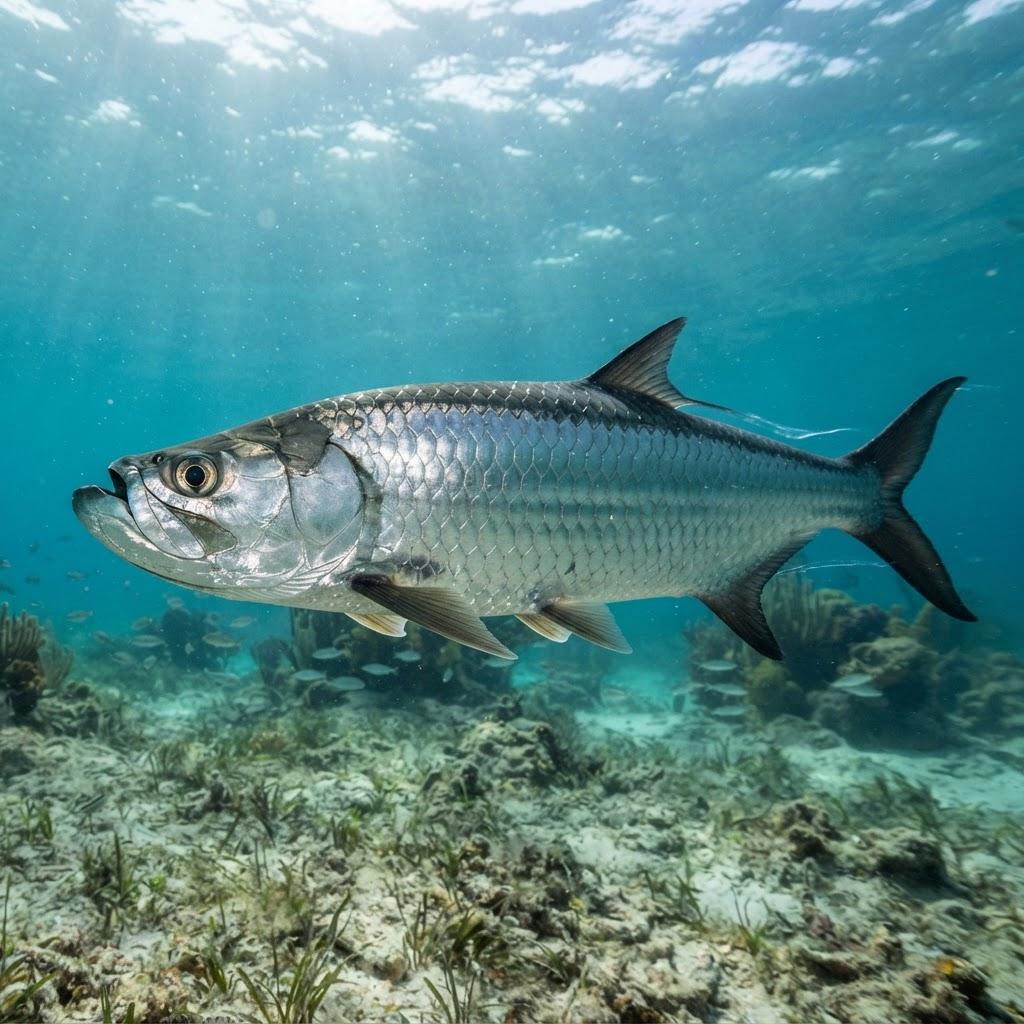
Megalops atlanticus
Tarpon
Meet the Silver King, a prehistoric glitter-bomb of a fish that can out-jump an Olympic gymnast and breathe air like a scuba diver. This massive, armored powerhouse is the ultimate celebrity of the Atlantic coastal scene.
Meet the Fish
Imagine a fish that looks like it was armored by a medieval blacksmith and then spray-painted with pure, industrial-grade chrome. That is the Tarpon. They are the A-list celebrities of the saltwater world, sporting massive, dinner-plate-sized scales that shimmer with the intensity of a disco ball gone rogue. But do not let that fancy outfit fool you; this is a rugged, prehistoric survivor. While most fish are busy worrying about the latest shark-infested trends, the Tarpon is busy patrolling the coastline like a bouncer at the club who has been working the door since the dinosaurs roamed the earth. They are big, they are bold, and they possess a jaw that looks like it was designed specifically to ruin a fisherman’s weekend. With a body built for both endurance and explosive, gravity-defying leaps, the Tarpon is essentially the sports car of the estuary. If fish had high school yearbooks, the Tarpon would undoubtedly be voted Most Likely to Jump Over Your Boat While You Are Trying to Eat a Sandwich. They are not just fish; they are living, breathing, silver-plated legends.
Weird Biological Superpowers Explained Simply
You know how you feel when you run out of air during a particularly intense game of tag and have to stop to wheeze? The Tarpon laughs at your puny lungs. These guys have a biological party trick that feels like pure science fiction: they can breathe air. They possess a modified gas bladder that acts almost like a primitive lung. When the water gets swampy, low on oxygen, or just downright gross, the Tarpon does not panic. Instead, it glides to the surface, rolls its giant, glassy eye, and takes a refreshing gulp of air from the atmosphere. It is like having a backup oxygen tank built directly into your torso. This allows them to thrive in stagnant, oxygen-starved environments that would make other fish faint from lightheadedness. It is a brilliant adaptation, basically turning the Tarpon into an aquatic scuba diver that never needs to worry about running out of air. They are the only fish in the neighborhood that can hang out in a murky river-bottom cocktail party while everyone else is gasping for breath at the surface.
Absurd Self-Defense Mechanisms
If you are a predator thinking about turning a Tarpon into a snack, you might want to rethink your life choices. First, these fish are absolute tanks. They grow to massive sizes, meaning that by the time they reach adulthood, very few things are foolish enough to try to take a bite out of them. Their primary defense, however, is a classic 'jump and scare.' When a Tarpon feels threatened, it does not hide in a cave like a coward; it goes airborne. We are talking about a two-hundred-pound slab of muscle launching itself six to ten feet out of the water, shaking its entire body with the grace of a glittery wrecking ball. It is an intimidator tactic designed to leave any shark or barracuda confused, rattled, and hopefully swimming in the opposite direction. Between the armor-plated scales that act like a suit of chainmail and the sheer, chaotic energy of their mid-air acrobatics, the Tarpon makes being a predator look like a truly thankless, high-risk job.
Fish Drama and Gossip
In the world of the Tarpon, everything is a bit of a soap opera. These fish are gregarious socialites, often hanging out in pods or loosely organized gangs in the backwaters. There is a hierarchy, of course, but it is less about complex social rules and more about who has the biggest set of scales and the most intimidating presence. When food is scarce or a particularly prime piece of prime real estate in a mangrove root system opens up, you can bet there is some serious posturing going on. They do not have Twitter to air their grievances, but they have plenty of body language. A flick of a massive tail or a sudden, aggressive charge is enough to settle most disputes. It is like watching a group of brawny dudes in expensive suits trying to decide who gets the best table at the restaurant without actually wanting to spill their drinks. The drama is constant, the tension is thick, and the gossip travels through the water faster than a text message in a high school hallway.
The "Wait, That's Real?!" Deep-Sea Oddities
While our friend the Tarpon prefers the sunny, shallow coastal waters over the crushing, pitch-black abyss, it is worth comparing them to their deep-sea cousins just to appreciate how weird the ocean really is. In the twilight zones of the deep, fish are basically turning into living, glowing neon signs. We have anglerfish with literal lures growing out of their foreheads and barreleye fish that have transparent heads—yes, you read that right, clear glass-like domes—so they can stare directly through their own skulls at potential meals. Compared to these deep-sea aliens, the Tarpon looks relatively normal, like a tuxedo-wearing banker at a convention of wizards. But the Tarpon is an expert in its own right. While deep-sea fish have to deal with the pressure of a thousand elephants sitting on them, the Tarpon has mastered the art of the surface tension. It is the contrast between the high-pressure, bioluminescent freak show of the deep and the high-energy, sun-drenched athleticism of the coastal Tarpon that proves the ocean is just one big, wild circus.
Myth Busting
There is a long-standing myth that Tarpon are these gentle, mindless giants that just drift along waiting for a snack. Wrong. These are cunning, highly intelligent predators with an uncanny ability to learn. They are not just mindless eating machines; they exhibit something that looks suspiciously like problem-solving. If a fisherman tries to hook one, the Tarpon will learn, adapt, and use every trick in the book to shake that hook free. There is also a rumor that they only eat small minnows, but these guys are the trash cans of the sea—they will eat pretty much anything that fits in their giant, shovel-shaped mouths, from crabs to mullet to whatever else is unlucky enough to be swimming by. They have been accused of being sluggish in cold water, but that is just because they are conserving energy like a pro athlete on a rest day. Don't believe everything you hear on the docks; the Tarpon is smarter and hungrier than the legends suggest.
Humorous Historical Tales or Folklore
Humans have been obsessed with the Tarpon for centuries. In some coastal cultures, the sheer size and beauty of the fish turned it into a semi-mythical beast. Legend has it that the massive, thick scales of the Tarpon were used as jewelry or even as decorative elements in ancient households, symbols of strength and prosperity. There are whispers of sailors telling campfire tales about 'The Silver King,' a giant, ghostly Tarpon that could guide ships away from reefs or, depending on who was telling the story, lead them straight into a hurricane. It is the kind of folklore that springs up around any creature that is big enough to break a boat and shiny enough to reflect the moonlight. They are the 'Moby Dick' of the warm-water angler, minus the homicidal tendencies. Even today, catching a Tarpon is considered a rite of passage, a story worth telling your grandkids about, assuming you can actually hold onto the rod long enough to finish the fight.
Underwater Love Stories and Bizarre Romances
The dating scene for a Tarpon is not exactly a candlelit dinner. It is more of an epic, endurance-based marathon. When spawning season arrives, these silver giants congregate in massive numbers to perform what is essentially the ocean’s biggest, most intense dance-off. There is a lot of swimming, a lot of splashing, and a lot of showing off who has the best-looking scales. They migrate vast distances just to find the perfect spot to mingle, moving like a silver river through the ocean currents. It is high-stakes romance where the goal is to produce as many eggs as possible in a short window of time. No one is buying anyone flowers; they are too busy trying to keep up with the pack and make sure they are in the right place at the right time. It is a chaotic, beautiful mess of biological destiny that ensures the next generation of Tarpon arrives with a bang, literally.
Underwater Architecture and DIY Nesting
When it comes to building a home, the Tarpon is more of a 'nomad' than a 'homeowner.' They do not spend their days stacking rocks or weaving seagrass like some of the more fastidious fish. They prefer a minimalist lifestyle. Why build a fancy sand castle when you can just drift with the current and sleep in the deep, protective embrace of a mangrove root system? They seek out areas with complex, tangled roots that provide a natural fortress against larger predators. It is the ultimate low-maintenance housing plan. By utilizing the natural architecture of the coastline, they save their energy for the important things: leaping, breathing, and looking absolutely stunning. They are the ultimate minimalists of the sea, showing us that you do not need a fancy palace to be a king—you just need a good hiding spot and a whole lot of confidence in your ability to survive the night.
The Chaos of Raising Tiny Swimmers
If you think your kids are messy, you haven't seen a Tarpon’s version of daycare. It is basically a survival-of-the-fittest experiment on a massive scale. Tarpons do not hang around to read bedtime stories to their fry. They release millions—yes, millions—of eggs into the open water and hope for the best. The tiny larvae that hatch are thin, transparent, ribbon-like creatures that look absolutely nothing like their silver-plated parents. They drift in the currents, vulnerable to every hungry mouth in the ocean. It is a numbers game. Out of those millions of eggs, only a tiny fraction will make it to adulthood. It is not exactly 'parent of the year' material, but it is an effective, if brutal, way to ensure that the species keeps marching on. They are betting on volume, flooding the market with so many tiny swimmers that even the hungriest predators can't possibly eat them all. It is chaotic, it is wild, and it works perfectly.
How to Spot One & How It Is Doing
So, how do you find the king? Look for the silver flash. If you are near a coastal inlet or a bridge during a tide change, keep your eyes peeled for a giant, metallic-looking shadow patrolling the surface. You will often see them 'rolling'—that is the scientific term for them coming up to take that gulp of air. It looks like a heavy, silver ripple breaking the glassy surface of the water. As for their health, they are currently listed as Vulnerable. They are not going extinct tomorrow, but they face a lot of challenges from pollution, habitat loss, and getting a little too much attention from over-zealous anglers. The best thing you can do to help is to support healthy, clean waterways. When the estuaries are thriving, the Tarpon is thriving. Protect the mangroves, keep the trash out of the rivers, and maybe, just maybe, you will get to witness the magnificent, glittery leap of the Silver King for yourself. It is a sight that makes you realize exactly why we need to keep these giants around.