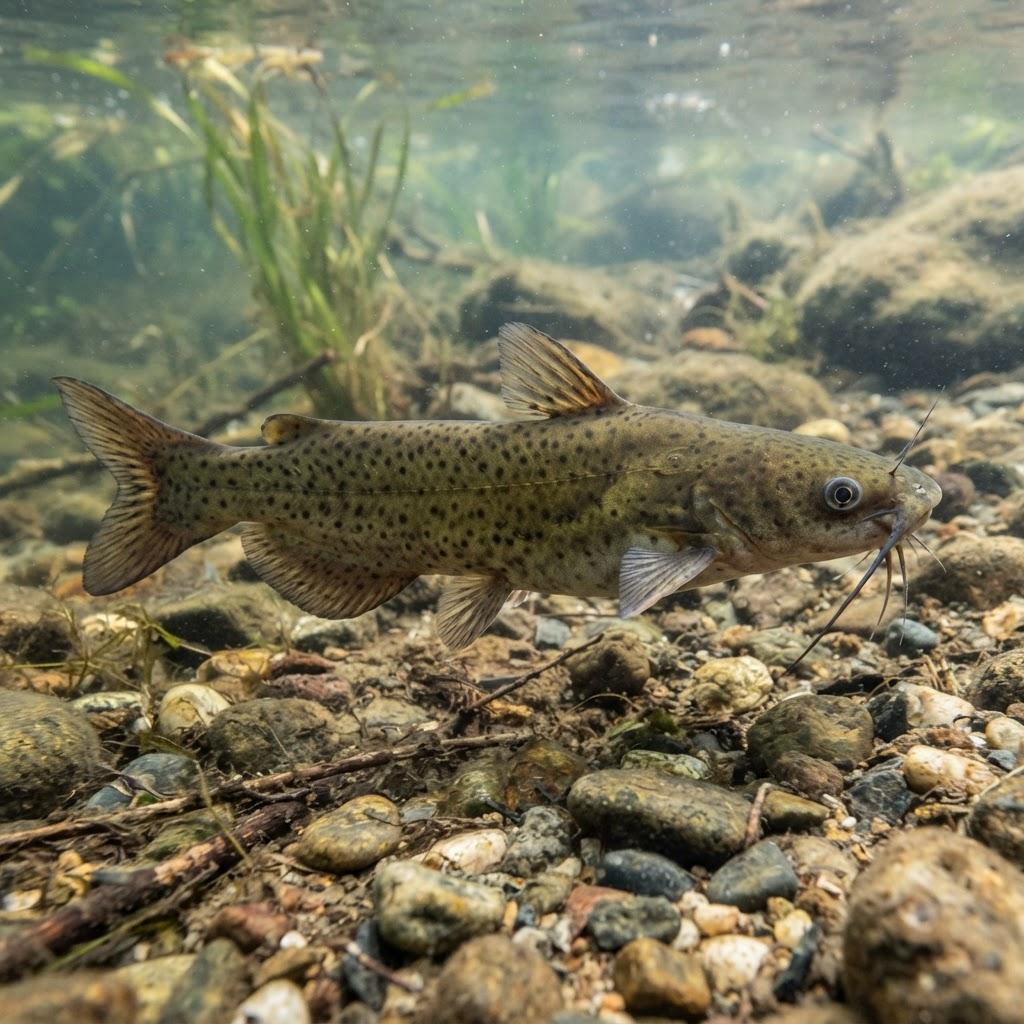
Ictalurus punctatus
Channel Catfish
Meet the Channel Catfish, the river-dwelling party animal with a face full of sensors and a serious attitude. This mustachioed bottom-feeder is nature's ultimate survivor, turning murky water into his personal playground.
Meet the Fish
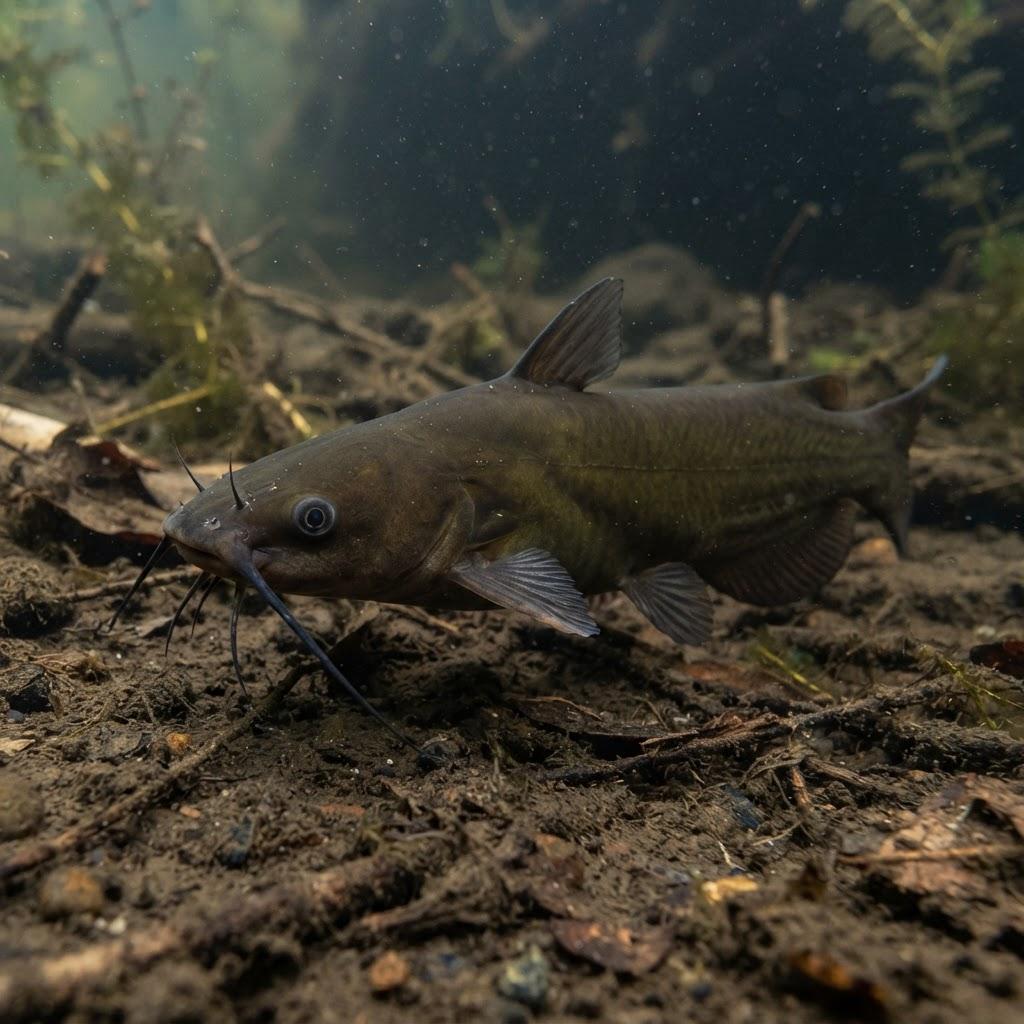
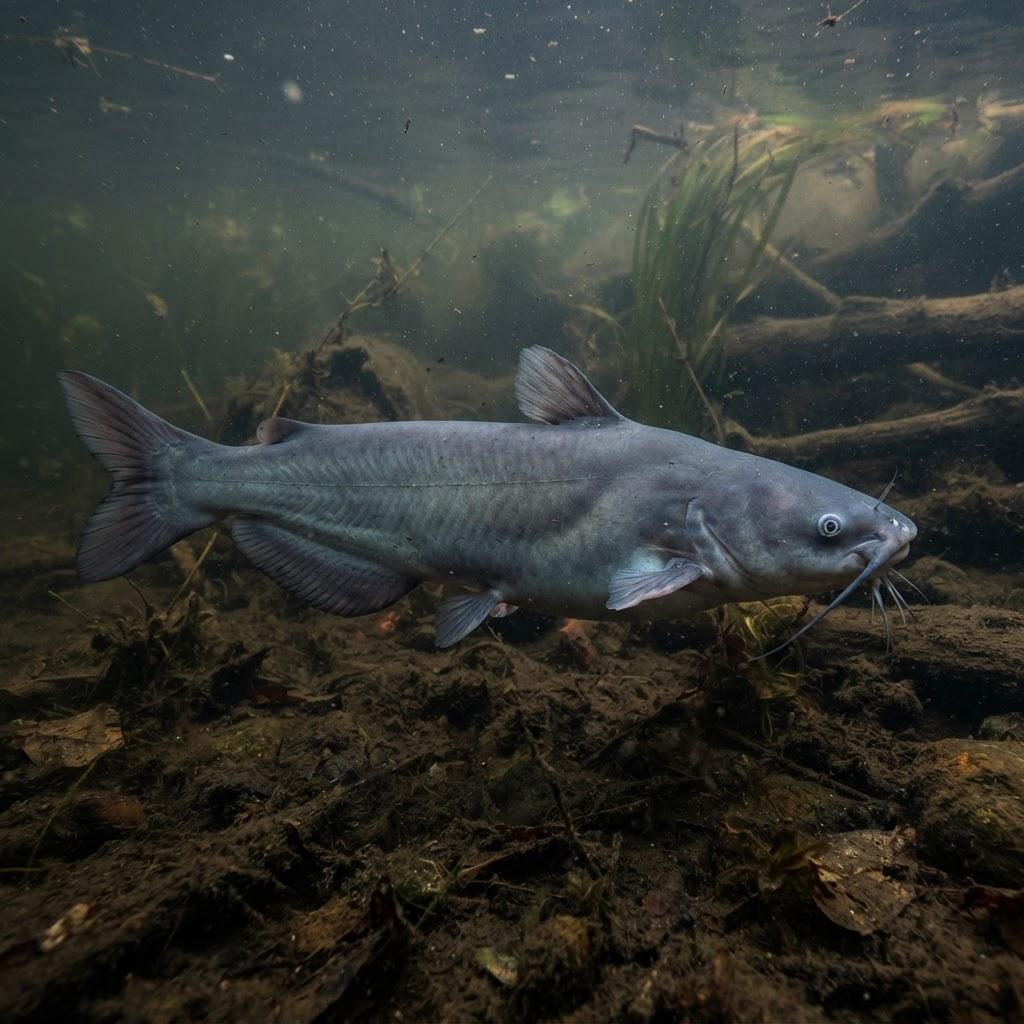
Imagine you are at a local dive bar, the kind where the neon lights flicker and the jukebox plays nothing but classic rock. In the corner, sitting on a stool that has seen better days, is the Channel Catfish. He is the guy who does not need to talk to know exactly what is going on in the room. With his sleek, smooth skin and a set of long, dangling barbels—which are basically fancy, taste-bud-covered whiskers—he is the ultimate mystery man of the murky depths. He does not wear a tie; he wears a look of permanent, slightly grumpy suspicion. While other fish are out there darting around trying to show off with flashy scales and neon colors, the Channel Catfish keeps it real with a mottled, olive-brown aesthetic that says, I am here for the snacks, not the fashion show. He is the river's favorite scavenger, the guy who knows where the best leftovers are hidden under a pile of logs. He is calm, cool, and collected, but do not let that stoic face fool you; beneath that calm exterior lies a creature that has been dominating the North American river scene for ages. He is the king of the muddy bottom, the undisputed heavyweight champion of the backwater social club, and honestly, he is exactly the kind of character you want to have on your side when things get weird in the deep dark river.
Weird Biological Superpowers Explained Simply
If you think your smartphone is impressive because it can detect your face, wait until you meet a Channel Catfish. These guys are basically living, breathing, underwater Swiss Army knives. Their most legendary feature? Those whiskers, or barbels. They are not just for show; they are packed with taste buds. Imagine if you could walk down the sidewalk and know exactly what a restaurant is cooking three blocks away just by the air hitting your skin. That is essentially the life of a catfish. They literally taste their environment. They can sense chemical traces in the water from incredible distances, effectively turning the entire river into a giant flavor map. But wait, there is more. Their bodies are covered in sensors that detect vibrations and pressure changes, which means they can feel you coming long before they see you. It is like having super-hearing in your entire body. When you combine this chemical-tasting ability with their pressure-sensing superpowers, the Channel Catfish becomes the ultimate hunter. In dark, silty, or muddy water where eyes are practically useless, these guys can navigate, find a snack, and avoid trouble like they are surfing on a sea of information. They are the true masters of sensory perception in a world where everyone else is effectively wearing a blindfold, and that makes them one of the most efficient survivalists on the planet.
Absurd Self-Defense Mechanisms
If you are thinking about grabbing a Channel Catfish for a little fun, you better check your insurance policy first. These fish are not just tough; they are literally armed. Their fins feature sharp, serrated, bony spines that are designed for one purpose: to make you regret touching them. These aren't just pokey little needles; they are built with a locking mechanism that can keep them extended, which is a giant flashing neon sign for predators that says, Do not even think about it. If a larger fish tries to swallow a young Channel Catfish, the spines pop out and lock in place, making the catfish look like a living, breathing caltrop. It is a brilliant, albeit slightly painful, defensive tactic. Furthermore, many catfish species have a specialized protein in their skin that acts like a localized sting if they get you, though the Channel Catfish relies mostly on its 'don't-touch-me' spines to get the point across. They are the bouncers of the river, and their bouncer-grade security is effective enough to make even the most aggressive pike rethink their lunch plans. They don't need fancy camouflage or dramatic speed to survive; they just need to be exactly as prickly as they need to be to ensure that every predator learns the hard way that a meal of catfish is usually just not worth the headache and the puncture wounds.
Fish Drama and Gossip
If you think your local neighborhood watch is dramatic, you clearly haven't been keeping tabs on the social hierarchy of the Channel Catfish. While they aren't necessarily known for complex, soap-opera-level friendships, they are incredibly territorial. Think of them as the grumpy neighbors who take their lawn care way too seriously. When they aren't busy scavenging for food, they are busy staking out the best underwater real estate. A prime hole under a submerged log or a deep, dark undercut bank is prime river-front property, and the Channel Catfish will defend it with the intensity of a homeowner’s association president on a power trip. They use body language, aggressive posture, and sometimes direct confrontation to let other fish know that this specific piece of mud is taken. It is not just about space; it is about status. The largest, strongest males generally claim the best spots, while the younger, smaller ones have to make do with the suburbs. The gossip among the smaller fish about which massive male has taken over the log pile is legendary in the riverbed. They live in a world where being the 'big guy' on the block matters, and the drama of claiming the perfect, most protective den is a never-ending cycle of posturing, intimidation, and occasional, very brief underwater brawls.
The "Wait, That's Real?!" Deep-Sea Oddities
While the Channel Catfish prefers the murky comfort of a freshwater river to the crushing, midnight darkness of the deep ocean, the comparison to his deep-sea cousins is fascinating. In the deep sea, creatures are dealing with near-freezing temperatures and pressures that would turn a submarine into a soda can. They use bioluminescence to light up the gloom like a malfunctioning Vegas strip. The Channel Catfish doesn't have the luxury of glow-in-the-dark skin, but he shares a similar vibe with those deep-sea dwellers: the adaptation to life without light. Where a deep-sea anglerfish uses a glowing lure to trick prey, the Channel Catfish uses his taste-bud-covered whiskers to map out his dark world. Both fish have evolved to thrive in environments where sight is a liability rather than an asset. It is an evolutionary masterclass in playing the hand you are dealt. While the anglerfish looks like a monster from a low-budget horror film, the Channel Catfish looks like the sensible, hard-working relative who decided to stay in the suburbs instead of going to live in the wild, neon-lit metropolis of the ocean floor. They are distant cousins in the school of 'we don't need eyes to be the boss,' and that connection is something to appreciate.
Myth Busting
Let’s clear the air about some of the nonsense you might have heard about these guys. There is a persistent myth that the Channel Catfish is just a trash-eating bottom-feeder with no brain power. People love to think that because they aren't 'game fish' in the traditional, pretty sense, they must be simple-minded gluttons. This is absolute fiction. Catfish are surprisingly intelligent. They have been shown to learn and adapt to their environments, and they can even recognize human activity, especially if that activity frequently results in food. They aren't just mindless vacuum cleaners moving across the mud; they are calculated hunters that wait for the right moment and the right conditions. Another myth? That they are entirely scavengers. While they aren't picky, they are actually skilled predators that hunt live fish, crawfish, and even insects on the surface. They have a versatile palate that would make a food blogger jealous. So, the next time someone tries to tell you that these fish are just boring, sluggish bottom-dwellers, you can tell them with confidence that they are actually sophisticated, highly adaptive creatures that know exactly what they are doing. They are the survivalists of the river, and they have more going on in their heads than people give them credit for.
Humorous Historical Tales or Folklore
The relationship between humans and catfish is as old as the rivers themselves, and the history is filled with some truly bizarre folklore. In some regions, ancient legends held that giant catfish were the rulers of the river, mythical beasts capable of causing earthquakes or massive floods if they thrashed around too much. It sounds ridiculous, but back when you didn't have a map of the riverbed, seeing a massive, whiskered creature surface in the moonlight was enough to invent a few sea monsters. Even more amusing are the historical accounts from the American frontier, where catfish were often the only reliable source of protein for settlers. There are tall tales of 'noodling'—the act of catching catfish with your bare hands—that have turned into the stuff of legend. You’ve got stories of folks reaching into a dark, muddy hole, thinking they’re grabbing a fish, only to find themselves in a wrestling match with a beast that weighs as much as a toddler. These stories, passed down through generations, have painted the catfish as a kind of river-bottom outlaw. They are the fish of the people, the subject of campfire stories, and the star of more 'the one that got away' anecdotes than any other species in the American river system.
Underwater Love Stories and Bizarre Romances
When it comes to romance, the Channel Catfish is all about commitment and interior decorating. You won't find any flashy, colorful dance numbers or elaborate displays of speed here. Instead, it is all about finding the right house. The male Channel Catfish is the architect of the relationship. He scouts for a secluded, safe, and sturdy den—perhaps a hollowed-out log or a deep cave carved into the riverbank—and he spends a significant amount of time cleaning it up. He is essentially preparing the 'starter home' for his future family. Once the den is ready, he performs a subtle display to attract a female, letting her know he has the perfect spot for her to lay her eggs. It is remarkably domestic. Once she moves in and lays the eggs, the romance doesn't just fizzle out; it shifts into a partnership of duty. The male takes on the role of the devoted protector. It is not exactly a candlelit dinner, but in the world of fish, it is as close as it gets to a solid, stable marriage. They are the 'homebody' couple of the river, focused on building a secure foundation rather than chasing the thrills of a fleeting romance.
Underwater Architecture and DIY Nesting
You have to admire the engineering prowess of a Channel Catfish when it comes to nesting. While other fish might just dump their eggs in a pile of weeds and call it a day, the Channel Catfish treats nesting like a professional construction project. The male will use his fins and his tail to excavate a cavity, clearing out debris, mud, and silt to ensure that the eggs have a clean, oxygenated surface. He isn't just digging a hole; he is building a nursery. If you were an underwater architect, you would look at a catfish nest and appreciate the structural integrity of a well-placed log or a perfectly hollowed-out bank. This nesting site acts as a fortress against the rest of the river. It’s safe, it’s secure, and it provides the necessary protection for the fragile eggs as they develop. It is impressive to think that this fish, often dismissed as a simple creature, has such a dedicated approach to creating a safe environment for its offspring. They are the DIY kings of the river, proving that you don't need fancy materials to create something that does exactly what it needs to do, providing the perfect shelter in a world that is otherwise full of hungry threats.
The Chaos of Raising Tiny Swimmers
Once the eggs hatch, the real fun begins. The male Channel Catfish doesn't just clock out once the little ones arrive; he stays on the job as a full-time, high-stress security guard. The newly hatched fry are basically tiny, transparent, vulnerable versions of their parents, and they are prime targets for just about everything else in the river. The father spends his days hovering over them, using his pectoral fins to fan the nest, ensuring that the water stays oxygenated and clean. He is the ultimate helicopter parent. If any intruders come near the nest, he turns into a miniature tank, chasing them off with an intensity that is honestly quite funny to witness. Once the fry get a bit older, they form a 'school' or a ball and swim around together under his supervision, looking like a fuzzy, moving cloud of tiny catfish. It is a scene of pure, chaotic joy. Watching them navigate the dangers of the river under the watchful eye of a grumpy, whiskered father is one of the most endearing sights in nature. It is a high-stakes, underwater daycare system, and the sheer dedication these fish show to raising their brood is nothing short of heroic in the messy world of river survival.
How to Spot One & How It Is Doing
If you want to catch a glimpse of the Channel Catfish, you need to head to the slower, muddier parts of the river or a local lake. Look for the 'mustache'—those long, white or grey barbels hanging off their faces—and the forked tail that sets them apart from other, rounder catfish species. They are generally found near the bottom, so look for them in the shadows of submerged logs, rocks, or steep banks. As for their conservation status, the good news is that the Channel Catfish is doing just fine. They are classified as Least Concern, which is the scientific way of saying they are thriving. They are incredibly hardy, highly adaptable, and honestly, they seem to be perfectly content with the way things are going. That doesn't mean we can just ignore our rivers, though. Keeping our waterways clean, preventing chemical runoff, and protecting the natural structure of our riverbanks ensures that the Channel Catfish—and all the other awesome creatures living there—continue to rule the roost. If you want to help, just be a good steward of your local stream or lake. Pick up your trash, respect the habitat, and maybe take a moment to appreciate the unsung, whiskered hero of the muddy depths the next time you are out by the water.