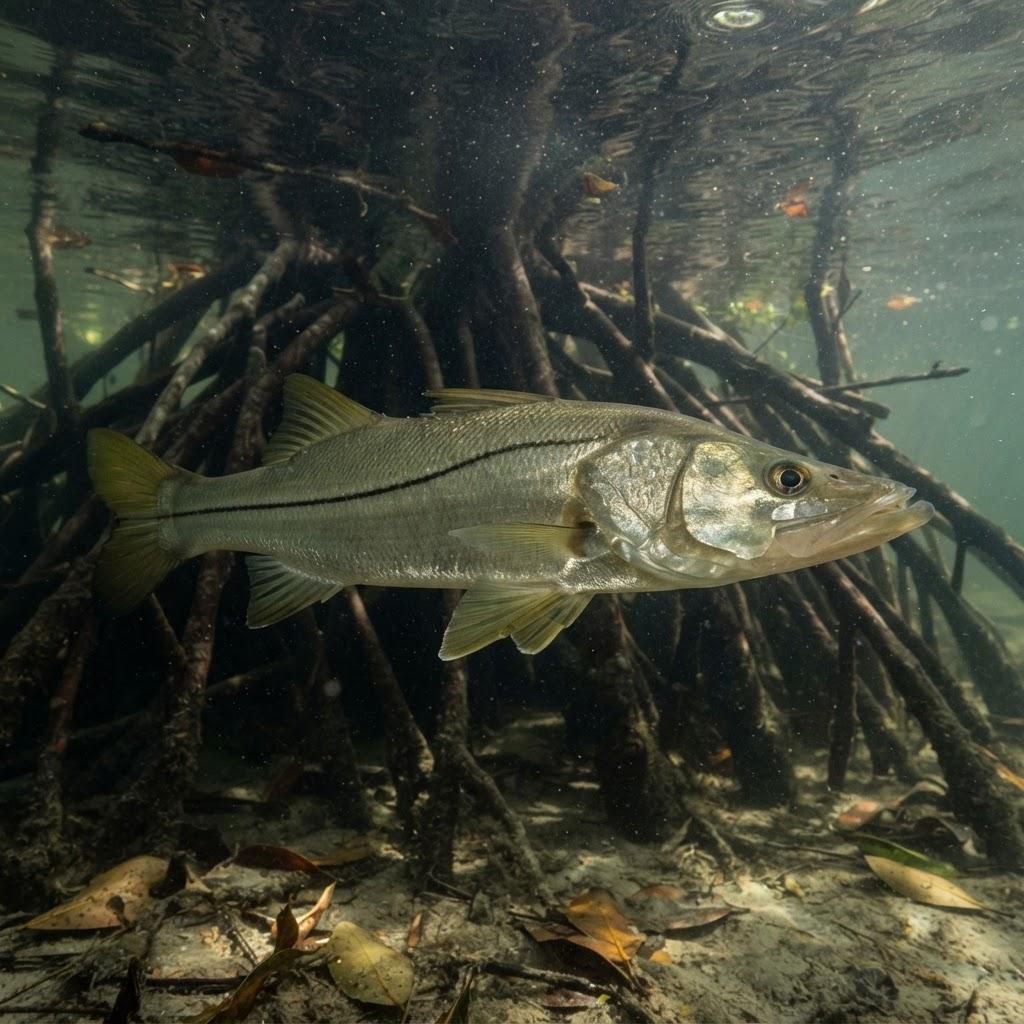
Centropomus undecimalis
Common Snook
Meet the Common Snook, the silver-clad gangster of the mangroves that hits like a freight train and changes gender on a whim. This legendary predator is the ultimate bucket-list catch for anyone who likes their fish with a side of high-octane attitude.
Meet the Fish
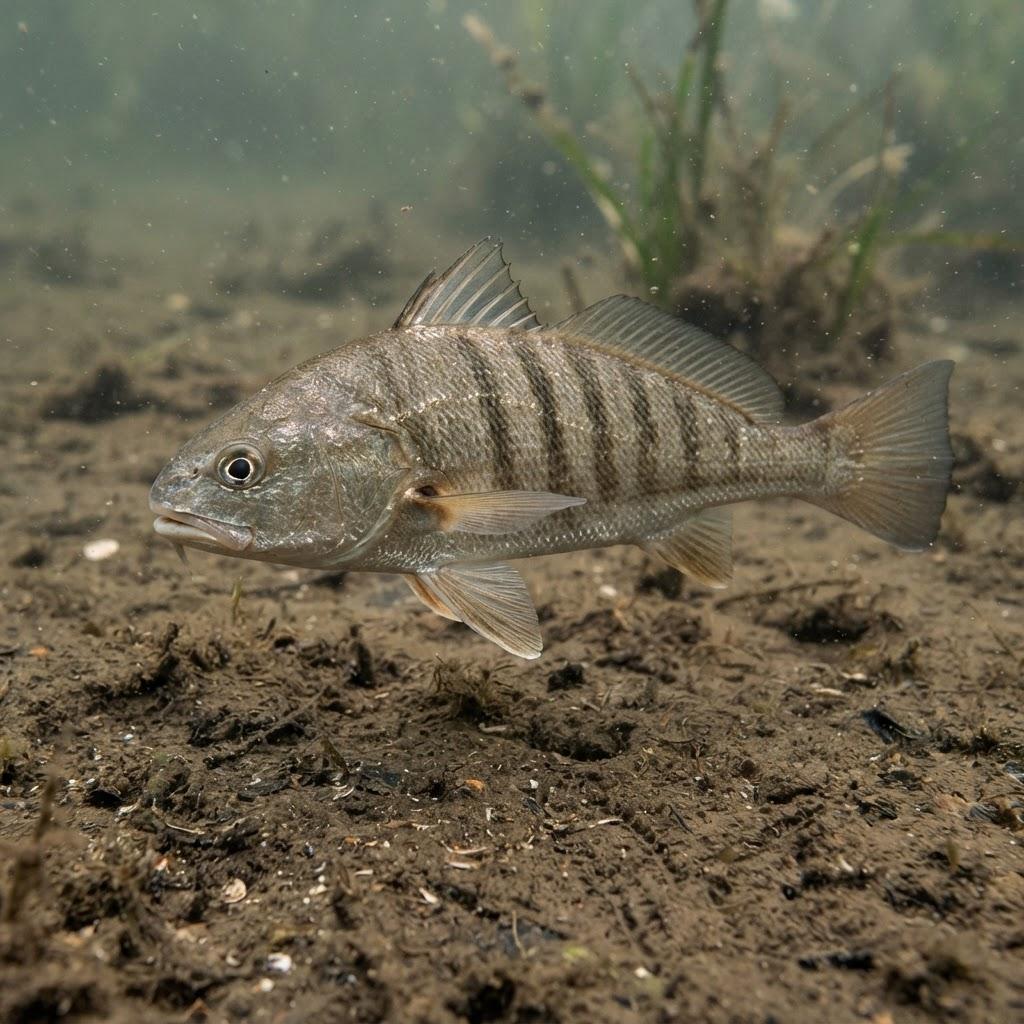
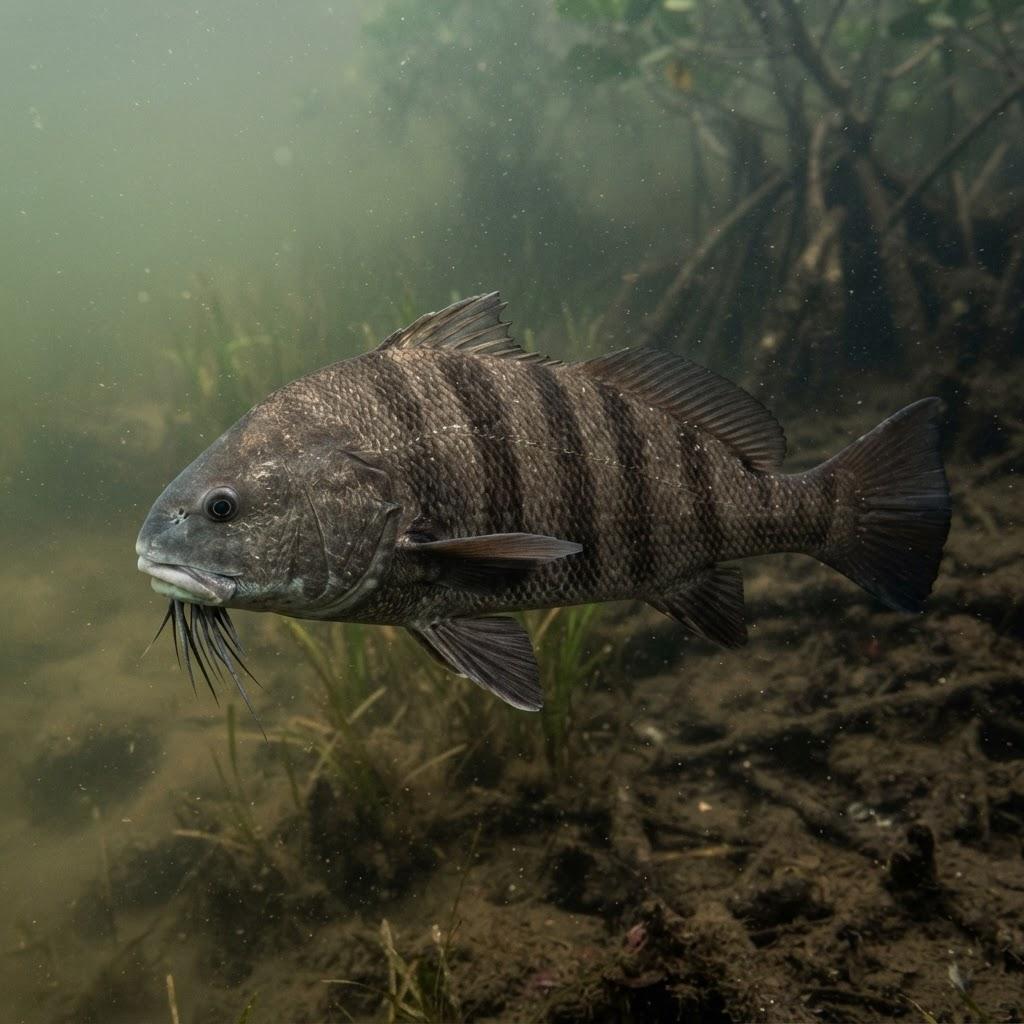
Imagine a fish that spent its entire life taking steroids, practicing parkour, and watching mafia movies. That is the Common Snook. With a body built like a sleek, silver torpedo and a jawline that could probably cut glass, this fish is the undisputed king of the coastal shadows. It possesses a dark, lateral line—a literal stripe running down its side—that acts like a high-tech sensor array, letting it feel the vibrations of a tiny shrimp twitching from ten feet away. The Snook is the ultimate ambush predator, lurking under mangrove roots or around bridge pilings with the patience of a statue. When it decides to strike, it does not just swim; it explodes. It is like watching a water-based firework go off in slow motion, followed by a violent, tail-whipping splash that usually leaves amateur anglers staring at their broken fishing lines in pure, baffled silence. It is not just a fish; it is a lifestyle, a legend, and a complete jerk to anything small enough to fit in its cavernous, gaping maw.
Weird Biological Superpowers Explained Simply
The Snook has a party trick that would put any X-Men character to shame: it is a functional hermaphrodite. That is right, the Snook can flip its biological gender as it grows up. It starts its life as a male, roaming the estuaries and trying to keep its head down, and then, once it reaches a certain size and maturity, it pulls a 'switcheroo' and becomes a female. This is not just a weird quirk; it is a tactical evolutionary masterclass. By transitioning into females once they grow larger, Snook ensure that the biggest, strongest fish in the population are the ones carrying the eggs. This maximizes the number of offspring, making them the ultimate survivalists of the saltwater world. Think of it like a video game character that starts as a rogue and upgrades into a tank class halfway through the boss fight. They also have an incredible ability to navigate between fresh water and salt water, thanks to a complex biological pump system in their gills that keeps their internal chemistry balanced, regardless of the salinity around them.
Absurd Self-Defense Mechanisms
When you are a top-tier predator, you don't necessarily need to be a defensive genius, but the Snook has a secret weapon: pure, unadulterated speed and a skull that feels like it was made of titanium. When a Snook gets spooked or decides that a shark is getting too close for comfort, it does not hide; it engages its afterburners. Its acceleration is so rapid that it creates a cavitation bubble, a vacuum pocket in the water that makes a loud popping sound. This sonic boom is a distraction tactic that disorients pursuers just long enough for the Snook to vanish into the murky labyrinth of mangrove roots. These roots are like a spiked obstacle course of death for anything else, but for a Snook, it is home base. They use their aerodynamic, flat-sided bodies to slide through gaps that would leave other fish stuck and flapping like fish out of water. They aren't just fast; they are masters of geometry, using their surroundings as a physical barrier that no hungry barracuda wants to crash into at high speed.
Fish Drama and Gossip
If you could eavesdrop on the mangrove forests, the gossip about the Snook would be scandalous. These fish are not the type to hang out and share snacks. They are highly territorial, cranky loners who would prefer to have the best ambush spot under a dock all to themselves. When two big Snook meet, it is not a friendly 'hello;' it is a stand-off that looks like a Western shootout, but with fins. They flare their gills, turn their bodies sideways to appear as large as possible, and stare each other down with eyes that clearly say, 'Do you want to get smacked?' They hold grudge matches over prime hunting spots for days. They don't have friends, they have temporary neighbors who are either currently being ignored or actively being chased away. The drama peaks during the spawning season, where these territorial monsters are forced to tolerate each other’s presence to fulfill their biological destiny, resulting in a tense, high-stakes gathering that is basically the underwater version of a bad family reunion where everyone is fighting over the last piece of cake.
The "Wait, That's Real?!" Deep-Sea Oddities
While the Snook is a shallow-water celebrity, it is worth comparing its lifestyle to the bizarre creatures living in the midnight zone, like the spookfish or the barreleye. If the Snook is the muscle-bound bodyguard of the mangroves, the deep-sea fish are the aliens from another galaxy. Down there, where sunlight is a foreign concept, fish have developed things like transparent heads or organs that glow with neon blue light to lure in dinner. The Snook’s lateral line is a basic sensor compared to the extreme sensory arrays of deep-sea dwellers that can detect a single drop of sweat from a whale miles away. While the Snook relies on its keen eyesight to pick off targets in the shifting sunlight of the shallows, the deep-sea fish are masters of psychological warfare, using bioluminescence to confuse, distract, and dazzle. The Snook might seem tough, but it would have an absolute nervous breakdown if it ever drifted into the crushing pressure and pitch-black emptiness where glowing jellies dictate the law of the land.
Myth Busting
There is a long-standing myth that Snook are 'dumb' fish that will strike at anything shiny. This is absolutely false. Snook are actually incredibly observant and cautious. If you drop a plastic lure in front of a big Snook that doesn't look or act like a real, struggling fish, they will simply stare at it, perhaps swim around it with a look of pure, fishy disdain, and then ignore it entirely. They are the detectives of the shoreline, constantly analyzing water pressure, light patterns, and movement. Another common myth is that they are constantly hungry. In reality, they are efficient energy managers; they would much rather wait for one massive, easy meal than waste precious calories chasing down a swarm of small minnows. They are selective, strategic, and frankly, they have better judgment than most humans when it comes to knowing when a deal is too good to be true. They don't just 'eat'; they curate their dining experience with the pickiness of a high-end food critic.
Humorous Historical Tales or Folklore
For centuries, the indigenous tribes of the Caribbean and Florida held the Snook in a mix of fear and reverence. Local lore suggests that the Snook was once the guardian spirit of the mangrove labyrinths, a shape-shifter that could guide lost travelers to safety or lead them into a bottomless mud pit depending on their moral character. There are old tales from Florida fishermen in the early 1900s claiming that a giant, 'ghost' Snook lived under specific bridges, a creature so large it could snap a wooden boat oar in half with a single swipe of its tail. While these stories are likely exaggerated by the rum supply, they speak to the sheer presence these fish have. In some cultures, their sharp, bony gill plates were used as primitive knives or ritual tools, leading to the belief that wearing a Snook’s bone could protect a sailor from being cut by the sharp coral of the reef. They are the legends of the swamp, the fish that the old-timers whispered about while waiting for the tide to turn.
Underwater Love Stories and Bizarre Romances
Dating for a Snook is a frantic, high-speed affair that happens under the cover of darkness. They don't do slow dances or long walks on the beach. Instead, they wait for the perfect lunar cycle to congregate in massive groups near the ocean inlets. It is a mass-chaos event. The females, significantly larger and more imposing than the males, wait for the males to show off their best speed-swimming moves. It is essentially a high-pressure, group-participation event where millions of eggs and sperm are released into the current simultaneously. There is no 'getting to know you' phase. The romantic interest is purely biological, driven by the tides and the phases of the moon. It is the ultimate one-night stand, where the primary goal is to ensure the species continues, and then everyone immediately goes back to their respective mangrove bunkers, acting like the whole thing never happened. It is the antithesis of a romantic comedy, and yet, it is the most successful dating strategy in the history of the estuaries.
Underwater Architecture and DIY Nesting
Snook are not the interior decorators of the ocean. They don't build elaborate sand castles like the pufferfish or weave nests out of seaweed like the stickleback. Their architecture is purely about 'location, location, location.' They are masters of finding the perfect 'apartment' within the mangrove root system. A good Snook home requires specific criteria: protection from the current, a clear line of sight for hunting, and a quick escape route to deeper water. They will spend hours scouting a new bridge piling or a submerged log to ensure it meets their safety standards. If the conditions aren't perfect, they move on. They take over existing structures—docks, rocks, and sunken wrecks—and 'renovate' them by clearing out debris or scaring off smaller residents. They are effectively the slum-lords of the estuary, taking over the prime real estate and letting the ecosystem work around them. If you find a spot where the water flow is just right, you can bet a Snook has already claimed it as its executive office.
The Chaos of Raising Tiny Swimmers
Once the Snook eggs are released, they are completely on their own. There is no protective mother, no guard duty, and no after-school tutoring. The eggs are tiny, transparent spheres that drift in the open current, acting as the ocean’s equivalent of a snack-pack for every hungry fish in the vicinity. The survival rate is statistically terrifying; out of thousands of eggs, only a tiny fraction will make it to the fingerling stage. The survivors that manage to hide in the shallow, protective grassy flats learn the art of 'being small' very quickly. They live in a world where everything, from a heron's beak to a larger sibling, is a constant threat. This brutal, sink-or-swim upbringing is exactly why the adult Snook is so aggressive and cautious. They survived the gauntlet of the open ocean when they were the size of a grain of rice, so by the time they reach adulthood, they are essentially hardened veterans of a thousand close calls.
How to Spot One & How It Is Doing
If you want to spot a Snook, look for the 'shadow with eyes' lurking near structures where the water moves. Look for that signature dark line running from the gills to the tail. They are masters of blending in, so you need to look for a subtle silhouette against the sandy bottom. Currently, the Snook is doing quite well, thanks to strict management policies and a growing community of catch-and-release anglers who respect the fish too much to harvest them into oblivion. The biggest threats are habitat loss—those mangroves they love so much are disappearing—and water quality issues. Ordinary people can make a huge difference by supporting coastal restoration projects and advocating for the protection of mangroves and estuaries. When you see a healthy ecosystem, you see a healthy Snook. By keeping our water clean and our shorelines wild, we ensure that these silver-sided legends keep lurking under the docks, waiting to give the next lucky angler the fight of a lifetime.