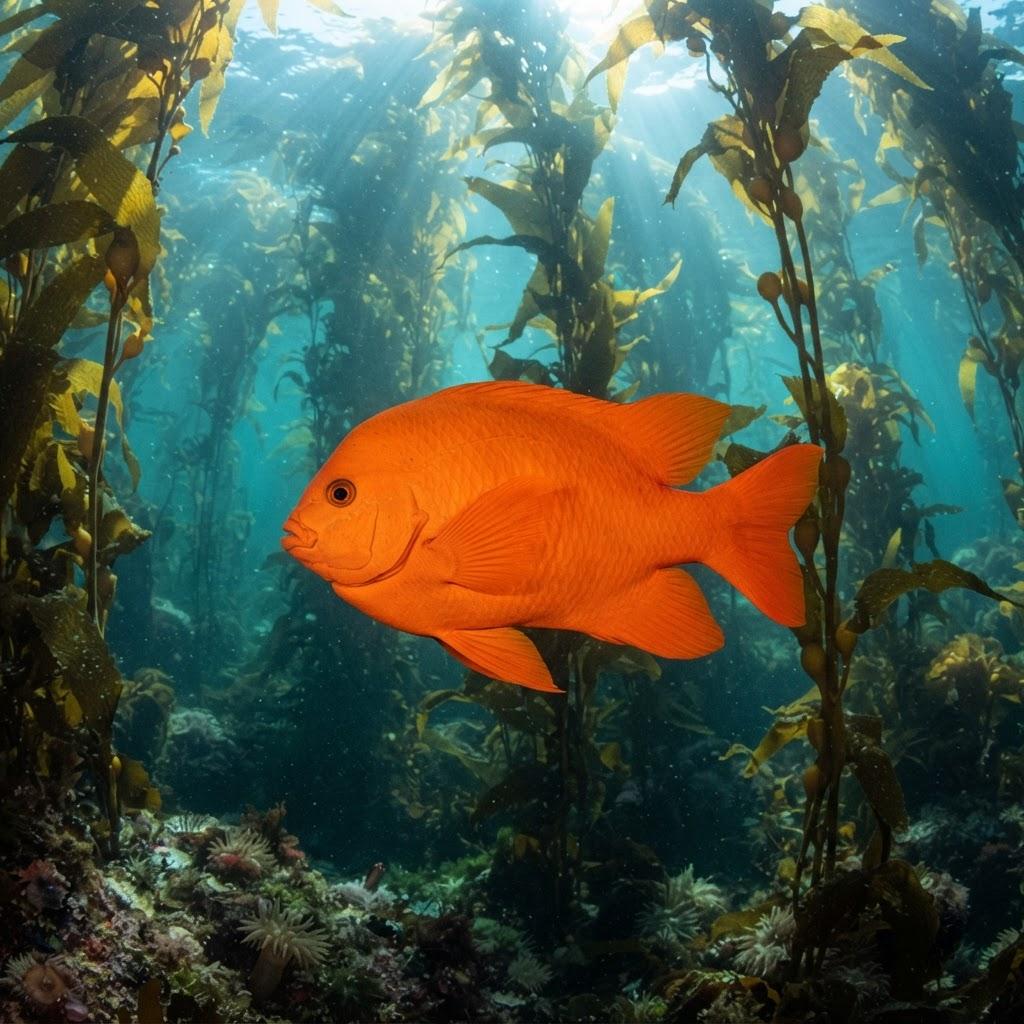
Hypsypops rubicundus
Garibaldi
Meet the Garibaldi, California's official marine state fish, who acts like a tiny, orange-clad bouncer protecting the neighborhood reef. With an ego twice its size and a penchant for aggressive landscaping, this feisty damsel is the undisputed superstar of the Pacific kelp forest.
Meet the Fish
Imagine walking into a high-end coastal cocktail party wearing the loudest, most neon-orange tuxedo imaginable, and then acting like you own the building. That is the Garibaldi in a nutshell. This fish is not just bright; it is a walking traffic cone with an attitude problem. As California's official state marine fish, the Garibaldi is the kind of character you cannot miss, even if you are squinting through a foggy diving mask. It is a member of the damselfish family, but calling it a simple damsel is like calling a lion a house cat with a haircut. These fish are intensely territorial, fiercely proud, and seemingly convinced that the entire Pacific Ocean was built specifically for their own personal enjoyment. Whether it is darting between kelp stalks or staring down a scuba diver who got a little too close to its living room, the Garibaldi carries itself with the swagger of a movie star who just won an Oscar and is not afraid to let you know about it. It is bold, it is brassy, and it is undoubtedly the most vibrant thing you will ever see underwater.
Weird Biological Superpowers Explained Simply
Beyond their glowing orange appearance, Garibaldi have a secret weapon that sounds like something out of a superhero comic book: they are masters of color control and size manipulation. Well, maybe not size manipulation, but they certainly know how to look intimidating. The most fascinating thing about their biology is how they handle the intense sunlight of shallow waters. Because they live in such bright, sunny kelp forests, their scales are built like a high-tech reflective shield. These scales are tough, almost like armor plating, protecting them from the scrapes and bumps of living in a rocky, high-current environment. They also have a unique way of processing oxygen that allows them to remain highly active even when the water temperature dips. Think of it like a biological internal heater that keeps them cruising through the kelp while other fish are sluggishly waiting for the sun to come out. Their ability to remain bright orange at various depths is a marvel of biology, as they have evolved to reflect light in a way that keeps them looking like a neon sign, even when the water turns murky or deep.
Absurd Self-Defense Mechanisms
When you are a bright orange target, you do not exactly excel at the art of camouflage. Instead, the Garibaldi has chosen a different path: intimidation. If a predator, like a curious seal or a hungry bass, dares to wander into its territory, the Garibaldi does not swim away. Oh no, that would be cowardly. Instead, the fish turns into a buzzing, darting, chirping ball of fury. That is right, they actually make noise! By grinding their teeth together, they produce a sharp, percussive sound that warns others to back off. It is basically the underwater equivalent of someone yelling, 'Get off my lawn!' in a high-pitched, gravelly voice. If sound does not work, they put on a display of pure, unadulterated aggression. They will flare their fins, expose their spines, and charge directly at the intruder. They are fully prepared to go to war for a few feet of rock. It is a bluffing tactic that works surprisingly well because most things in the ocean realize that an animal this crazy is probably not worth the trouble of eating.
Fish Drama and Gossip
If the reef had a tabloid newspaper, the Garibaldi would be the headline story every single week. Their social lives are packed with more drama than a primetime soap opera. They are obsessed with status, and the size of their territory is the only currency that matters. You will often see them patrolling the borders of their 'estates' with a level of intensity that would put a security guard to shame. If a neighbor swims an inch too close to the boundary, a chase sequence immediately ensues, complete with aggressive posturing and fin-flaring. It is like watching two neighbors argue over a property line, except both neighbors are wearing highlighter-orange suits and swimming at high speeds. This is not just random violence; it is a complex, high-stakes game of status. Younger, smaller fish have to constantly navigate around the older, larger, and much more irritable 'property owners' who treat the reef like an exclusive gated community where everyone else is an uninvited guest.
The "Wait, That's Real?!" Deep-Sea Oddities
While the Garibaldi loves the shallow, sun-drenched kelp forests, it has some distant cousins living in the deep, dark abyss that would make our orange friend feel like it was living in a luxury penthouse. The deep sea is a place where sunshine is a myth and pressure is intense enough to crush a submarine, yet things like the Barreleye fish exist. This creature has a transparent head—literally, you can see its brain—and green tubular eyes that look straight up to catch the shadows of prey above. Compared to that, the Garibaldi is a suburban homeowner, but they share the same 'neighborhood' in the vast ocean ecosystem. The Garibaldi relies on visual cues and the clear, filtered light of the shallows, while its deep-sea cousins have evolved bioluminescent lures to trick prey into swimming right into their jaws. The Garibaldi is essentially the sunny, loud, extroverted cousin who enjoys bright lights, while the deep-sea fish are the quiet, mysterious, glow-in-the-dark geniuses who prefer to keep their secrets hidden in the dark, silent depths of the midnight zone.
Myth Busting
Let’s squash a few myths. One of the biggest misconceptions about the Garibaldi is that they are just 'pretty decorations' for the reef. People often look at their bright color and assume they are slow-moving or easy targets. In reality, they are some of the most complex, hard-working, and intelligent creatures on the reef. Another common myth is that fish have a three-second memory. Tell that to a Garibaldi that has been guarding the exact same rock for five years. They know their territory like the back of their fins. They recognize the layout of the rocks, the flow of the currents, and even the specific divers who frequent their area. They are not mindless swimmers; they are sophisticated managers of their own little piece of the Pacific. To think they are just swimming around aimlessly is a total disservice to their character. They are precise, they are focused, and they have an memory that puts a lot of forgetful humans to shame. They aren't just fish; they are the architects and rulers of their own domain.
Humorous Historical Tales or Folklore
History has always been fascinated by the sea, but strangely, the Garibaldi has managed to avoid being the subject of terrifying kraken-style myths. Instead, they appear in more recent folklore as the 'ghosts of the kelp.' In early Californian diving circles, because of their bright color, they were often said to be the spirits of old sailors watching over the forests. It is easy to see why. When you are hovering in a quiet, shadowy kelp forest and a brilliant, glowing orange face suddenly zips right up to your mask to inspect your existence, it feels like a ghost from a different world. They have become iconic symbols of the California coast, represented in local art, logos, and even sports teams. They have transitioned from a 'fish you see on a dive' to a cultural icon. There is something inherently human about giving a fish a personality, and because the Garibaldi acts so much like a little person, it is no wonder they have found their way into our stories as the sassy guardians of the underwater kingdom.
Underwater Love Stories and Bizarre Romances
Romance for the Garibaldi is an absolute circus. When it is time to find a partner, the male does not just send a bouquet of flowers; he spends months transforming his home into a masterpiece. He spends hours picking off algae, clearing away debris, and polishing his rock until it is a pristine stage for his future bride. Once the rock is ready, he starts the dance. He swims in tight circles, dashing toward the female and then zipping back to his rock, as if to say, 'Look at my place! Look how clean it is! Please, for the love of the ocean, come look at the algae-free zone I built for you!' It is a high-pressure, high-energy courtship display that would be exhausting for anyone. If the female is impressed by his landscaping skills and his general intensity, she lays her eggs on his meticulously scrubbed rock. It is a brutal, high-stakes dating game where the most well-kept rock usually gets the girl, and the rest are left to continue their frantic cleaning duties alone.
Underwater Architecture and DIY Nesting
The construction phase of the Garibaldi’s life is perhaps its most impressive feature. These fish are the contractors of the reef. They spend an incredible amount of time 'gardening' their territory. They will bite off long strands of invasive algae, carefully clearing patches of rock to ensure the perfect spot for egg-laying. This isn't just about cleaning; it is about creating a specific ecosystem. They cultivate certain types of red algae, trimming them to a specific height as if they were maintaining a manicured lawn. By creating these 'nests' of perfectly trimmed algae, they provide a safe, oxygen-rich environment for the eggs to develop. It is a level of environmental engineering that you really don't expect from a fish. They are not just living on the reef; they are actively shaping it, turning a jagged, chaotic rock face into a curated, beautiful nursery. If you look closely at a Garibaldi’s home, you will see it is far cleaner and more organized than your average roommate’s kitchen.
The Chaos of Raising Tiny Swimmers
Parenting, for the Garibaldi, is a full-time, high-stress job that would make any human parent shudder. Once the eggs are laid, the father takes his role as the protector to an extreme level. He spends every waking second guarding those eggs, chasing away anything—and I mean anything—that gets too close. He is like a one-fish army. He fans the eggs with his fins to keep them oxygenated, ensuring they get the best possible start. It is a relentless, exhausting routine that lasts until the eggs hatch. The moment the tiny, translucent fry emerge, they have to fend for themselves in the vast, dangerous ocean. The father has done his part: he built the home, he protected the nursery, and he defended the nest against all odds. It is a cycle of intense, singular focus. The fry are basically on their own the moment they swim away, starting their own chaotic, orange-tinted lives in the kelp forest, eventually finding a rock of their own to guard, groom, and brag about.
How to Spot One & How It Is Doing
If you want to see a Garibaldi in person, it is actually quite easy. Head to the shallow, rocky reefs of Southern California, put on a mask and snorkel, and look for the brightest thing in the water. You really cannot miss them; they are literally glowing orange. They are usually found in areas with plenty of kelp and rocky crevices. If you see one, give it some space—not because it is dangerous, but because it is busy working. As for how they are doing, the good news is that the Garibaldi is currently thriving. Thanks to protective laws in California, they are no longer harvested for the aquarium trade, which was a huge problem in the past. Their numbers have rebounded beautifully, and they are a shining example of what happens when we give nature a chance to recover. So, the next time you are near the coast, think about the little orange bouncer on the reef. Support local marine sanctuaries, keep the water clean, and maybe, if you are lucky, you will get a front-row seat to the most dramatic fish show on earth.