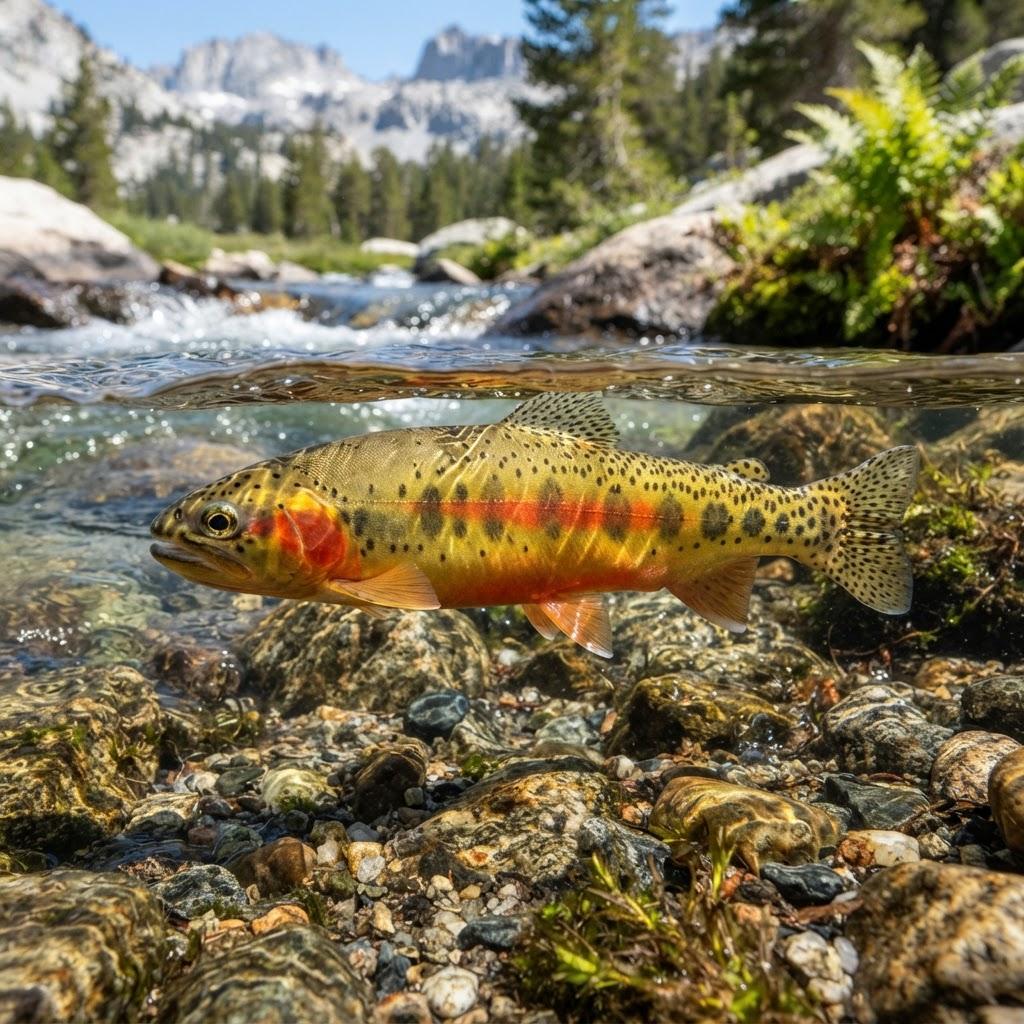
Oncorhynchus aguabonita
Golden Trout
Meet the Golden Trout, the absolute supermodel of the mountain streams who wears a neon suit to work every single day. This fish is a high-altitude diva that turned living in freezing water into a high-fashion statement.
Meet the Fish
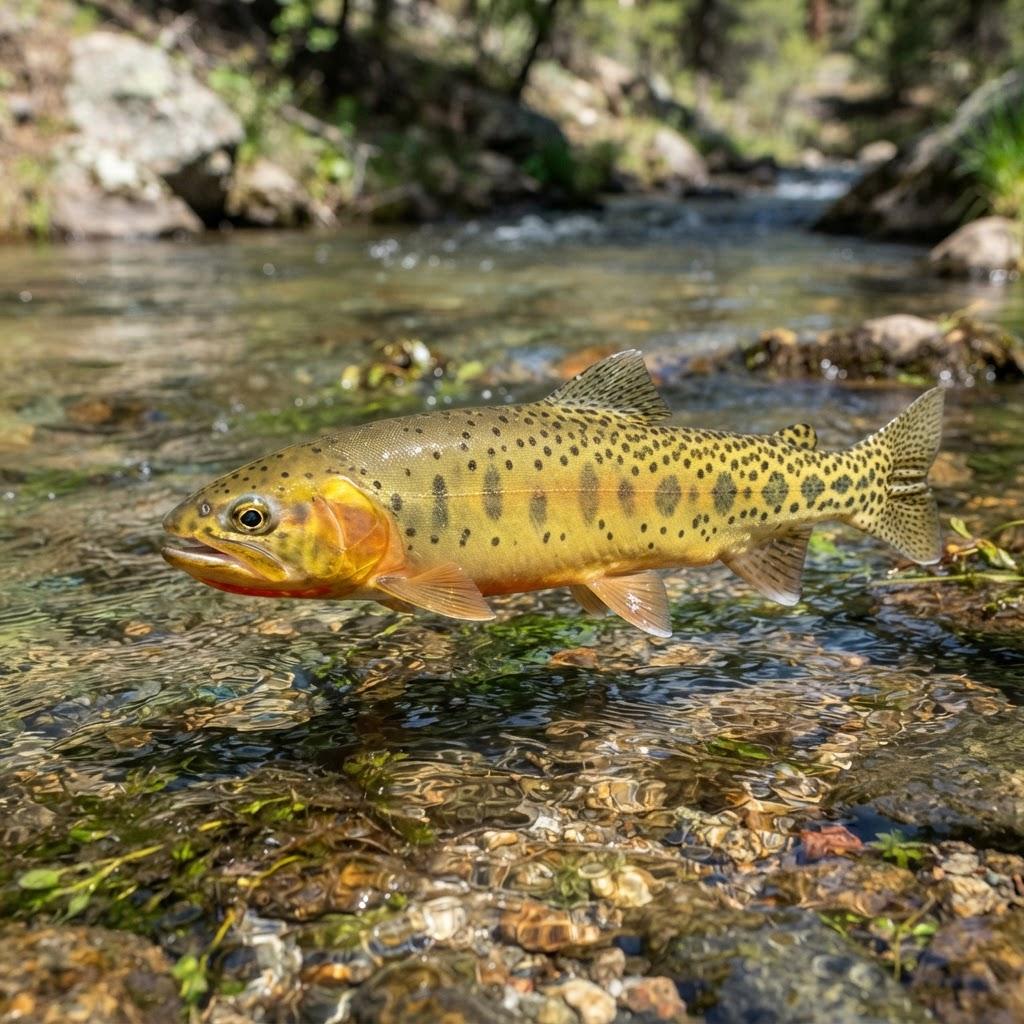
Imagine you are walking through the breathtaking, icy corridors of the high Sierras, your lungs burning from the altitude and your brain foggy from the thin air. Suddenly, you look down into a crystal-clear pool, and it is like someone dropped a freshly polished gold bar mixed with a box of Crayola markers into the water. Enter the Golden Trout, the undisputed king of aesthetic excellence in the trout world. This fish does not just swim; it struts. It is the fashion icon of the Salmonidae family, sporting a brilliant, incandescent gold belly that shimmers like a sunken treasure chest. Its flanks are kissed with a vibrant, horizontal red stripe, accented by spots that look like they were painted on by a tiny, very precise underwater artist. It is the kind of fish that makes other, drabber trout look like they are wearing last season’s dusty sweaters. Living life above 10,000 feet, this fish is essentially a high-altitude mountaineer that decided to prioritize glamor over everything else, making every casual observer pause in total awe.
Weird Biological Superpowers Explained Simply
The Golden Trout is essentially an elite cold-weather athlete, but its real secret weapon is its ability to process oxygen in an environment that would turn a lesser fish into a frozen block of ice. Think of the water in these mountain streams like a smoothie that has been left in the freezer for too long. Because this trout lives at such extreme altitudes, the water is packed with high levels of dissolved oxygen, and the Golden Trout has evolved gills that are basically turbo-charged, high-efficiency filters. While a human might pass out from the lack of air pressure up here, the Golden Trout is just vibing, using its specialized blood chemistry to suck up oxygen molecules like they are the last sips of a milkshake. It is essentially a master of extreme climate adaptation, possessing a metabolism that acts like a biological heater. It keeps its internal systems humming perfectly while everything around it is literally freezing solid, which is basically the equivalent of you sitting in a walk-in freezer wearing a swimsuit and feeling perfectly comfortable.
Absurd Self-Defense Mechanisms
If you are a fish that looks like a literal nugget of gold, you might think you are asking to be eaten by every hungry bear or predatory bird in the forest. You would be right, which is exactly why the Golden Trout relies on the most advanced defensive tactic in the wild: being incredibly, frustratingly fast and hyper-aware. They are not hiding behind clouds of slime or inflating like spiky beach balls; instead, they operate like a secret agent with ultra-fast reflexes. The moment a shadow flickers over the surface—whether it is a suspicious cloud or a hungry osprey—this fish has already vanished into the shadows of a submerged rock. Their reaction time is so rapid that it puts your smartphone’s processor to shame. By blending into the dappled sunlight of their shallow, rocky homes, they become masters of the 'now you see me, now you don't' game. It is a defense based on pure, unadulterated speed, ensuring that by the time a predator figures out what it is looking at, the Golden Trout is already three pools away, probably laughing about it.
Fish Drama and Gossip
The social life of a Golden Trout is basically a high-stakes game of Monopoly played in a freezing mountain stream. These fish are not exactly the collaborative types; they are intensely territorial, believing that every prime patch of gravel is rightfully theirs. Imagine a bunch of glittery, angry teenagers fighting over the best seat in the cafeteria, except the cafeteria is a mountain stream and the 'seats' are prime feeding lanes where the current brings the food straight to their mouths. If a younger or smaller trout wanders into the neighborhood, the dominant fish will put on a display of dominance that is pure reality TV material. They arch their backs, flare their gills until they look twice as big, and perform aggressive, darting charges that scream, 'This is my stream, get your own!' It is a constant, dramatic cycle of posturing, intimidation, and territorial boundary disputes that would make a soap opera producer green with envy. There are no BFFs here, just rivals who are perpetually trying to one-up each other's feeding spots.
The "Wait, That's Real?!" Deep-Sea Oddities
While the Golden Trout is a mountain dweller, it is fun to look at its distant deep-sea cousins to realize how much the ocean is basically an alien planet. Think about the barreleye fish, which has a transparent head—a literal see-through dome—that lets you look inside its skull at its bright green, tubular eyes. Or consider the dragonfish, which uses bioluminescence to lure prey in the total darkness of the midnight zone, essentially walking around with a built-in neon sign that says 'Eat here!' The Golden Trout, by comparison, is like the sensible, well-lit suburban house compared to the haunted, glowing rave happening in the abyss. While the deep-sea fish have to deal with the pressure of miles of water crushing down on them, the Golden Trout deals with the thin, crisp reality of mountain life. The deep sea is a place where you grow giant teeth or become invisible just to survive, whereas the Golden Trout has opted for the strategy of 'look fancy and stay in the cold,' which is arguably just as wild when you consider the freezing conditions they call home.
Myth Busting
There is a long-standing myth that fish are just mindless swimming blobs with the memory span of a goldfish, which is frankly insulting. If you have ever tried to catch a Golden Trout, you would know better immediately. These guys have memories like a steel trap. If you make a mistake—like tripping on a rock near the water or casting your line too loudly—they remember that interaction for a long time, often becoming 'spooky' or hyper-cautious for days. It is not just instinct; it is a calculated, cognitive choice. Another myth we have to put to bed is that they are just passive, floating objects. In reality, they navigate complex current dynamics that would confuse a human kayaker, using their fins to 'steer' against heavy flow with the precision of a high-end sports car. They are not mindless; they are highly attuned, smart, and often much more observant than the person standing on the bank holding the fishing rod, wondering why they haven't caught anything yet.
Humorous Historical Tales or Folklore
The history of the Golden Trout is a story of accidental fame and frantic human intervention. Back in the day, the Golden Trout was only found in a few tiny, isolated creeks in the Kern River Basin. Humans, being humans, were absolutely obsessed with these glowing, beautiful fish. In the early 1900s, people were literally packing these trout into milk cans and hauling them over mountain passes on the backs of mules just to put them in other lakes. It was like a 19th-century version of an exotic pet delivery service gone rogue. There are tales of legendary fishing guides who swore that catching a Golden Trout would bring good luck for a year, though usually, the 'luck' just involved getting a terrible sunburn and a pair of very wet boots. They became the 'trophy' that every sportsman wanted, leading to a frantic era of 'fish moving' that changed the map of the Sierras forever. It is a bizarre piece of environmental history where these fish were treated like living gold bullion, moved around the mountains as if they were actual treasure.
Underwater Love Stories and Bizarre Romances
Love in the high Sierras is all about the mating dance. When spring rolls around and the water starts to get that special 'it is time to procreate' temperature, the Golden Trout undergoes a personality shift that is truly dramatic. The males stop worrying about their feeding lanes and start focusing entirely on the ladies. The courting process is a high-speed, choreographed ballet that involves a lot of fin-fluttering and body-shaking. The male will swim circles around the female, showing off his colors like a guy at a high school dance showing off his new leather jacket. It is a test of stamina and genetic quality. The female is the ultimate judge, watching these displays and deciding which suitor has the best dance moves and the brightest colors. If she is impressed, they get down to business in the gravel; if she is bored, she just swims away, leaving the poor guy to reflect on his failed performance. It is a cold, calculated, and high-energy drama that plays out in the freezing silence of the mountain pool.
Underwater Architecture and DIY Nesting
When it comes to nesting, the Golden Trout is a meticulous perfectionist. They do not just lay eggs on a random rock; they build what is known as a 'redd,' which is a fancy word for a gravel nest. The female uses her tail to fan away the silt and mud from the bottom of the stream, essentially scrubbing the floor until the gravel is perfectly clean. It is like watching a homeowner prep a room for renovations. She creates a deep, bowl-shaped depression that will protect her future offspring from being washed away by the current. It is a serious project that requires hours of intense physical labor, digging and clearing, digging and clearing. While she does the heavy lifting, the male is usually hovering nearby, keeping an eye out for 'intruders' (or just other guys trying to sneak in). Once the nest is ready, it is a piece of underwater engineering meant to ensure that the delicate eggs have the best possible chance of survival against the freezing, rushing water.
The Chaos of Raising Tiny Swimmers
Once the eggs are laid and fertilized, the Golden Trout parents essentially say 'good luck' and move on with their lives. There is no cozy mouth-brooding daycare center here; the eggs are left in the gravel nest to fend for themselves. This is the 'hope for the best' strategy of parenting. The fry, or tiny baby trout, hatch and have to survive on a yolk sac attached to their bellies for the first few weeks, which basically serves as a pre-packed lunch. Once that runs out, they are on their own in a world full of hungry things, including their own older cousins. It is a brutal, high-stakes initiation into life. Watching thousands of tiny fry emerge is like witnessing a massive, chaotic parade of miniature, semi-transparent specks trying to learn the rules of the stream. Many do not make it, but the ones that do are the toughest of the tough. It is nature’s way of ensuring that only the most resilient and clever little fish make it to adulthood, which is why these trout are so incredibly good at what they do.
How to Spot One & How It Is Doing
If you want to spot a Golden Trout, you need to go where the air is thin and the water is pure. Look for high-elevation streams or alpine lakes in the Sierras. Bring a pair of high-quality polarized sunglasses—this is non-negotiable, as they will cut through the glare of the water and let you see the neon gold flash of the fish beneath the surface. They are skittish, so move slowly and avoid casting a long, frantic shadow over the pool. Currently, the Golden Trout is classified as 'Vulnerable.' They are fighting a tough battle against invasive species that compete for their food, as well as the warming climate that is threatening their icy homes. The good news? You can help. Support local conservation groups in California that focus on protecting these mountain stream habitats. Keep streams clean, follow catch-and-release rules if you are fishing, and simply spread the word about how cool these little mountain fashionistas are. The more people who care about them, the better their chances of staying gold for future generations.