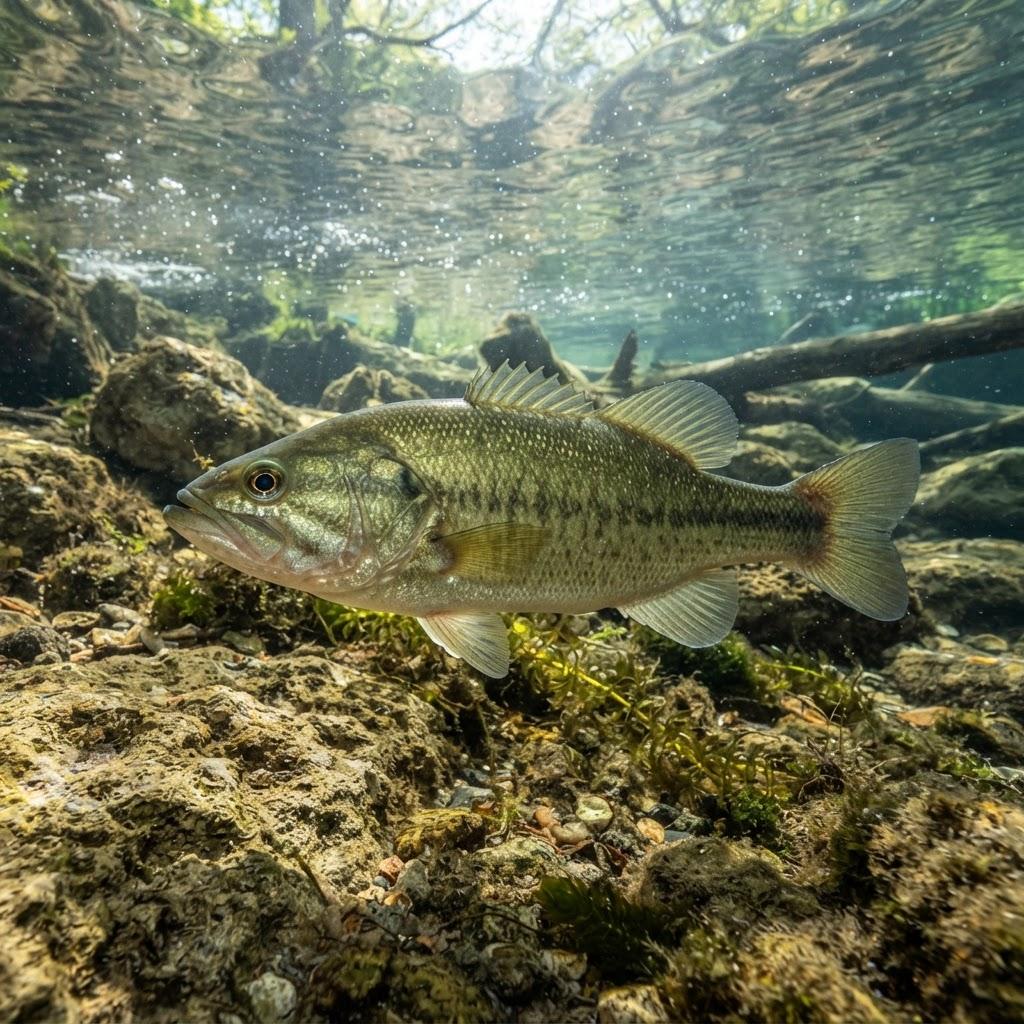
Micropterus treculii
Guadalupe Bass
Meet the Guadalupe Bass, the pugnacious little cousin of the largemouth bass that rules the clear, rocky streams of Texas. This feisty fighter is a regional icon with a major attitude problem and a surprising flair for survival.
Meet the Fish
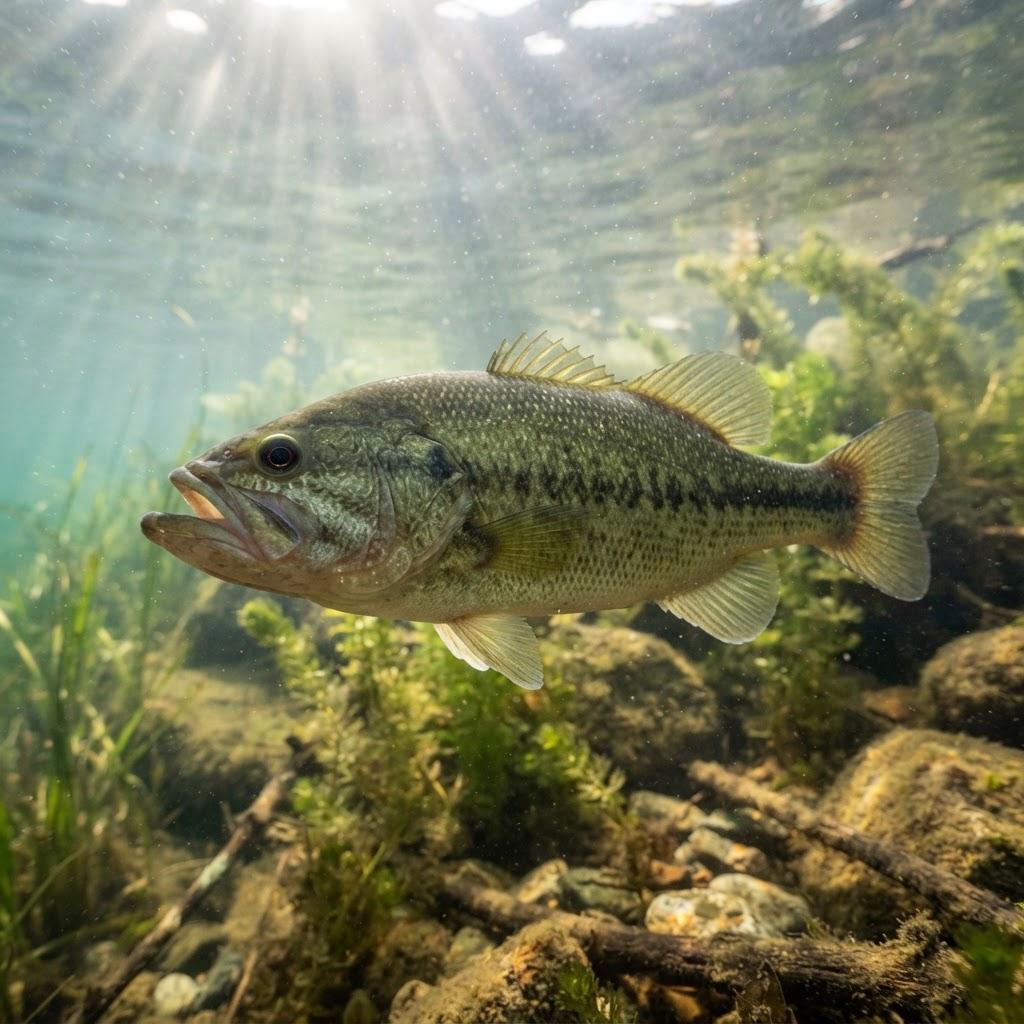
If you were to head down to the sparkling, limestone-lined rivers of the Texas Hill Country, you might expect to find a massive, gluttonous lunker of a bass waiting to snap your fishing line. Instead, you are far more likely to encounter the Guadalupe Bass, a fish that is essentially the 'cool kid' of the Centrarchidae family. Imagine a fish that treats every rushing current like a personal gym where it does CrossFit until it passes out. The Guadalupe Bass is the embodiment of 'small but mighty.' While its cousins in the big, murky lakes are out there getting fat and lazy eating giant meals, the Guadalupe Bass is a lean, mean, stream-dwelling machine. It possesses a sleek, bronzed physique that looks like it was polished with automotive wax. With its signature row of dark, blotchy diamonds running down its sides, this fish carries itself with a level of confidence that is honestly kind of intimidating for something that barely clears a foot in length. It is the fish version of a tiny, jacked personal trainer who yells at you to do more reps while you struggle to keep your head above water. It is fast, it is tactical, and it has an ego that could fill a stadium.
Weird Biological Superpowers Explained Simply
While other fish are busy evolving glow-in-the-dark appendages to lure in snacks like some sort of neon-lit bait shop, the Guadalupe Bass has mastered the art of the 'High-Speed Hydrodynamic Hustle.' Its primary superpower is its lateral line—a sensory organ that runs down its body like a top-secret fiber optic cable. This isn't just a stripe; it is a high-sensitivity motion detector that can feel the difference between a falling leaf and a delicious minnow trying to sneak by in the dark. It is like having a superpower that lets you feel the vibrations of a mosquito’s wings from three rooms away. Additionally, this bass is a master of rapid acceleration, using specialized white muscle fibers that act like a nitrous oxide tank in a sports car. When it decides to strike, it goes from zero to hero in a fraction of a second, snapping its jaw with such velocity that it creates a localized vacuum, sucking its prey directly into its mouth before the poor victim even has time to wonder what happened. It is pure, unadulterated physics working in the most violent, efficient way possible.
Absurd Self-Defense Mechanisms
When you are a pint-sized predator living in shallow water, you don't have the luxury of being a slow-moving giant. You have to be a tactical genius. The Guadalupe Bass doesn't rely on toxic slime or spikes that can pop a balloon; instead, it uses the art of 'aggressive camouflage' and 'evasive maneuvering.' Its coloration is a masterful piece of evolution—the mottled green and brown patterns are designed to perfectly mimic the light dancing on the pebbled bottom of a river. When a heron or a larger, less intelligent fish comes swooping in, the bass just flickers its fins and vanishes into the visual noise of the stream bed. It effectively turns invisible while standing right in front of you. If an attacker gets too close, it uses a sharp, sudden burst of speed to dive into the craggy, jagged rock crevices that litter its home turf. Imagine a ninja hiding in a wall; it finds a hole, wedges itself in with its spiny dorsal fins locked into place like a grappling hook, and sits there waiting for the danger to pass. It is the ultimate game of hide-and-seek.
Fish Drama and Gossip
The social life of a Guadalupe Bass is essentially a high-stakes, underwater soap opera where the lead actor is always looking to pick a fight. These fish are remarkably territorial. They do not do 'sharing.' If another fish enters their patch of prime current, the Guadalupe Bass doesn't just ask them to leave; it engages in a full-scale psychological warfare campaign. They flare their gills, turn their bodies to look as large and menacing as possible, and do a slow, aggressive 'death dance' around the intruder. It is the aquatic equivalent of puffing out your chest in a crowded bar. Sometimes, these interactions escalate into high-speed chases through the weeds. They are constantly jockeying for position near the best 'feeding lanes'—those spots in the river where the current delivers a buffet of bugs and baitfish like an endless conveyor belt. There is no such thing as a relaxed afternoon in the river when your neighbor is a hyperactive, territorial jerk who considers the entire log under the bridge his personal real estate.
The "Wait, That's Real?!" Deep-Sea Oddities
While our friend the Guadalupe Bass is busy conquering the shallow, sun-drenched streams, we have to pause and marvel at its cousins in the deep, dark abyss. The deep sea is a place where things get weird—fast. Think of the Guadalupe Bass as a sensible commuter car, while the deep-sea fish are like monster trucks designed by an artist on a fever dream. Down in the twilight zone, fish don't just swim; they hover like space stations, many sporting bioluminescent 'lures' that look like festive party lights hung by a deranged decorator. Some deep-sea fish have transparent skulls because, why not? Others have teeth so large they cannot actually close their mouths. While the Guadalupe Bass relies on bright sunlight and clear water to see its lunch, the deep-sea critters have evolved massive, telescope-like eyes to catch a single photon of light from miles away. It makes the river life of the bass seem almost quaint, but honestly, you have to respect the bass for choosing the path of the sunlight rather than hanging out in a place that looks like a spooky alien basement.
Myth Busting
Let’s clear the air: there is a long-standing myth that fish are essentially mindless, swimming vegetables with memories that last exactly three seconds. This is absolutely, 100% false, especially when it comes to the Guadalupe Bass. This fish is a genius of its environment. It learns the specific patterns of the water, it knows exactly which rocks offer the best protection, and it can absolutely learn to identify danger. If you fish for them, you will quickly find that they are not 'dumb fish' that will bite anything. They are wary, calculated, and observant. If they see a shadow looming over the surface that looks suspiciously like a human, they will simply refuse to cooperate. They have a spatial memory that would put most of us to shame—they know the layout of their home range better than we know the floor plan of our own houses. They are not mindless, they are just playing the long game. The next time someone tells you fish don't have personality or intelligence, tell them to try outsmarting a Guadalupe Bass in its home stream.
Humorous Historical Tales or Folklore
Folklore around the Guadalupe Bass is tied deeply to the spirit of the Texas Hill Country. For generations, locals have treated these fish with a kind of reverent annoyance. There is an old legend that the Guadalupe Bass was originally a much larger, more terrifying monster that tried to drink the entire Guadalupe River dry, only to be cursed by a thirsty tumbleweed to be small forever. While that is clearly a tall tale told by folks sitting on a porch with too much sweet tea, it speaks to the personality of the fish. It is a 'big fish' personality packed into a 'small fish' frame. There are also old-timey accounts from frontier days suggesting that the bass were so aggressive that they would snatch dragonflies right out of the air, leading some early settlers to wonder if the fish were evolving into birds. It is all part of the local mythology that keeps the Guadalupe Bass as the unofficial mascot of the clear, cool springs that define the region’s landscape.
Underwater Love Stories and Bizarre Romances
Courtship for the Guadalupe Bass is far less 'candlelight dinner' and far more 'intense fitness challenge.' When spring hits and the water temperatures rise, the males decide it is time to find a partner. The male bass clears a circular area on the riverbed, meticulously cleaning off every bit of loose debris until it is as smooth as a marble floor. He then struts around this nest like a proud peacock, flashing his brightest colors to any passing female. If a female finds his cleaning job impressive—and trust me, she is very picky about the quality of the sand—she will join him. The pair will engage in a synchronized swimming routine that looks like a high-speed ballet of flicking fins and tight turns. It is a dramatic, high-energy display meant to ensure that only the most fit, capable, and fast-moving fish get to pass on their genes. If he messes up the dance or his nest isn't perfectly round, the female will just keep swimming, and he is back to the drawing board.
Underwater Architecture and DIY Nesting
When we talk about the Guadalupe Bass as an architect, we are talking about a fish that takes home maintenance seriously. They are the 'do-it-yourself' enthusiasts of the river. The male identifies a spot with just the right flow—not too fast, not too slow—and begins the excavation. They use their tails to fan away silt and muck, exposing the clean gravel and rocks underneath. This is crucial because if the eggs sit on mud, they suffocate. He is essentially building a specialized nursery designed to keep the water oxygenated and clean. The result is a perfect, concave depression that functions as a high-tech incubator. It is not just a hole in the dirt; it is a carefully curated masterpiece of hydrologic engineering. Watching a male spend hours obsessing over the placement of a single pebble is a humbling experience. He is basically the HGTV host of the river, obsessed with curb appeal, structural integrity, and making sure the nest is exactly right for the arrival of the next generation.
The Chaos of Raising Tiny Swimmers
Once the eggs are laid in that custom-built, luxury rock nursery, the real chaos begins. The male takes on the role of a hyper-vigilant security guard. He doesn't go to sleep, he doesn't take lunch breaks, and he doesn't tolerate visitors. He guards the nest with the intensity of a dragon protecting a gold hoard. Anything—and I mean anything—that wanders too close gets chased off. When the eggs finally hatch, the tiny fry are like a swarm of hyperactive dust motes. They don't just swim; they drift in a swirling, frantic cloud that looks like a living, breathing liquid. The father stays nearby, hovering like a nervous helicopter parent, darting in to snap at anyone who gets a little too curious about his children. It is a dangerous world for a fry, with every other predator in the river seeing them as a light snack, but the Guadalupe Bass father is a relentless protector. It is a high-stress, high-stakes game of survival where the only thing that matters is keeping the cloud moving.
How to Spot One & How It Is Doing
If you want to catch a glimpse of this Texas legend, you need to head to the clear, rocky rivers of the Edwards Plateau. Look for areas with gentle currents, limestone rocks, and clear water where you can see the bottom. If you see a fish that looks like a bronzed, athletic version of a largemouth bass with those distinctive, jagged dark blotches, you have found one. Sadly, the Guadalupe Bass is currently considered Near Threatened. The primary issue isn't just one thing, but a mix of habitat loss and, weirdly enough, its own relatives. Sometimes, non-native bass species get introduced to the same waters and start breeding with the Guadalupe Bass, diluting their unique genetic identity. The best way to help is simple: support organizations that protect the water quality of Hill Country rivers and stick to catching-and-releasing them if you go fishing. They are a treasure of the Texas wild, and by keeping their rivers clean and their bloodlines pure, we ensure they stick around to keep being the feisty, pint-sized terrors we love.