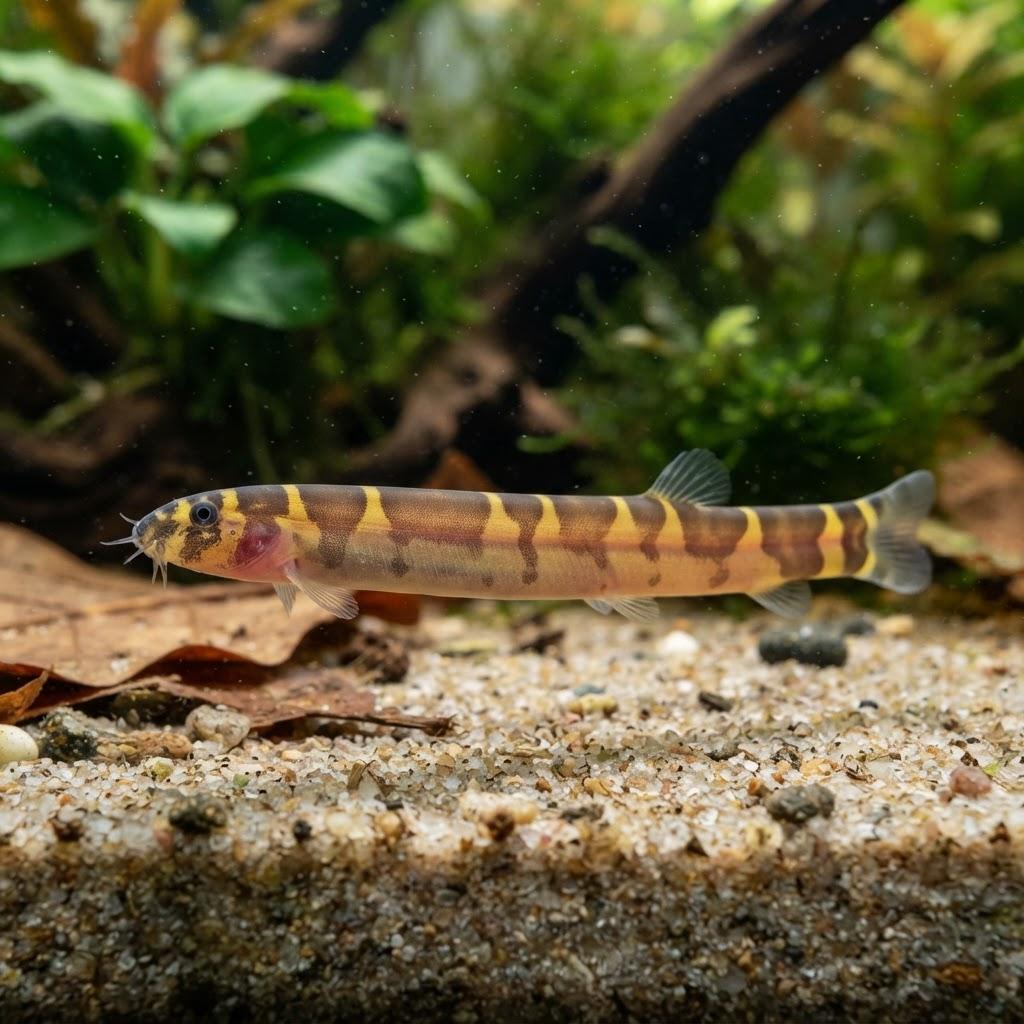
Pangio kuhlii
Kuhli Loach
Meet the Kuhli Loach, the underwater world's favorite wiggly noodle that prefers hiding in the sand to being a star. Part eel, part zebra, and 100% shy, this fascinating creature is the ultimate aquatic prankster.
Meet the Fish
Imagine a gummy worm decided to evolve, grew a pair of eyes, and then spent its entire life questioning its own existence. That is the Kuhli Loach. If you have ever looked into a freshwater aquarium and wondered why the sand was moving on its own, congratulations, you have encountered the most elusive wiggle-noodle in the business. These creatures look like they escaped from a coloring book where someone forgot to finish the stripes, opting instead for a haphazard mix of chocolate brown and salmon pink. They are built like a wet ribbon, designed specifically to slide into the tiniest crevices that other fish wouldn't even dream of entering. They have a vibe that can only be described as 'mildly confused Victorian ghost' combined with 'I am definitely hiding a secret.' While their goldfish neighbors are busy bumping into glass, the Kuhli Loach is busy plotting its next stealth mission. They are the ninjas of the substrate, moving with a fluid, serpentine grace that makes them seem less like a fish and more like a liquid. They do not swim so much as they slither, turning the bottom of the tank into their own personal slip-and-slide. If they were at a party, they would be the ones hiding behind the curtains, peaking out occasionally to see if there is any food, and then immediately retreating into the shadows to avoid social interaction. They are quirky, weird, and absolutely delightful.
Weird Biological Superpowers Explained Simply
While other fish are busy evolving fancy fins or flashy colors, the Kuhli Loach has mastered the art of being a biological Swiss Army knife for tight spaces. Their superpower is literally being made of jelly-like flexibility. Unlike most fish that have a rigid skeleton that acts like a cage, the Kuhli Loach has a skeletal structure that is so loosely organized it seems like a suggestion rather than a rule. This allows them to compress their bodies into cracks in driftwood or burrow into sand with the ease of a submarine entering a dock. They possess specialized barbels, which are essentially long, sensitive whiskers around their mouths. Think of these as high-tech sensory antennas that can taste and feel the environment. In the murky waters of Southeast Asia, these whiskers function like a blind person’s cane, detecting the tiniest vibrations or bits of organic matter in the sediment. It is not quite magic, but it is close. They essentially taste the world through their faces, allowing them to scavenge for dinner in complete darkness without ever bumping into a rock. They have effectively mastered the art of eating lunch while keeping their eyes closed, which is a talent most humans would kill for during a stressful work week.
Absurd Self-Defense Mechanisms
If you are a predator and you try to snap up a Kuhli Loach, you are going to have a very bad day. These fish come equipped with subocular spines, which are essentially hidden daggers located right under their eyes. When they feel threatened, they can flare these little spikes out like a tiny, aquatic version of a switchblade. It is a bold move for a fish that looks like a sentient piece of licorice. When a larger fish tries to swallow them, the Kuhli Loach makes itself incredibly difficult to consume by flaring its spines, which often get stuck in the predator’s throat. It is the fish equivalent of a person wearing a sweater covered in cactus needles to discourage hugs. If that isn't enough, they are masters of the 'vanishing act.' They can dive headfirst into soft sand, effectively burying themselves alive until the coast is clear. One moment you are looking at a fish, the next moment you are looking at a slightly disturbed patch of sand. It is a masterclass in invisibility that would make a spy proud. They do not believe in standing their ground; they believe in becoming one with the floorboards until the scary thing goes away, which is a life philosophy we can all learn from when our emails get too stressful.
Fish Drama and Gossip
Life in the Kuhli Loach neighborhood is remarkably low-key, but do not let that fool you into thinking they are boring. Their social structure is like a quiet, underground book club where nobody actually reads the book and everyone just naps instead. They are gregarious little creatures, preferring the company of their own kind to hanging out with the flashy, egotistical bettas or the hyperactive tetras. If you keep them alone, they get incredibly depressed, turning into the aquatic equivalent of an emo teenager listening to sad music in a dark room. However, put them in a group of six or more, and suddenly it is a non-stop, wiggly party. They engage in what hobbyists call 'loach racing,' where they zoom up and down the glass like they are trying to reach the surface to tell the humans about the lack of snacks. They have a hierarchy of sorts, but it is very passive-aggressive. Instead of fighting for territory, they just pile on top of each other like a noodle-based game of Jenga. You will often see them resting in a heap of tangled bodies, looking for all the world like a bowl of overcooked spaghetti that has somehow gained sentience and a love for deep-sea naps.
The "Wait, That's Real?!" Deep-Sea Oddities
While the Kuhli Loach is a shallow-water dweller, it is effectively the 'deep-sea alien' of your living room. When you look at the deep-sea abyss, where creatures like the barreleye fish have transparent heads just to get a better view of their own eyeballs, you realize that the ocean is full of weird design choices. The Kuhli Loach shares that same bizarre, 'who designed this?' energy. Deep-sea fish often utilize bioluminescence, turning themselves into living glow-sticks to survive the absolute darkness of the midnight zone. The Kuhli Loach, meanwhile, doesn't need to glow because it has evolved to be so streamlined that it can hide in the gaps between pebbles where no light would ever dare to go. Comparing the Kuhli to deep-sea monsters is like comparing a stealth bomber to a giant, glowing jellyfish. One is a high-tech machine designed to be invisible, while the other is a chaotic explosion of light and tentacles. Both, however, serve as a reminder that nature has absolutely no qualms about making things look as strange as possible. The Kuhli Loach is essentially a reminder that you don't need to go to the Mariana Trench to find something that looks like it came from another planet; you just need to look at the bottom of a stream in Indonesia.
Myth Busting
There is a long-standing myth that Kuhli Loaches are purely nocturnal and that you will never see them during the day. This is essentially the fish world's version of 'the dog ate my homework.' People keep them, never see them, and assume they are ghosts. In reality, Kuhli Loaches are just shy, not strictly vampires. If you provide them with enough hiding spots, soft sand, and a comfortable environment, they will gain enough confidence to emerge in the daylight. They are not hiding because they hate the sun; they are hiding because they are terrified of being eaten by the larger, more aggressive tank mates you might have paired them with. Another common misconception is that they are dirty fish that clean the aquarium substrate. While they do scavenge, they are not your personal maid. They need real food, not just the leftovers from the other fish's dinner plate. Treating them like a living vacuum cleaner is a great way to end up with a malnourished, grumpy noodle. Give them their own high-quality sinking pellets, and you will see a much more active, healthy, and happy creature that is far more than just a glorified janitor.
Humorous Historical Tales or Folklore
Throughout history, humans have been fascinated by eel-like creatures, often attributing them with mystical powers or equating them to miniature sea serpents. In certain regional folklore of Southeast Asia, loaches are sometimes considered spirits of the riverbanks because of their ability to vanish into the mud at a moment's notice. It is easy to see how an ancient observer, catching a quick glimpse of a striped, wiggly tail disappearing into the muck, might have spun a yarn about a local river sprite. There are no grand legends about Kuhli Loaches bringing prosperity or causing shipwrecks, mostly because they are far too small and self-absorbed to care about human drama. However, they hold a special place in the history of the aquarium hobby. Before the internet turned them into internet famous 'noodle-fish,' they were the cryptic, mysterious prize of serious collectors. There was a time when identifying the specific species of Pangio was considered a rite of passage for the elite hobbyist, a task fraught with frustration because, surprise, they all look exactly like slightly different versions of the same stripey ribbon. They are the quiet, unassuming legends of the hobby, respected more for their invisibility than for any heroic exploits.
Underwater Love Stories and Bizarre Romances
Romance for the Kuhli Loach is a chaotic, high-speed chase that makes a high school dance look like a funeral. When the mood strikes them, the males will pursue the females with the relentless energy of a toddler fueled by too much sugar. This 'courtship' usually involves a lot of high-speed darting around the tank, zig-zagging through plants, and eventually, a dramatic belly-to-belly embrace that looks less like a kiss and more like a tactical wrestling hold. The pair will swim together in a tight, swirling dance near the surface or tucked away in a quiet corner of the aquarium. It is truly a sight to behold: two squiggly lines trying to coordinate their movements while vibrating with excitement. They don't have flowers or chocolates, just a frantic, rhythmic dance that communicates everything they need to know. It is intimate, it is fast, and it is entirely focused on the goal at hand. It lacks the long-term commitment of a penguin, but what it lacks in sentimentality, it makes up for in pure, unadulterated velocity. Once the dance is over, they go right back to their normal, solitary napping habits, proving that sometimes even the most passionate romances are just a momentary lapse in judgement.
Underwater Architecture and DIY Nesting
If you are looking for an architectural marvel like the pufferfish's geometric sand-circles, you are looking at the wrong fish. The Kuhli Loach is less of a master builder and more of a minimalist interior designer who prefers the 'exposed pipes and dirt' aesthetic. They do not build castles; they repurpose nature's leftovers. A Kuhli Loach's idea of a dream home is a piece of decaying driftwood with a nice, dark tunnel, or perhaps a thick bed of Java moss where they can tuck themselves away like a secret letter in a library book. They are excellent at burrowing, effectively creating their own underground bunkers in the substrate. They might move a few grains of sand here or there, but they are generally content to let the environment dictate the floor plan. They prefer a house that is sturdy, dark, and difficult for anyone else to find. It is the aquatic equivalent of an introverted author living in a cabin in the woods. They do not want a mansion; they want a hidey-hole with good Wi-Fi, or in their case, good water flow and plenty of snacks. They are the ultimate 'fixer-upper' enthusiasts who prefer to leave things exactly as messy as they found them.
The Chaos of Raising Tiny Swimmers
Parenting is not exactly a high priority for the Kuhli Loach. Once the eggs are laid—usually scattered carelessly amongst dense vegetation—the parents move on with their lives as if the last five minutes of romantic fervor never even happened. There is zero parental guidance, zero school runs, and definitely no fishy college fund. The eggs are tiny, greenish, and sticky, adhering to the undersides of leaves where they are left to face the world alone. When the fry hatch, they are essentially microscopic, translucent slivers of nothingness. They have to fend for themselves from the very first second of life, hiding in the safety of microscopic algae and debris. It is a harsh, chaotic start, but it works for them. They do not need the protection of a hovering parent; they are born with the inherent 'stay hidden' instinct that defines their entire species. Raising them in a tank is notoriously difficult because they are so small that most standard aquarium filters treat them like snacks. It is a high-stakes game of survival where the strongest, smallest, and most elusive noodles survive to grow up and repeat the cycle of being absolutely, adorably weird.
How to Spot One & How It Is Doing
If you want to spot a Kuhli Loach, forget looking for a fish swimming in the open. You need to channel your inner detective. Turn off the bright lights, dim the room, and watch the very bottom of your tank, specifically under the shaded areas or behind rocks. You are looking for a flash of striped movement that disappears as quickly as it arrived. If you see a small, wiggly shadow, you have found one. In the wild, these fish are doing okay, though they are often threatened by the loss of their natural forest stream habitats due to deforestation. Their status is 'Least Concern,' which means they aren't going extinct tomorrow, but that doesn't mean we should take them for granted. To help, focus on keeping your own tanks clean and supporting sustainable pet trade practices. Do not buy fish that were caught in ways that damage the environment. The best way to help is to learn about where they come from and appreciate the fragile, muddy ecosystems that produce such unique, wonderful little noodles. They are living, breathing, striped reminders that nature loves to experiment, and we are just lucky enough to watch the show from the comfort of our couches.