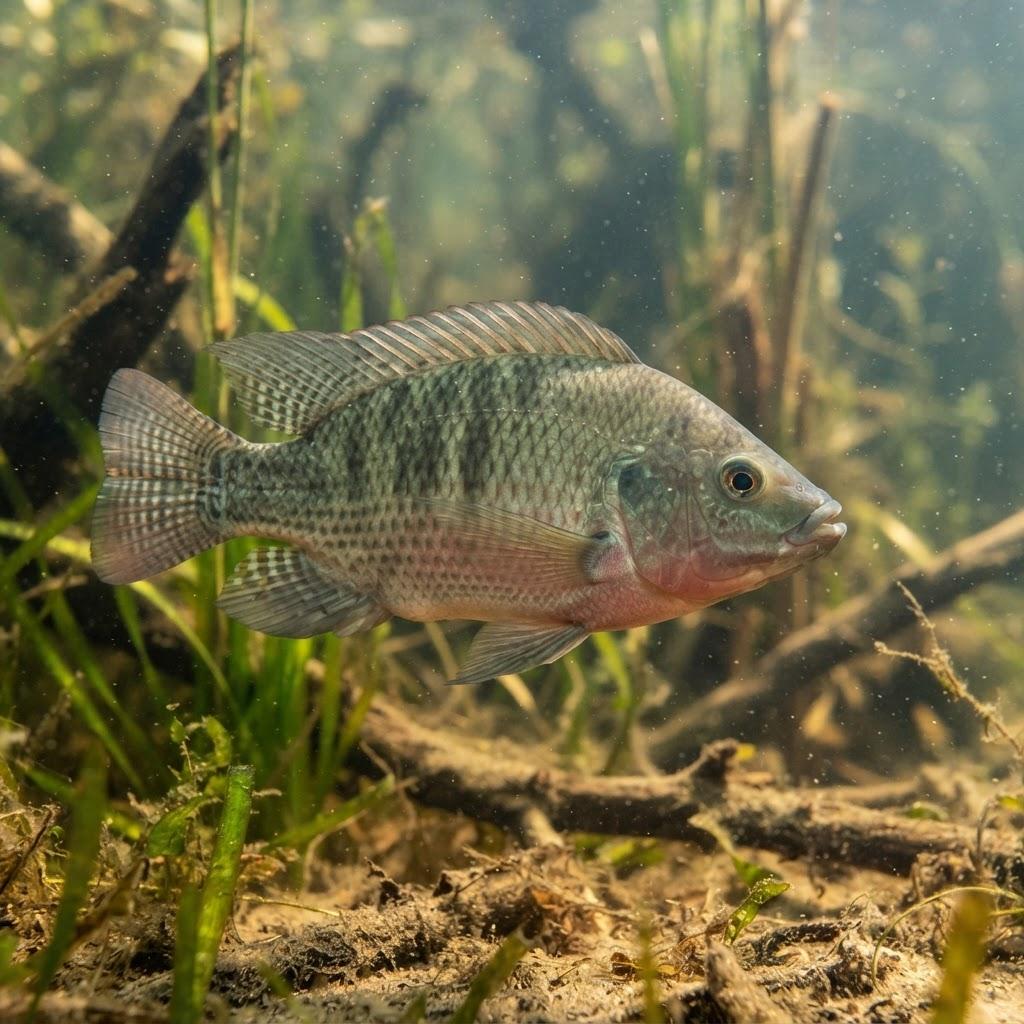
Oreochromis niloticus
Tilapia
Meet the Tilapia, the undisputed king of the freshwater cafeteria and a fish with a parenting style that would make a human stage mom blush. This humble fish is a survivor, a world traveler, and a biological marvel disguised as your favorite Tuesday night dinner.
Meet the Fish
If the ocean were a high school, the Tilapia would be the kid who is in every club, has a job, runs on the track team, and still manages to get straight A's while everyone else is still trying to figure out which locker is theirs. The Tilapia is not here to be mysterious or elusive; it is here to live its best life and take over the neighborhood. Imagine a fish that looks like a shimmering, silver-grey business executive, complete with a perpetually stoic expression that suggests it is always calculating the next best move in the stock market of freshwater ecosystems. This fish is the ultimate opportunist. While other fish might spend all their time worrying about the latest fashion trends in scale patterns or avoiding the social anxiety of the deep reef, the Tilapia is busy eating, growing, and colonizing every pond, stream, and irrigation ditch it can find. It has a vibe that screams 'I am here to stay' and frankly, it is hard to argue with that level of confidence. It does not need to hide in the shadows because it is built to survive just about anywhere you can find a puddle that is warm enough to sustain life. It is the fish version of a cockroach with better manners and a much nicer skin care routine.
Weird Biological Superpowers Explained Simply
Think of the Tilapia as the Swiss Army Knife of the freshwater world. While it might not have the electric zap of an eel or the sonar of a dolphin, it has something far more practical: an immune system that is essentially made of titanium. These fish possess a physiological superpower called phenotypic plasticity, which is just a fancy way of saying they are the ultimate shapeshifters of the survival world. If the environment changes, they just shift their gear. They can tolerate water that has almost no oxygen, water that is salty, and water that is so murky you would need a flashlight to see your own hand in front of your face. It is like if you could go from living in the Antarctic to the Sahara without having to pack a bag or change your clothes. Their metabolism acts like a thermostat that never breaks, allowing them to thrive in fluctuating temperatures that would turn most other fish into frozen snacks. It is a biological miracle that they don't have to spend half their lives complaining about the weather because they are literally built to handle whatever Mother Nature decides to throw at them on any given Tuesday.
Absurd Self-Defense Mechanisms
When you are a tasty morsel in the middle of a lake, you need a plan for when the big predators show up. The Tilapia’s defense is less about 'spiky armor' and more about 'the speed of light.' They have developed a reaction time that would make a professional tennis player look like they are moving in slow motion. When a predator lunges, the Tilapia does not panic; it deploys a burst of speed that is honestly rude. They can dart in a direction so suddenly that they basically disappear from the predator's field of vision. It is the fish equivalent of an disappearing magic trick. Additionally, they have very sturdy, sharp-looking fins that they can lock into place. This makes them feel like a mouthful of cactus if a predator tries to grab them. Nobody wants to eat a prickly, fast-moving target that is actively trying to make you regret your lunch choices. They are basically the 'don't touch me, I am busy' kids of the water. Their defense is not about fighting; it is about making themselves so annoying and difficult to catch that the predator eventually decides to go find a slower, softer-looking snack instead.
Fish Drama and Gossip
Welcome to the real-life underwater soap opera where the stakes are always high. If you watch a school of Tilapia, you are not seeing a group of friends hanging out; you are seeing a complex hierarchy that would make a high school prom queen jealous. The males are the biggest offenders, spending half their day patrolling their personal square footage of riverbed like they are the HOA president of the neighborhood. They flare their fins, change their colors to look as intimidating as possible, and chase away any rival who dares to suggest that maybe, just maybe, they aren't the toughest fish in the pond. It is constant drama. One moment they are grazing peacefully on some algae, and the next, a full-scale territorial war has broken out over a particularly nice rock. They are incredibly social, but their society is built on constant posturing and competition. Every fish is trying to climb the social ladder, and there is never a shortage of gossip or tension in the school. It is exhausting just watching them try to prove who is the king of the castle, but for them, it is just another day of trying to keep their street cred intact.
The "Wait, That's Real?!" Deep-Sea Oddities
Okay, the Tilapia is a creature of the shallows, the sunlight, and the busy, murky river life. It has absolutely zero interest in the dark, spooky abyss where the deep-sea fish live. To be fair, compared to the absolute nightmare fuel that lives down in the midnight zone—like the Fangtooth fish that looks like it crawled out of a B-movie monster flick—the Tilapia is remarkably normal. Deep-sea creatures are basically aliens. They have glowing lights on their bodies to attract prey, translucent skin that lets you see their dinner digesting, and jaws that can unhinge to swallow things twice their size. If you took a Tilapia and dropped it into the abyss, it would be like dropping a tourist into a volcanic eruption; it simply is not built for that kind of weird. The Tilapia is perfectly content being a surface-dweller. It does not need bioluminescence or alien-like appendages. It has mastered the art of being successful in the 'normal' world, and honestly, that is a feat all on its own. While its deep-sea cousins are busy evolving glowing lures and giant, creepy eyes, the Tilapia is busy just being a very, very good fish at its job.
Myth Busting
There is a massive rumor floating around that fish have a three-second memory. This is simply not true, especially for the Tilapia, which is essentially a genius compared to the myths about it. These fish are actually quite good at remembering their environments, their favorite spots, and even their mates. If you were to train a Tilapia to recognize your face, it would absolutely do it. They are not mindless swimming drones; they are thinking, feeling creatures that navigate complex social landscapes every single day. Another myth is that they are all the same, just boring, grey slabs of protein. That is entirely incorrect. There is a huge amount of variation in how they behave and how they express their personality. They are not just 'stock fish' that swim in circles. They are individual characters with preferences and moods. They aren't just living in a 'fish brain' loop; they are constantly observing, learning, and reacting to everything in their world. If you think they are dumb, it is only because you haven't taken the time to watch them actually solve the puzzles of their daily lives.
Humorous Historical Tales or Folklore
People have been obsessed with the Tilapia since the dawn of time, specifically in ancient Egypt. There is actually a legend that the Tilapia represents the soul of the sun god, Ra, as he sails his boat across the sky. They were depicted in ancient hieroglyphs as symbols of rebirth and creation, which is a pretty high status for a fish that basically just eats algae all day. Imagine being a regular fish in the Nile and finding out you are considered a divine icon. There are even tales of them being sacred to the goddess Hathor. It is funny to think that thousands of years ago, people were looking at these exact same fish and seeing grand, mystical symbols, while today we mostly see them on a menu next to a side of lemon and butter. History has a funny way of making things shift from 'divine essence of the sun' to 'quick Tuesday night dinner.' They have been part of human history for so long that they have essentially become the background characters in the story of civilization, silently observing the rise and fall of empires while they just keep swimming and doing their thing.
Underwater Love Stories and Bizarre Romances
Dating for a Tilapia is less 'candlelit dinner' and more 'intense wrestling match with high stakes.' When a male is ready to find a partner, he doesn't just ask a girl fish out for a drink; he builds a literal monument to his ego. He clears out a section of the riverbed, digging a circular nest with his mouth, and then he starts the courtship dance. This involves a lot of showing off his colors and vibrations that are designed to impress the female. If the female is interested, she will inspect his real estate project. If his nest isn't up to her standards—well, that is a failed date. If she likes the look of the place, they engage in a ritualized dance that looks like a synchronized swimming performance gone slightly off the rails. It is dramatic, it is intense, and it is entirely focused on ensuring the next generation is strong enough to survive the brutal realities of pond life. It is like an extreme makeover project combined with a ballroom dancing competition, and frankly, the effort they put into it is staggering.
Underwater Architecture and DIY Nesting
The construction phase of the Tilapia lifecycle is nothing short of impressive. We aren't talking about a beaver building a lodge; we are talking about a fish using its own face as an excavation tool to reshape the entire landscape. A male Tilapia will spend days painstakingly moving pebbles, sand, and debris to create the perfect pit. He is an architect, an engineer, and a general contractor all rolled into one. He constantly cleans the pit, removing any stray leaves or debris that might offend a potential partner. It is a level of home maintenance that would put most human homeowners to shame. These pits are not just random holes; they are precise, carefully curated environments intended to provide the safest possible foundation for the next batch of eggs. They show a level of dedication to their craft that is honestly inspiring. Watching a fish labor away to move a rock that is almost half its size just so he can impress a date is the kind of commitment we could all learn a little something from, even if it is just how to take a bit more pride in our own living space.
The Chaos of Raising Tiny Swimmers
Here is the part where the Tilapia really loses its mind: the mouth-brooding. After the eggs are laid and fertilized, the female doesn't just leave them in a nest to fend for themselves. She scoops them all up into her mouth. Yes, you heard that correctly. She keeps her babies in her mouth until they are strong enough to face the world. This is not a relaxing daycare situation. She cannot eat, she cannot fight, and she definitely cannot gossip with her friends because her mouth is full of wriggling, developing children. She is effectively 'on strike' from her own life for weeks just to ensure her fry survive. When the babies are finally big enough to venture out, they don't just swim away; they dart in and out of her mouth like she is a mobile submarine base. If there is a hint of danger, she opens her mouth, and the fry rush back inside like they are seeking shelter in a bunker. It is complete, unadulterated parenting chaos that makes you look at your own childhood and feel like you had it easy.
How to Spot One & How It Is Doing
If you want to spot a Tilapia, look for a fish that looks like a slightly oversized, metallic grey bluegill in warm, shallow water. They are usually hanging out near the bottom or in the shallows of ponds, canals, or lakes where the water is warm and slow-moving. If you see a fish that seems to be acting like the 'manager' of the area, chasing others around and looking generally busy, that is your guy. As for how they are doing, the news is surprisingly good: they are doing great. Maybe even too great. Because they are so good at surviving, they are considered a 'Least Concern' species, which is just a professional way of saying there are absolutely millions of them everywhere. In fact, they are so good at surviving that they have become an invasive species in many places where they shouldn't be. The best thing you can do to help is to be a responsible angler or aquarium owner. Never release a pet fish into the wild, because if that fish is a Tilapia, it will likely turn your local pond into a Tilapia-dominated kingdom overnight. Enjoy them for the fascinating, funny, and resilient survivors they are, but always keep them in their proper place so the rest of the ecosystem can keep breathing.