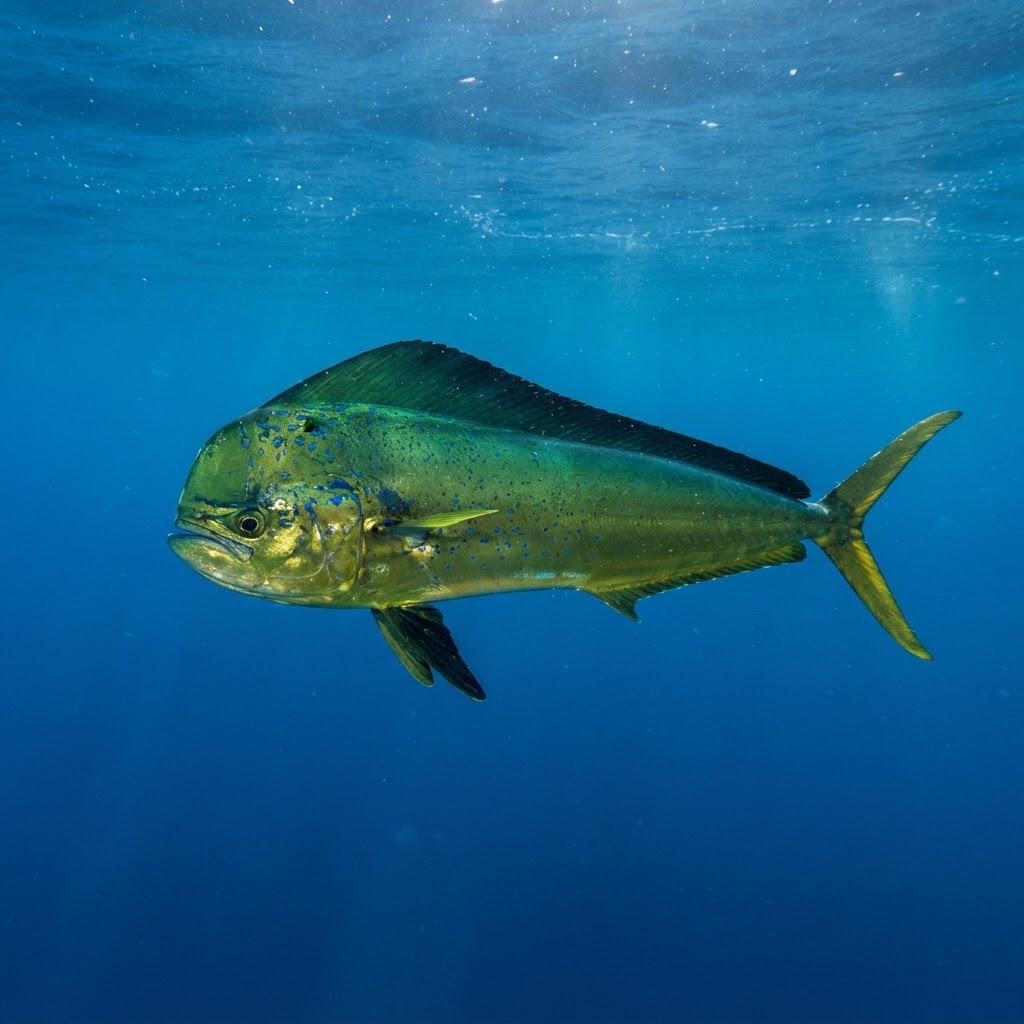
Coryphaena hippurus
Mahi Mahi (Dolphinfish)
Meet the Mahi Mahi, the neon-colored rockstar of the open ocean. It is the fastest, flashiest, and most flamboyant fish you will ever meet, living life in the fast lane with a literal glow-up every time it gets excited.
Meet the Fish
Imagine a fish that spent its entire paycheck on a wardrobe from a 1980s neon-themed dance club, then decided to become an Olympic sprinter. That is the Mahi Mahi, also known as the dolphinfish, though let us be very clear: it is not a dolphin, it does not nurse its young, and it definitely does not want to click at you. This fish is essentially the human equivalent of that guy who wears a lime-green suit to a business meeting and somehow pulls it off. It has a high, flat forehead that makes it look like it is constantly worried about its tax returns, but the moment it hits the water, that vibe vanishes. It is arguably the most vibrant creature in the big blue, capable of flashing shades of gold, electric blue, and highlighter green in a matter of seconds. It is the high-octane, glitter-covered party animal of the sea that everyone wants to see, but rarely catches up to.
Weird Biological Superpowers Explained Simply
The Mahi Mahi is basically a mood ring with fins. When it gets excited, angry, or hungry, it initiates a 'chromatophore' party. Think of its skin like a million tiny pixels on a giant flat-screen TV. These pixels are little sacks of pigment—think tiny balloons filled with paint—controlled by its nervous system. When the fish wants to communicate or hunt, it expands or contracts these balloons faster than a toddler changing their mind about a snack. This isn't just for fashion; it is a tactical display of dominance and predatory focus. While most fish have to struggle to blend in, the Mahi Mahi uses its colors to signal 'I am the boss of this current' or 'I am currently very focused on that flying fish.' It is bioluminescence's cooler, more colorful cousin, and it makes watching a school of Mahi Mahi look like a disco ball having a mid-life crisis under the waves.
Absurd Self-Defense Mechanisms
Most fish play the defense game by hiding under rocks or looking like a piece of inedible seaweed. The Mahi Mahi, however, thinks the best defense is simply being too fast and too stylish for anyone else to handle. When threatened, it doesn't inflate into a spiky ball or ooze disgusting slime; it turns into a turbo-charged rocket ship. Its body is designed like a professional racing car, thin and streamlined to slice through the water without a second of hesitation. If a shark or a tuna decides to start some trouble, the Mahi Mahi doesn't stick around to chat. It performs a series of acrobatic leaps, jumping completely out of the water like a dolphin caught in a high-speed chase. It literally jumps over its problems, soaring through the air while its predator is left staring at the ripples, confused and hungry. It is the ultimate 'can't touch this' strategy executed with perfect athletic grace.
Fish Drama and Gossip
The social life of a Mahi Mahi is essentially the high school cafeteria of the ocean, where everyone is trying to prove they are the coolest kid at the table. These fish are intensely social, often traveling in groups that act less like a disciplined squad and more like a rowdy band on tour. If you find one, there are likely dozens more nearby, all competing for the same delicious flying fish. The drama hits its peak during mealtime. They aren't particularly polite; they are the types to steal your fries even if they have their own. When a group of them spots prey, it is a chaotic, high-speed brawl where the fish change colors rapidly to signal 'I am taking this.' There is no hierarchy of quiet respect here—it is a fast-paced, neon-flashing scramble for glory where only the fastest fish gets the buffet, leading to endless underwater feuds.
The "Wait, That's Real?!" Deep-Sea Oddities
While the Mahi Mahi prefers the warm, sunny penthouse of the ocean surface, it spends its time observing the weirdos below. It lives in the epipelagic zone, the top layer where the sun actually reaches. If a Mahi Mahi were to visit the deep-sea cousins like the anglerfish or the barreleye, it would probably be horrified. Imagine a fish with a clear head like a glass dome—that is a deep-sea reality that makes our flashy hero look quite normal. Deep-sea creatures often produce their own light, known as bioluminescence, to attract mates or zap prey in a world of eternal black. The Mahi Mahi doesn't need to generate its own internal neon lights because it has the sun, but it does appreciate that its surface world allows it to maintain its vibrant, multi-colored wardrobe. The deep sea is a place of slow, terrifying weirdness, while the Mahi Mahi's world is a place of fast, frantic color.
Myth Busting
Let us clear the air: Mahi Mahi are not dolphins. You would be surprised how many people think these fish are related to Flipper simply because they have a high forehead and a name that sounds slightly mammal-ish. It is a classic case of mislabeling that has persisted for centuries. Another myth? That these fish are slow because they look a bit goofy with their blunt noses. This could not be further from the truth. They are among the fastest growing and fastest swimming fish in the ocean. They can grow up to a pound a day in their first year of life—which is like a toddler waking up a few inches taller every single morning. They aren't just pretty faces; they are biological machines designed for speed, efficiency, and a very short, very intense life span that challenges our ideas of what a 'standard' fish should look and act like.
Humorous Historical Tales or Folklore
Throughout history, sailors have held a special, slightly obsessed relationship with the dolphinfish. Because they change color so dramatically when they are hauled out of the water, ancient mariners often described them as dying rainbows or spirits of the sea. There is a melancholy beauty to it that poets have captured for centuries. Sailors used to swear that the fish shifted through every color of the spectrum before finally turning a dull, silver-grey as its life faded. It was considered a dramatic finale, and many sailors treated the sighting of a Mahi Mahi as a sign that they were entering warmer, more magical waters. They weren't seen as just fish; they were seen as the chameleons of the deep, mystical beings that held the secrets of the sun and the sky within their skin, only to vanish into grey mystery once they left their watery kingdom.
Underwater Love Stories and Bizarre Romances
Dating for a Mahi Mahi is less about candlelight dinners and more about a high-speed sprint to the finish line. Because these fish live such short lives—often only a few years—they don't have time for a long, drawn-out courtship. It is a 'live fast, love hard' philosophy. When mating, the male will often display the most intense colors imaginable, flashing electric blues to show the female that he is the most vibrant catch in the current. They engage in a fast-paced dance where they circle each other, showing off their speed and agility. It is a spectacle of endurance. If they decide they are a match, they release their eggs and sperm into the open water simultaneously, letting the ocean currents take over. It is a massive, communal event where thousands of potential Mahi babies are sent into the wild, hoping to survive the odds and become the next generation of neon speedsters.
Underwater Architecture and DIY Nesting
Unlike some fish that spend weeks building intricate castles of sand or carefully glue seaweed together into a nursery, the Mahi Mahi takes a more 'minimalist' approach to architecture. Their version of an underwater fortress is actually... nothing at all. They are pelagic spawners, meaning they treat the entire vast ocean as their backyard. They don't build nests; they deposit their eggs into the open current. However, their 'architecture' is more about finding the right environment. They love 'FADs'—Fish Aggregating Devices—which can be anything from a floating log to a massive patch of sargassum seaweed. These rafts act as the only solid home a baby Mahi Mahi will ever know. They aren't builders; they are expert hitchhikers who recognize that a floating piece of debris is the safest daycare in the middle of a giant, empty, and very hungry ocean.
The Chaos of Raising Tiny Swimmers
Parenting for a Mahi Mahi is essentially the parenting equivalent of dropping your kids off at a massive, chaotic summer camp and saying, 'Good luck!' They provide no care whatsoever after the eggs are released. The eggs are tiny, drifting specks that immediately become part of the plankton soup. When the larvae hatch, they are essentially transparent little specks that have to learn how to be a shark-bait-defying machine within minutes. It is a brutal numbers game. By releasing thousands of eggs at once, the Mahi Mahi relies on the hope that at least a few will avoid being eaten by every other creature in the sea. It sounds harsh, but it is actually a genius evolutionary strategy. Because they don't waste energy raising babies, they can put all their resources into growing at light speed and creating even more babies, keeping the population thriving in the face of constant oceanic peril.
How to Spot One & How It Is Doing
If you want to spot a Mahi Mahi, look for the 'neon sign' of the ocean. They are most commonly found in tropical waters, often hovering just below the surface near floating debris or seaweed mats. If you see a flash of gold or bright blue darting near a boat, you've found one. As for their status, these fish are remarkably resilient. Because they grow so fast and spawn so frequently, their populations are currently doing quite well, and they are listed as Least Concern. They are one of the most sustainable seafood choices, provided they are caught in ways that don't harm other species. You can help by supporting responsible fishing practices that leave the reefs alone and focus on these fast-growing speedsters. Protecting their ocean home ensures that this neon-colored rockstar continues to zoom through the waves, keeping the ocean's party going for generations to come.