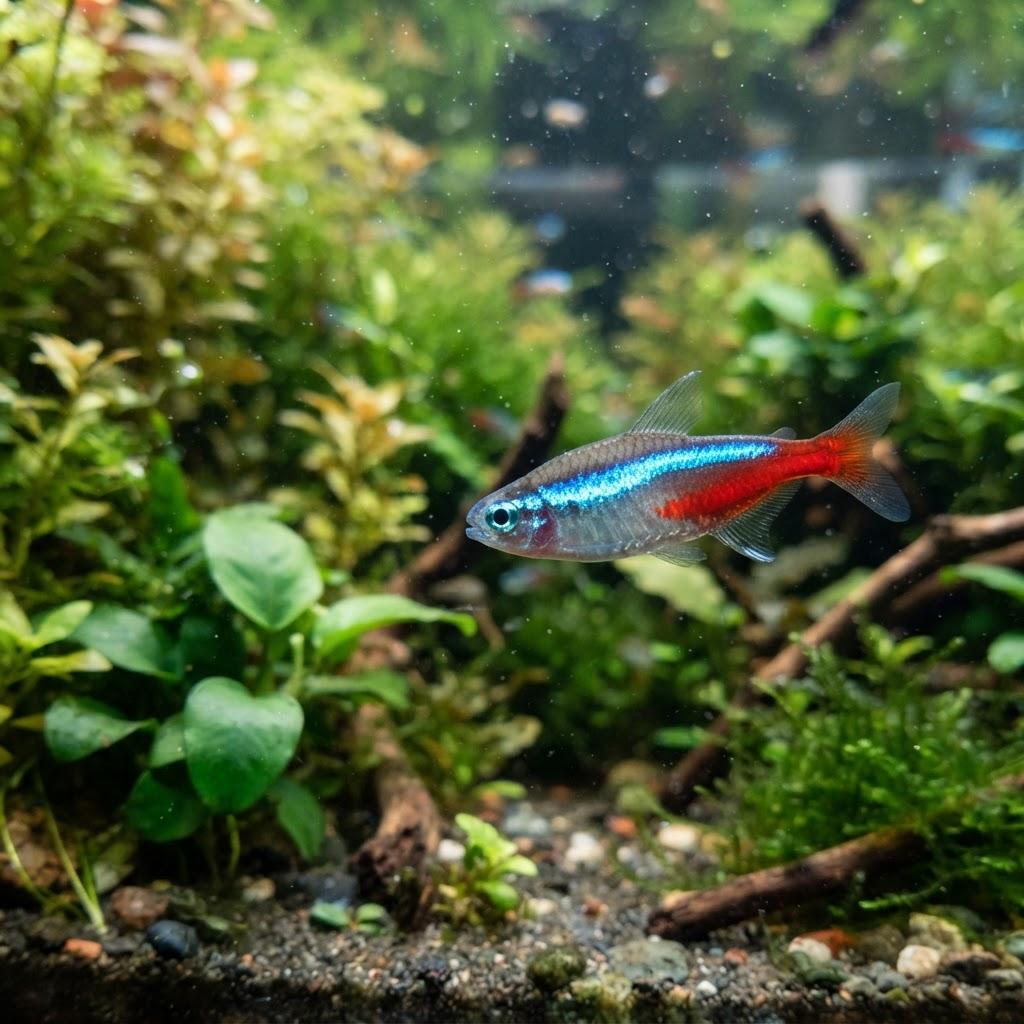
Paracheirodon innesi
Neon Tetra
Meet the Neon Tetra, the pint-sized party animal of the Amazon that sports a permanent glow-in-the-dark vest. These tiny, flashy swimmers are the ultimate fashionistas of the freshwater world.
Meet the Fish
Imagine walking into a dark, moody jungle bar where everyone is wearing boring beige and camouflage, and suddenly, a squad of tiny, glowing strobe lights zooms past your head. That is the Neon Tetra. Standing at a whopping inch and a half of sheer confidence, this fish looks less like an animal and more like a high-end highlighter that accidentally fell into a puddle. They are the quintessential divas of the aquatic scene, characterized by a horizontal stripe of electric blue that looks like it was painted on with a laser pointer, followed by a bold patch of fire-engine red. They don't just swim; they hover with the precision of a luxury drone, always hanging out with their crew because being a loner is simply not in their vocabulary. While other fish are busy being stealthy, the Neon Tetra decided long ago that the best way to survive is to be so bright that you just have to be noticed. They are the neon-sign equivalent of the animal kingdom, perpetually dressed for a rave in the murky, tea-stained waters of the Amazon. They are energetic, slightly twitchy, and undeniably the best-dressed guests at any underwater dinner party.
Weird Biological Superpowers Explained Simply
You might think the Neon Tetra has a tiny battery pack hidden under its scales, but the secret to their glow is actually a clever piece of physics called iridescence. Instead of creating light like a firefly, these fish are playing a trick on your eyes. They have specialized cells called iridophores that contain stacks of tiny, thin plates. When light hits these plates, it bounces around and scatters in a way that makes the blue stripe look like it is vibrating with pure energy. Think of it like looking at the back of a CD or an oil slick on the road—the colors shift and shimmer because of how light interacts with those microscopic layers. It is essentially nature’s way of using structural engineering to create a neon sign. Because the water they live in is often dark and stained brown by rotting leaves, this light-scattering trick is the perfect way to make sure their friends can see exactly where they are without having to shout or leave a breadcrumb trail. It is sophisticated, it is flashy, and it is entirely reliant on the clever geometry of their own skin.
Absurd Self-Defense Mechanisms
When you are the size of a paperclip, you are essentially a walking snack for every bigger fish in the jungle. The Neon Tetra knows this, so they have mastered the art of the 'Flash-and-Dash.' Because they travel in tight-knit social circles, they use their bright blue stripes to disorient potential attackers. If a hungry predator lunges at one, the group instantly scatters in a hundred different directions, creating a chaotic explosion of light that messes with the predator’s depth perception. It is like trying to swat a swarm of fireflies—by the time the big fish decides which one to bite, the entire school has swerved, regrouped, and vanished into the shadows of a floating plant. They are essentially using a strobe-light defense mechanism to trick the brain of their enemy. This collective, shimmering confusion turns a simple lunch into a headache for the predator, often resulting in the hunter just giving up and going to find something less headache-inducing to eat, like a nice, slow-moving snail that doesn't have a built-in light show.
Fish Drama and Gossip
If the Neon Tetra had a reality show, it would be titled 'Amazonian Shore.' Their social structure is entirely built on 'schooling,' which is basically the fish version of a mandatory group hangout that never ends. They are intensely gossipy, keeping a close eye on where their friends are at all times. If one fish wanders off to check out a particularly tasty-looking piece of algae, the rest of the school gets genuinely restless. They communicate through these constant, micro-adjustments in swimming speed and proximity, creating a complex web of social signals. It is not just about safety; it is about status. The bigger and more synchronized the school, the more 'in' you are. They are constantly jostling for position, performing tiny, rapid-fire turns that would make a synchronized swimming team blush. It is a high-octane social environment where you are either with the cool group or you are just a snack, and the drama of maintaining that perfect, unified formation is enough to keep them busy for their entire lives.
The "Wait, That's Real?!" Deep-Sea Oddities
While our Neon Tetra friends live in the freshwater shallows, their deep-sea cousins are living in an entirely different reality. Down in the twilight zone of the ocean, things get truly alien. Imagine the barreleye fish, a creature with a transparent, fluid-filled dome head that lets you look right into its skull to see its glowing green eyes pointed straight up at the surface. Or consider the dragonfish, which has teeth so sharp it doesn't need to chew; it just swallows anything that looks vaguely like food. While the Neon Tetra uses reflection to look cool in the sun, deep-sea fish have mastered bioluminescence, which is chemically producing their own light to lure prey into their gaping maws. It is a world where eyes become telescopes and stomachs become stretchy storage units. Compared to these deep-sea monsters, the Neon Tetra is a well-behaved houseguest, but they share the same fundamental understanding: when life is dark and dangerous, you had better have a really bright light or a really weird way to see what is coming next.
Myth Busting
There is a long-standing myth that Neon Tetras are extremely fragile, 'glass-like' fish that will die if you look at them the wrong way. While they certainly prefer a well-maintained home, this reputation for being impossible to keep is largely outdated. Some people still believe that they require pristine, distilled water that is literally impossible to replicate, but modern science has shown they are actually quite adaptable if their basic needs are met. Another myth is that they only swim in straight lines; in reality, they are master acrobats, capable of pulling off high-speed maneuvers that defy the idea that they are simple, mindless followers. They are not just mindless swimmers waiting for the current to take them; they have personalities, preferences, and a surprising amount of spatial awareness. They can recognize their primary feeders and often hover near the glass when they see their favorite human approaching, proving that they are far from the mindless, twitchy decorations some people once thought they were.
Humorous Historical Tales or Folklore
The discovery of the Neon Tetra is a story of adventure that sounds like a pulp novel. In the 1930s, a French explorer named Auguste Rabaut was searching the Amazon and supposedly stumbled upon these fish. Legend has it that he was so stunned by their electric glow that he brought them back to Europe, where they caused a absolute frenzy in the aquarium hobby. People were so desperate to own a piece of the 'living neon' that they were trading them for exorbitant amounts of money. In some folklore, indigenous groups in the Amazon saw these fish as spirits of the river, 'little stars' that had fallen from the night sky into the dark water. It is a beautiful sentiment that captures the absolute magic of their appearance. Whether they were seen as celestial visitors or just a profitable discovery for collectors, the Neon Tetra has a history of making people stop in their tracks, blink their eyes, and wonder if what they are looking at is actually real.
Underwater Love Stories and Bizarre Romances
Romance for a Neon Tetra is less about roses and candlelit dinners and more about a high-speed chase through the ferns. During the breeding season, the males turn into absolute show-offs, performing a series of rapid, vibrating dances to get the attention of the females. It is a display of pure energy, with the male showing off his brightest colors and his ability to hold a precise position in the water column. The female, ever the choosy critic, watches from the sidelines, looking for the male with the most vibrant, unwavering stripe—because in the Neon world, fitness is definitely a fashion statement. Once a pair decides to connect, they go for a swim together, darting through fine-leaved plants where the female will eventually drop her eggs. It is a fleeting, fast-paced courtship that relies on pure charisma and a lot of swimming in circles, proving that even a fish the size of your thumb knows that you have to put on a good show to find a partner.
Underwater Architecture and DIY Nesting
Neon Tetras are not exactly the master architects of the fish world; they are more of the 'minimalist design' type. They do not build fortresses or elaborate sand castles. Instead, they look for the perfect patch of 'underwater real estate'—usually a thicket of fine-leaved plants like Java moss. To them, a tangled mess of aquatic greenery is a luxury suite. They seek out these areas because the dense leaves provide perfect protection for the eggs and the tiny fry that will eventually hatch. They are very picky about the lighting in these 'nurseries,' preferring areas with low, diffused light that keeps them safe from prying eyes. They are essentially looking for a dark, cozy, plant-filled bedroom where they can be left alone. It is a classic case of 'less is more'—they don't need a monument to their love, they just need a nice, secluded patch of weeds and the right amount of privacy to keep their future generations safe from being gobbled up by hungry neighbors.
The Chaos of Raising Tiny Swimmers
Raising baby Neon Tetras is like trying to organize a daycare for a hundred toddlers who are all wearing rocket-powered sneakers. Once the eggs hatch, the tiny 'fry' are basically microscopic specks of dust with eyes. They have no parental guidance; the parents have already checked out and are back to their daily social rounds. The fry survive on their own yolk sacs for the first few days, effectively living off a packed lunch stored in their own bodies. After that, they are on their own, trying to hunt down even smaller pieces of food in a world where everything is a giant monster. It is a chaotic, high-stakes game of survival where the goal is to grow fast and blend in with the school before you become someone's hors d'oeuvre. They are constantly on the move, learning the ropes of the schooling dance from day one, desperately trying to grow enough to earn their stripes—literally—and join the big, flashing, neon-lit party that defines their adult lives.
How to Spot One & How It Is Doing
If you want to spot these glowing gems in the wild, you need to head to the Amazon basin and look for slow-moving, tea-colored water. Look for the glint of blue. In the hobbyist world, they are everywhere, and thankfully, they are doing quite well. Because they are so popular, they are often bred in huge numbers, which takes the pressure off the wild populations. They are listed as 'Least Concern,' which is the best news a fish can get. You can help keep them safe by supporting sustainable aquarium practices and ensuring that your own tanks are kept clean and comfortable. If you see them in a store, look for the ones with clear, bright colors and active, alert movements—those are the happy, healthy ones. They are little ambassadors for the biodiversity of the Amazon, reminding us that even the smallest, flashiest creature plays a part in the massive, complex machine of the natural world. Keep them swimming, keep them bright, and enjoy the show.