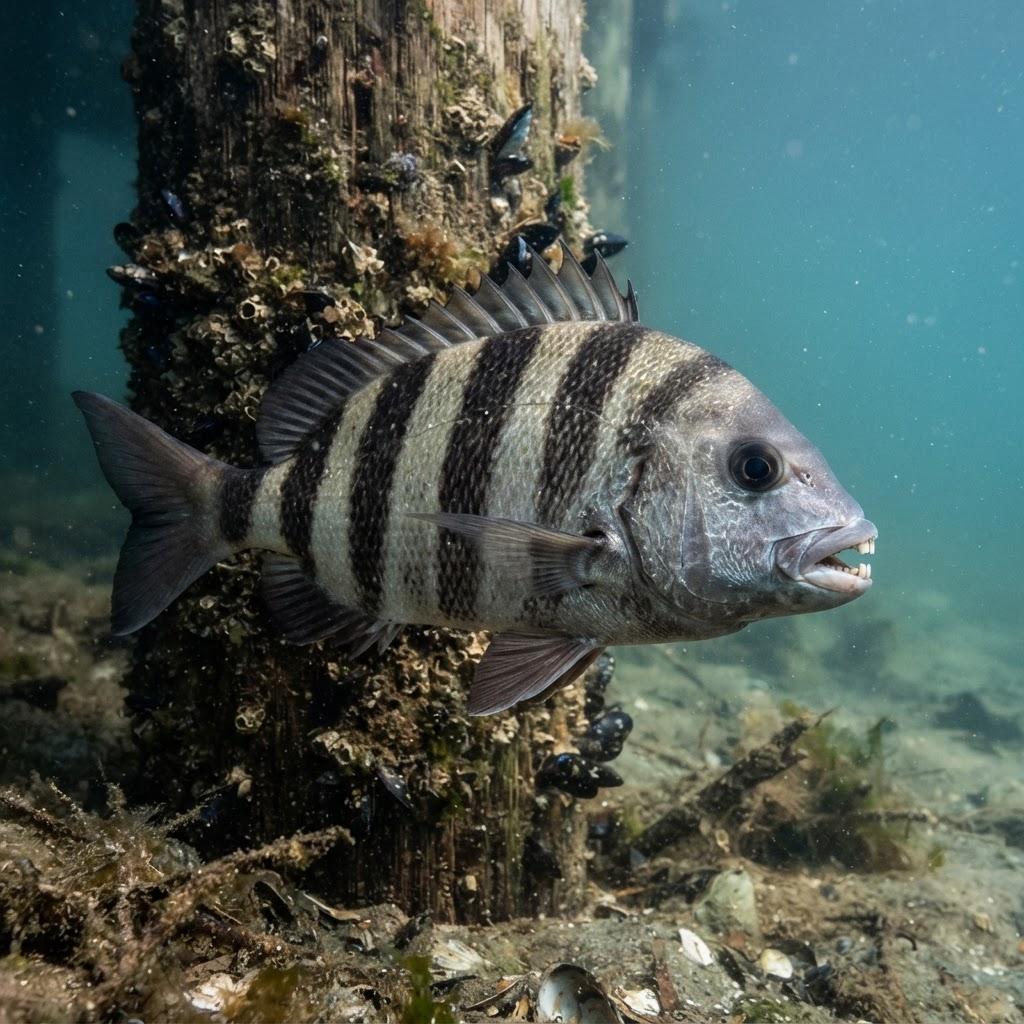
Archosargus probatocephalus
Sheepshead
Meet the Sheepshead, the ocean's resident orthodontist with a set of teeth that will make you rethink your own dentist visits. This striped bandit is a master of the pier, combining a bizarre human-like grin with the skills of a professional safe-cracker.
Meet the Fish
Imagine you are strolling down a sun-drenched fishing pier, minding your own business, when you pull a fish out of the water that looks like it just stepped out of a surrealist painting. That is the Sheepshead. With its distinct black-and-white vertical stripes, it looks like it is wearing a permanent prisoner’s uniform, but the real star of the show is the mouth. This isn't just any fish mouth; it is a full-blown set of human-looking incisors and molars that look like they belong on a dentist’s exhibit rather than an underwater creature. They are the ultimate tough guys of the shallow water, possessing an attitude that says they own every barnacle-covered pylon they hover near. They don't zip around like tuna or hide in the sand like flounder; they just hang out, stoically munching on snacks that would break a normal fish's jaw. They are the neighborhood bullies of the shellfish world, and frankly, they wear their weirdness with such confidence that you can't help but respect the hustle.
Weird Biological Superpowers Explained Simply
The Sheepshead’s superpower isn't shooting lasers or turning invisible; it is having a bite force that would make a nutcracker weep. Those creepy human teeth are evolution’s answer to the ultimate challenge: eating things that are literally made of armor. While other fish spend their time chasing fast-moving shrimp or frantic minnows, the Sheepshead decided that the ocean’s buffet of oysters, clams, and barnacles was just sitting there waiting to be claimed. Its mouth is lined with rows of flat, crushing molars that function like a hydraulic press. Think of it like someone walking up to a brick wall and deciding to chew through it for lunch. When they find a juicy oyster, they don't just bite it; they use these specialized teeth to scrape the prey right off the piling and then crush the calcified shell into smithereens before swallowing the soft inside. It is a masterclass in brute force mechanics combined with surgical precision, turning the toughest snacks in the sea into a gourmet meal.
Absurd Self-Defense Mechanisms
If you were a fish covered in sharp, spiny armor, you might feel pretty safe, but the Sheepshead takes no chances. Its body is absolutely riddled with sharp, jagged dorsal spines that make handling them about as fun as hugging a cactus. These aren't just for show; they are a clear warning to any shark or predator looking for an easy bite that this meal comes with a heavy dose of pain. Beyond the hardware, the Sheepshead is a master of the 'look but don't touch' strategy. When startled, they don't sprint away like a nervous teenager; they dive into the nooks and crannies of the rock structures they call home, essentially turning themselves into an unmovable part of the scenery. Their coloration, which is a high-contrast black-and-white stripe, acts as a perfect visual disruptor in the shimmering light of the shallow surf, making them surprisingly difficult to lock eyes on. They don't need slime or poison when they have the perfect camouflage and a prickly personality.
Fish Drama and Gossip
The social life of a Sheepshead is less like a peaceful school and more like a never-ending territorial dispute over a prime apartment in a high-rise. These fish are fiercely individualistic when it comes to their favorite restaurant—the local pier piling. If a new Sheepshead tries to muscle in on a prime feeding spot that is already occupied by a dominant resident, you can expect some serious posturing. They flare their fins, show off those terrifying teeth, and engage in high-stakes staring contests that would make a poker champion sweat. It is all about dominance, and the biggest, grumpiest-looking fish usually gets the best spot with the most barnacles. They aren't interested in forming elaborate shoals or synchronized swimming teams; they are lone wolves of the pier, trading territorial glares and keeping their neighbors on their toes. It is the ultimate underwater soap opera, where the price of a bad reputation is being relegated to the barren rocks while the kings of the pier dine on the finest oysters.
The "Wait, That's Real?!" Deep-Sea Oddities
While the Sheepshead loves the sunny shallows, its deep-sea cousins are living in a world that feels like an alien invasion. Imagine living in the Midnight Zone, where there is zero sunlight and the pressure is high enough to flatten a submarine. Out there, you have creatures like the Barreleye fish, which has a transparent head so you can see its brain and eyes, or the Anglerfish, which carries a glowing fishing pole on its forehead to lure in dates and dinner. The Sheepshead, by comparison, seems almost boring until you realize that its teeth are just as 'alien' as anything you would find in the deep. Deep-sea fish rely on bioluminescence to communicate in the dark, but the Sheepshead relies on its rugged, sturdy construction to thrive in the chaotic, high-energy world of the surf. While the deep-sea fish are trying to survive in a cold, silent void, the Sheepshead is busy grinding its way through a rocky, turbulent playground where every day is a test of strength.
Myth Busting
Let’s clear the air about the Sheepshead: they are not human-fish hybrids, and no, your uncle didn't catch one that was 'smiling' at him because it was happy. The legend that they are somehow related to humans because of their teeth is a fun bit of folklore, but it is pure anatomy. Evolution simply gave them teeth that look remarkably like ours because we both share a need for crushing hard materials. Another myth is that they are impossible to catch because they are too 'smart.' In reality, they are just incredibly observant and possess a delicate touch that makes them experts at stealing bait off a hook without getting caught. They don't need a high IQ to outsmart a fisherman; they just need to be patient and wait for the bait to be presented in a way that doesn't feel like a trap. They aren't geniuses, but they are certainly the masters of bait-thievery, which has led to many a frustrated angler declaring them the most cunning fish in the sea.
Humorous Historical Tales or Folklore
Throughout history, coastal communities have viewed the Sheepshead with a mix of awe and mild terror. In some old maritime tall tales, the Sheepshead was said to have the spirit of a toothy, grumpy ancestor reborn to keep watch over the docks. People used to believe that if you caught a Sheepshead, you had to treat it with a certain level of respect, or your luck in catching other fish would dry up for the rest of the season. There is a story from the 1800s about a fisherman who caught a particularly large specimen and claimed it tried to bite his wedding ring right off his finger. Whether it was just the fish acting on instinct or the man being prone to tall tales, the story stuck, and the Sheepshead gained a reputation as the 'pickpocket of the sea.' These stories aren't backed by scientific journals, but they highlight just how much this fish stands out from the rest of the underwater crowd.
Underwater Love Stories and Bizarre Romances
Love in the world of the Sheepshead is a rather impersonal affair, lacking the romantic dinners or long walks on the beach. When the season hits, these fish migrate offshore to deeper, warmer waters to do their business. It is not so much a dance-off as it is a massive, chaotic party where everybody shows up to release their eggs and sperm into the water column. There is no 'til death do us part' here; once the deed is done, they just drift away like two ships passing in the night. It is a high-volume approach to romance—why invest in one partner when you can aim for a numbers game? The males put on a show of vitality, flashing their stripes to attract a mate, but as soon as the genetic exchange is complete, they are back to their solitary, barnacle-crushing lifestyles. It is a very pragmatic, 'no-strings-attached' kind of love story that ensures the next generation has plenty of swimmers.
Underwater Architecture and DIY Nesting
If you were hoping for the Sheepshead to build some sort of elaborate underwater palace like a pufferfish or a cichlid, you might be disappointed. They are not the interior decorators of the reef. Instead of building, they prefer to exploit the existing architecture provided by nature and humanity. Piers, jetties, wrecks, and rocky outcroppings are their preferred housing developments. They don't need to pile up sand or weave seagrass into a nursery; they just find a sturdy, stationary object that provides a good buffet of mussels and call it a day. In a way, their 'nesting' behavior is just finding a spot that keeps them safe from strong currents while putting them in the middle of a grocery store. It is the fish equivalent of moving into a pre-furnished apartment located directly above a 24-hour pizza shop. Why work hard on architecture when you can let the humans build the piers and the ocean provide the snack-covered pillars?
The Chaos of Raising Tiny Swimmers
Parenting is not really a thing for the Sheepshead. After the chaotic spawning event in the offshore waters, the eggs are left to their own devices. They drift with the currents, turning into tiny, defenseless larvae that have to survive on pure luck and whatever plankton they can gulp down. It is a harsh world out there for a baby Sheepshead. They don't have a mother to protect them or a father to guard the nest; they are basically in a high-stakes game of hide-and-seek from the moment they hatch. By the time they are big enough to develop those signature stripes and move toward the safety of the seagrass beds, the vast majority of their brothers and sisters have already become snacks for other fish. It is a brutal, numbers-driven system, but it works well enough that the population stays stable. The sheer amount of eggs released ensures that enough survivors make it to the pier to keep the tradition of biting through oyster shells alive.
How to Spot One & How It Is Doing
If you want to see a Sheepshead in the wild, grab a snorkel and head to the nearest dock or pier. Look for the black-and-white vertical stripes—they are as unmistakable as a zebra in a swimming pool. If the water is clear, look near the base of the pylons, where you will see them hovering, turning sideways to pick off barnacles. They are currently doing quite well, thank you very much! Their populations are stable, and they are considered a species of least concern, mostly because they are masters of hiding and eating things other fish ignore. You can help keep their home healthy by making sure you don't litter plastic or fishing line around piers, as those lines can tangle around these rocky structures and cause problems for the fish. Keep the water clean, respect the piers, and you will have a front-row seat to the most interesting dental patient in the ocean for years to come.