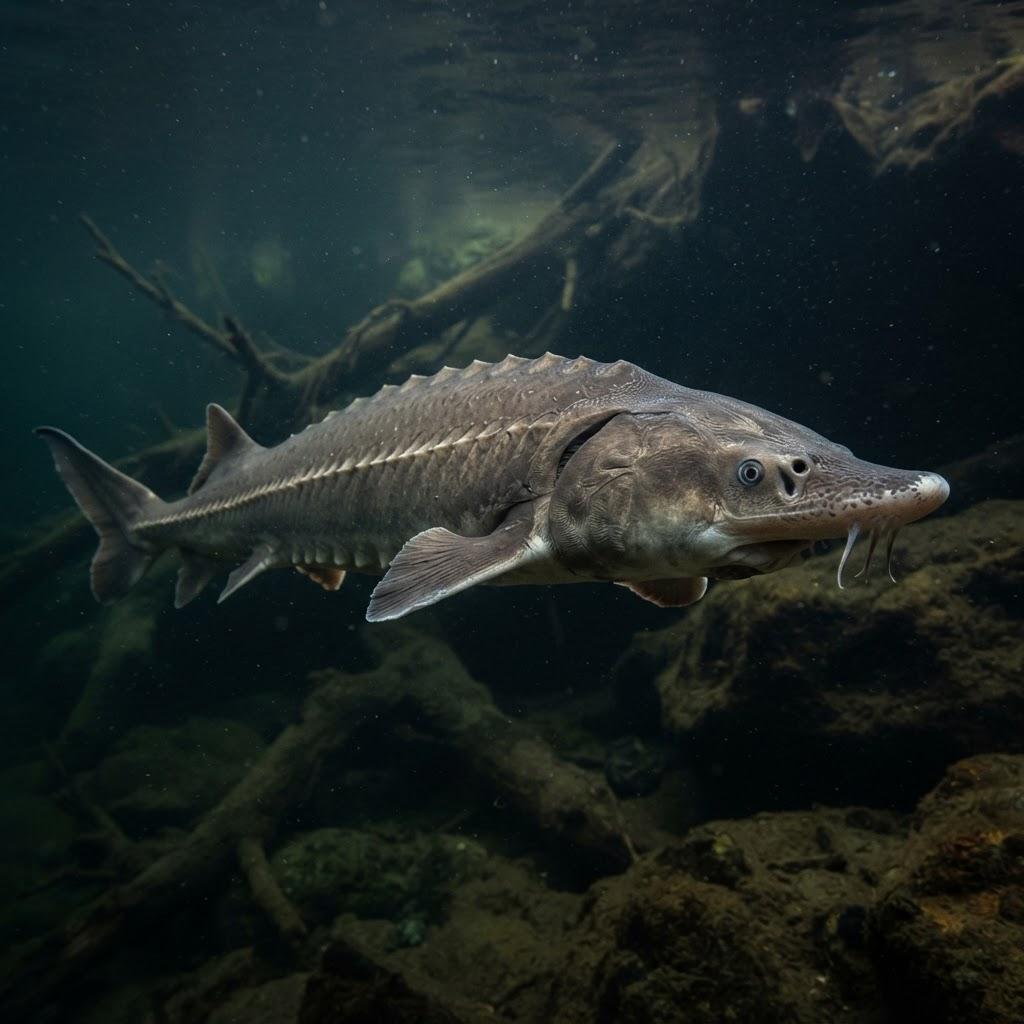
Acipenser transmontanus
White Sturgeon
Meet the White Sturgeon, the prehistoric tank of the river world that has been rocking the same dinosaur-era look since the Jurassic period. It is a gentle giant with a vacuum cleaner for a mouth, a literal living fossil, and the coolest roommate you never knew you had.
Meet the Fish
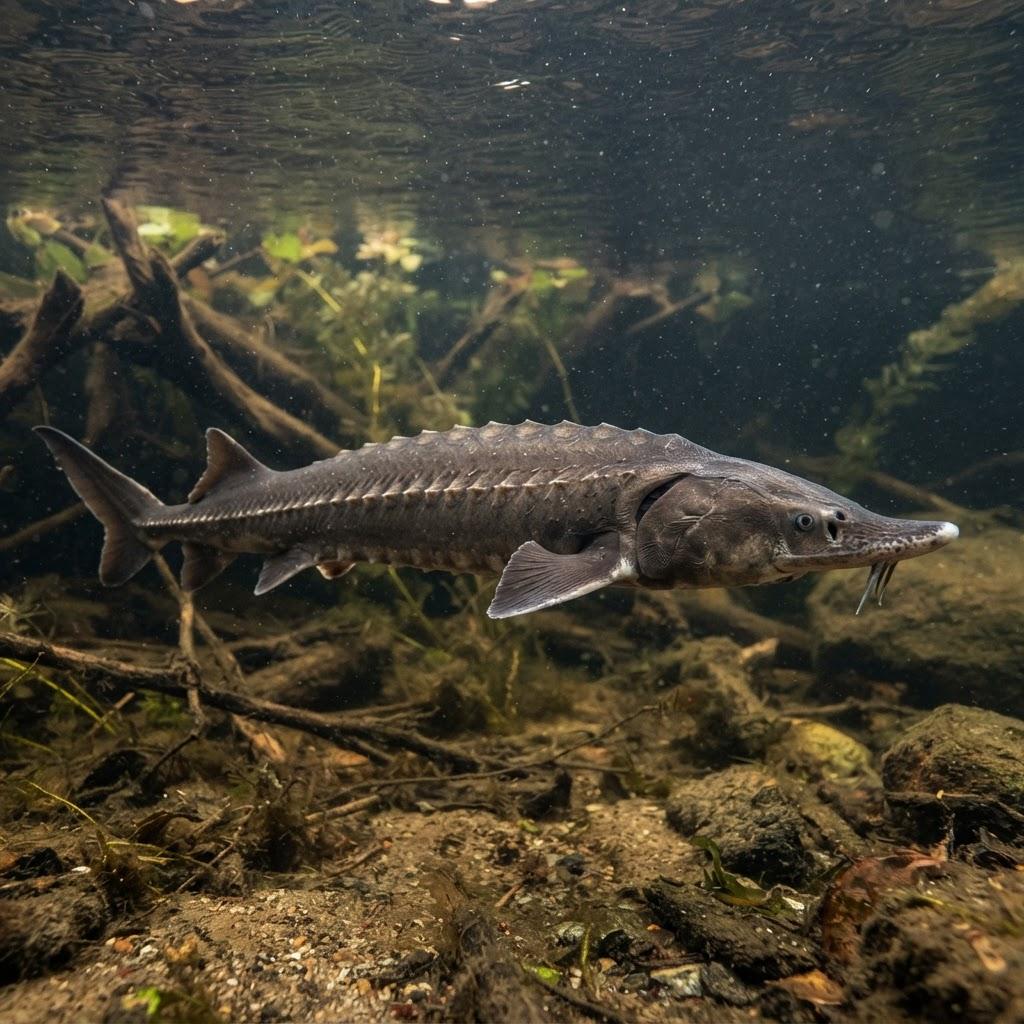
Imagine you are strolling through a natural history museum, and suddenly, one of the fossilized dinosaur skeletons stands up, decides it is done being dead, and wanders off to find a snack. That is basically the vibe of the White Sturgeon. This creature is the absolute definition of an evolutionary overachiever. While other species have been busy evolving flashy colors, fancy fins, or the ability to walk on land, the White Sturgeon has spent the last 200 million years perfecting a look that can only be described as armored grunge-chic. It is the largest freshwater fish in North America, and it carries itself with the sleepy, confident swagger of a king who knows that he was the apex predator before mammals even figured out how to be anything other than frantic, squeaky snacks. With its torpedo-shaped body, rows of sharp, bony plates called scutes, and a mouth that looks like a permanent 'O' of surprise, it is impossible to miss. It does not swim so much as it cruises through the murky depths, a silent, armored submarine patrolling the riverbed, entirely unbothered by the passing trends of the modern marine world.
Weird Biological Superpowers Explained Simply
If you ever look closely at the face of a White Sturgeon, you might wonder what those four little dangly bits are near its mouth. Those are barbels, and they are basically high-tech, organic metal detectors. Imagine if your chin could sense the electrical impulses of a delicious worm hiding under five inches of sand. That is the sturgeon’s life. Beyond their sensory beard, they possess electro-reception, an ability that sounds like a comic book power but is actually just physics doing its best. They use something called the Ampullae of Lorenzini, which are tiny jelly-filled pores on their snouts. These act like underwater antennas, picking up the tiny, microscopic electrical fields generated by the muscles of every crustacean or fish nearby. They do not even need to see their dinner to find it; they just feel the static electricity of a shrimp’s heartbeat from across the riverbed. It is the ultimate form of remote sensing, turning the murky, brown water of a river into a high-definition dashboard of glowing, edible signals that only the sturgeon can perceive.
Absurd Self-Defense Mechanisms
When you are a six-meter-long armored tank, you do not really spend much time worrying about the neighborhood bullies. The White Sturgeon is essentially the rhinoceros of the river, wearing a suit of jagged, diamond-hard armor plates. These plates, called scutes, are not just for show; they are like a medieval knight’s suit of mail, designed to make biting down on a sturgeon a genuinely painful experience for any predator foolish enough to try. If a shark or a massive seal wanted to take a bite, they would likely walk away with a mouth full of sharp, bony shield and a profound sense of regret. Unlike other fish that rely on camouflage or speed, the sturgeon relies on the sheer, stubborn fact that it is a literal brick wall with fins. If that fails, they are incredibly strong swimmers with a surprising amount of explosive power in their tails. They are the heavyweight champions of the water, and they carry themselves with the defensive philosophy of a tank parked in the middle of a playground—nobody bothers the tank.
Fish Drama and Gossip
Living to be a hundred years old means you see a lot of things, and the sturgeon is the ultimate veteran of the river. While they are generally solitary, independent spirits, the river bottom is a constant stage for micro-dramas. During the spawning seasons, the social hierarchy gets a little messy. It is like the royal court of an underwater kingdom where everyone is trying to remember who is the biggest, who has the most impressive scutes, and who has the right of way in the deep channels. While they do not have the complex, flashing-light communication of coral reef fish, they definitely have an understanding of physical presence. The larger females are the undisputed divas of the river, often attracting several smaller males who follow them around like persistent paparazzi. It is not exactly a high school hallway, but there is definitely a sense of seniority in the way these giants interact. Older fish clearly carry a sense of 'been there, done that,' navigating the river with a calm that keeps the younger, more frantic fish in their place without even trying.
The "Wait, That's Real?!" Deep-Sea Oddities
The White Sturgeon might be a river dweller, but it has the heart of a deep-sea pioneer. While it does not dwell in the crushing, midnight depths where anglerfish hang out with their glowing fishing poles, the sturgeon’s lifestyle is arguably just as mysterious. Compare it to the barrel-eye fish, which has a transparent head so it can look through its own skull. While the sturgeon isn't quite that weird, it shares that ancient, alien feeling. It thrives in conditions that would make most fish go belly-up. It is comfortable in silty, dark water where visibility is practically zero, relying on its internal radar rather than its eyes. It belongs to a group of fish that seem to have skipped the evolution party, remaining largely unchanged while their cousins went off to develop bright colors and complex light displays. They are the 'monsters' of the river in the best way possible, proving that you do not need neon lights or a see-through head to be the most bizarre, fascinating creature in the water.
Myth Busting
Let us clear up some of the nonsense that gets thrown around about sturgeons. People love to say that because they are old, they must be dumb or sluggish, like an elderly tortoise. This is completely false. A White Sturgeon is a high-performance athlete in a dinosaur suit. When hooked by a fisherman, these things do not just sit there; they go absolutely airborne. We are talking about six-hundred-pound monsters launching their entire bodies clean out of the water like a flying ballistic missile. It is a sight that has broken more fishing rods and jaws than any other fish in North America. Another myth? That they are scavengers who only eat garbage. While they are bottom-feeders, they are actually opportunistic hunters that will snatch up anything from lamprey to salmon if the mood strikes them. They are not just cleaning the floor; they are patrolling the buffet line, and they are surprisingly tactical about when and where they choose to strike, showing a level of memory and environmental awareness that would put a goldfish to shame.
Humorous Historical Tales or Folklore
Humans have had a weird, complicated relationship with sturgeons for as long as we have had recorded history. There are ancient stories of sturgeons so large that they were mistaken for river spirits or even rogue sea serpents that wandered too far upstream. In some historical accounts, fishermen were so terrified of the sheer size of these giants that they would tell tall tales about sturgeons that could pull a boat all the way to the ocean if you didn't cut the line fast enough. There are even legends of kings who tried to make the sturgeon a royal fish, decreeing that only the crown could own them, which is a hilarious thought considering that a fish the size of a minivan doesn't really care about your human laws or royal decrees. Throughout the centuries, their appearance has fueled the fires of local folklore, with people inventing all sorts of wild stories about why these fish look like they were carved out of stone, usually involving gods, curses, or magical rivers.
Underwater Love Stories and Bizarre Romances
When a White Sturgeon decides it is time to find a partner, things get epic. Unlike fish that just spawn in a cloud and hope for the best, the sturgeon has a whole routine. They migrate hundreds of miles, navigating currents that would make an Olympic swimmer cry, all to find the perfect rocky bed to deposit their eggs. It is a slow, methodical courtship. You don't see the frantic, rapid-fire flashing of colors you get on a reef; instead, you get a series of synchronized drifts and tactile nudges. They are like two ballroom dancers in heavy suits of armor, moving with a grace that defies their massive, bulky frames. They seek out high-flow areas where the water is turbulent and oxygen-rich, because they know that their future offspring need the best, most aerated water to grow. It is a deeply serious, long-term approach to family planning that has kept them thriving for eons, even if the actual 'dance' is a bit more like two submarines bumping into each other in slow motion.
Underwater Architecture and DIY Nesting
If you are expecting a nest built out of twigs or soft, leafy pillows, you are looking at the wrong fish. The White Sturgeon is a minimalist architect. They don't build nests so much as they select 'high-value real estate.' They look for areas of the riverbed with just the right grain size of gravel and rock. They don't dig with their fins; they use their sheer mass and the force of their movement to shift river material around. It is a brutalist form of interior design. Once they clear a spot, they want a space that is shielded from the worst of the current but still allows for constant water flow over the eggs. They are the ultimate 'fixer-upper' experts of the riverbed. They spend days scouting the perfect location, feeling out the flow and the texture of the bottom, because they know that in a river, a house is only as good as its foundation. Once the spot is selected and cleaned, the egg-laying begins, resulting in thousands of tiny, sticky eggs that attach themselves to the rock like little pearls of potential.
The Chaos of Raising Tiny Swimmers
Once the eggs hatch, the real insanity begins. A tiny baby sturgeon, or fry, is essentially a piece of sushi with dreams of grandeur. They don't have parents hanging around to drop them off at soccer practice; they are born into a world where everything wants to eat them. From the moment they hatch, these little guys are on their own, programmed with a 'run or hide' instinct that kicks in instantly. They look like weird, elongated tadpoles, and they spend their early days tucked away in the deepest, darkest crevices of the river, trying their best not to be noticed by the thousands of predators that see them as a bite-sized snack. They grow fast, but the mortality rate is high, which is why nature has them lay eggs in massive numbers. It is a chaotic, high-stakes game of hide-and-seek, but those that survive the gauntlet grow into the massive, armored tanks that rule the river, turning the tables on every predator that tried to eat them when they were small.
How to Spot One & How It Is Doing
If you want to catch a glimpse of this prehistoric wonder, you generally need to be near the big rivers of the Pacific Coast, and you need a lot of patience. Keep an eye out for 'breaching'—if you see a massive, jagged shape launch itself completely out of the water, that is your golden ticket. That is a sturgeon saying hello to the world above. They are doing okay, but they definitely need a helping hand. Because they live so long and take so many years to mature, they are sensitive to changes in their home. Dams and habitat loss are the biggest buzzkills for the sturgeon. You can help by supporting local river conservation projects, reducing the amount of plastic and chemicals that end up in our waterways, and simply spreading the word that we have living, breathing dinosaurs swimming in our own backyard. They aren't just fish; they are a direct link to the ancient history of our planet, and it is our job to make sure they are still around to freak out the next generation of river-goers.