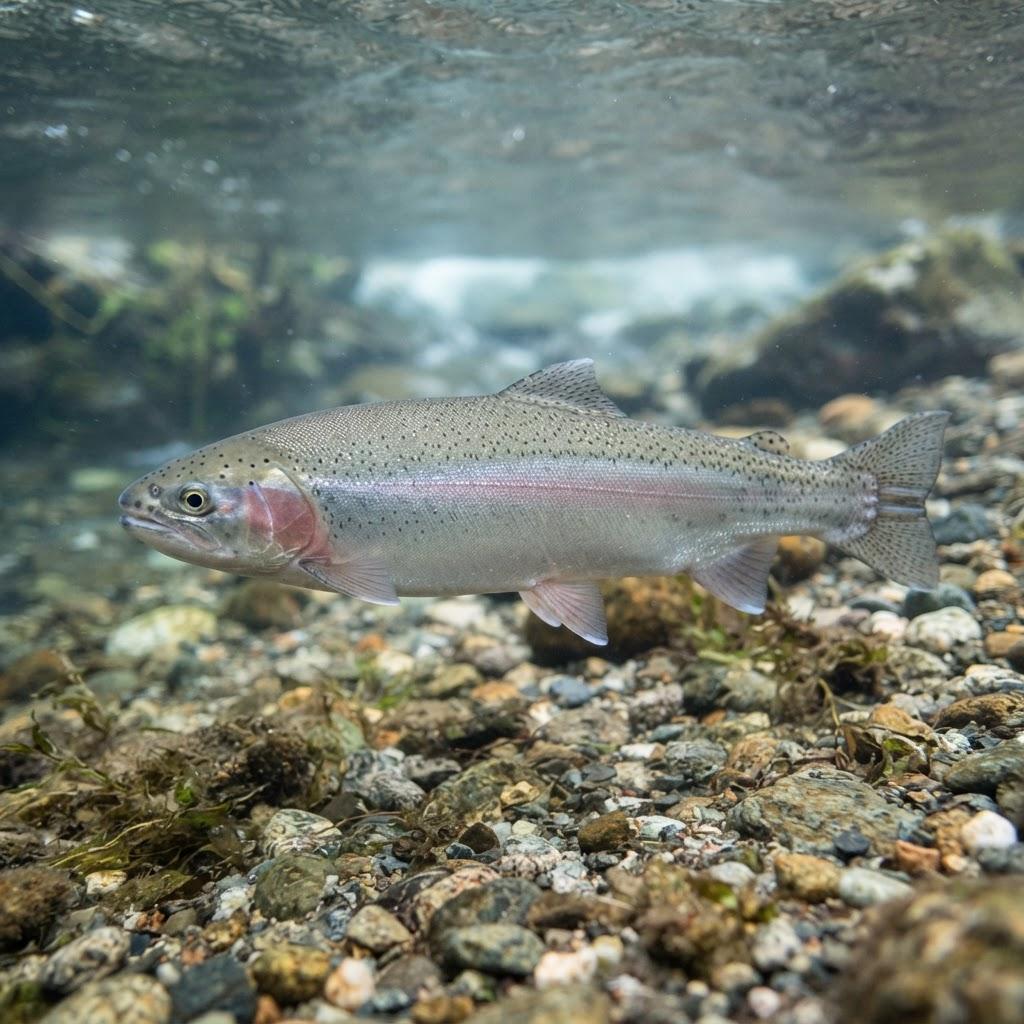
Oncorhynchus mykiss
Steelhead Trout
Meet the Steelhead, the heavy-metal rockstar of the trout world that refuses to pick a single lifestyle. This silver-scaled daredevil lives life in the fast lane, splitting its time between the rugged mountain streams of its youth and the wild, salty expanse of the Pacific Ocean.
Meet the Fish
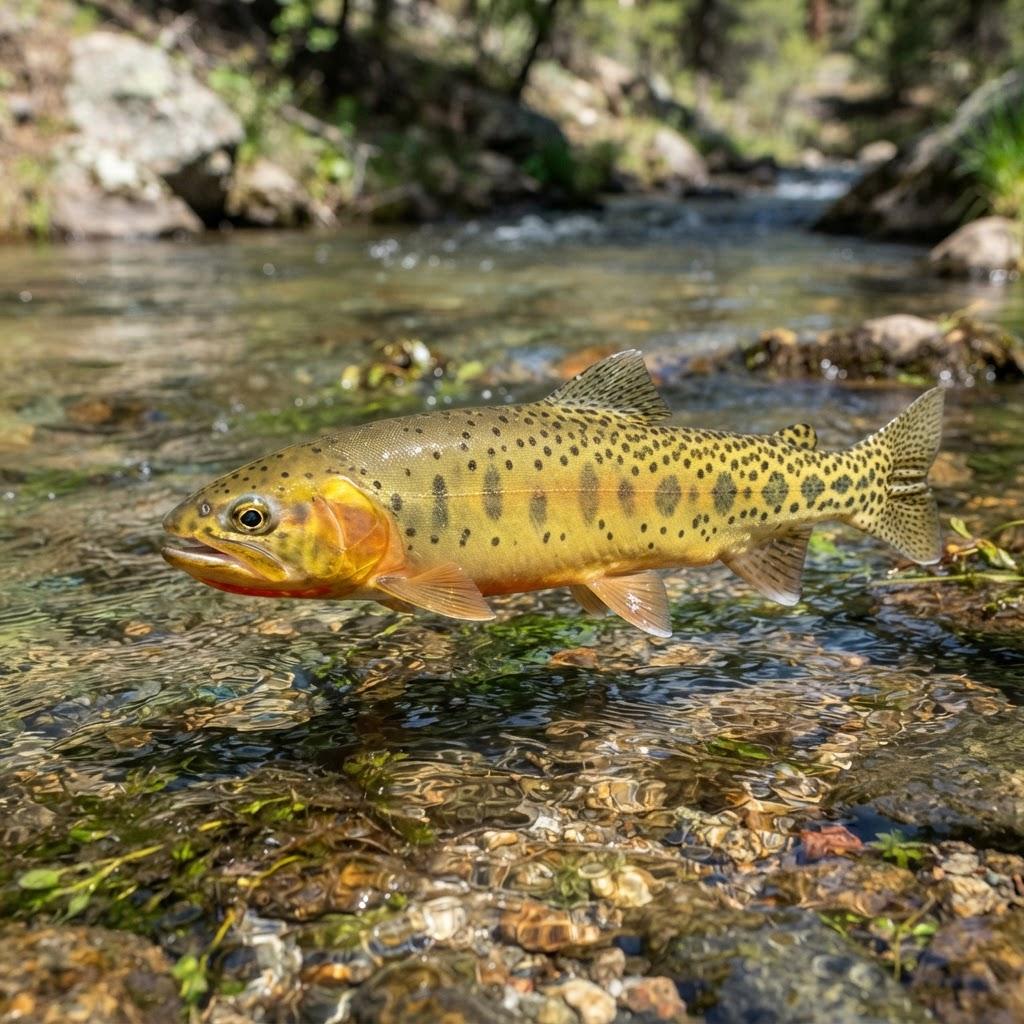
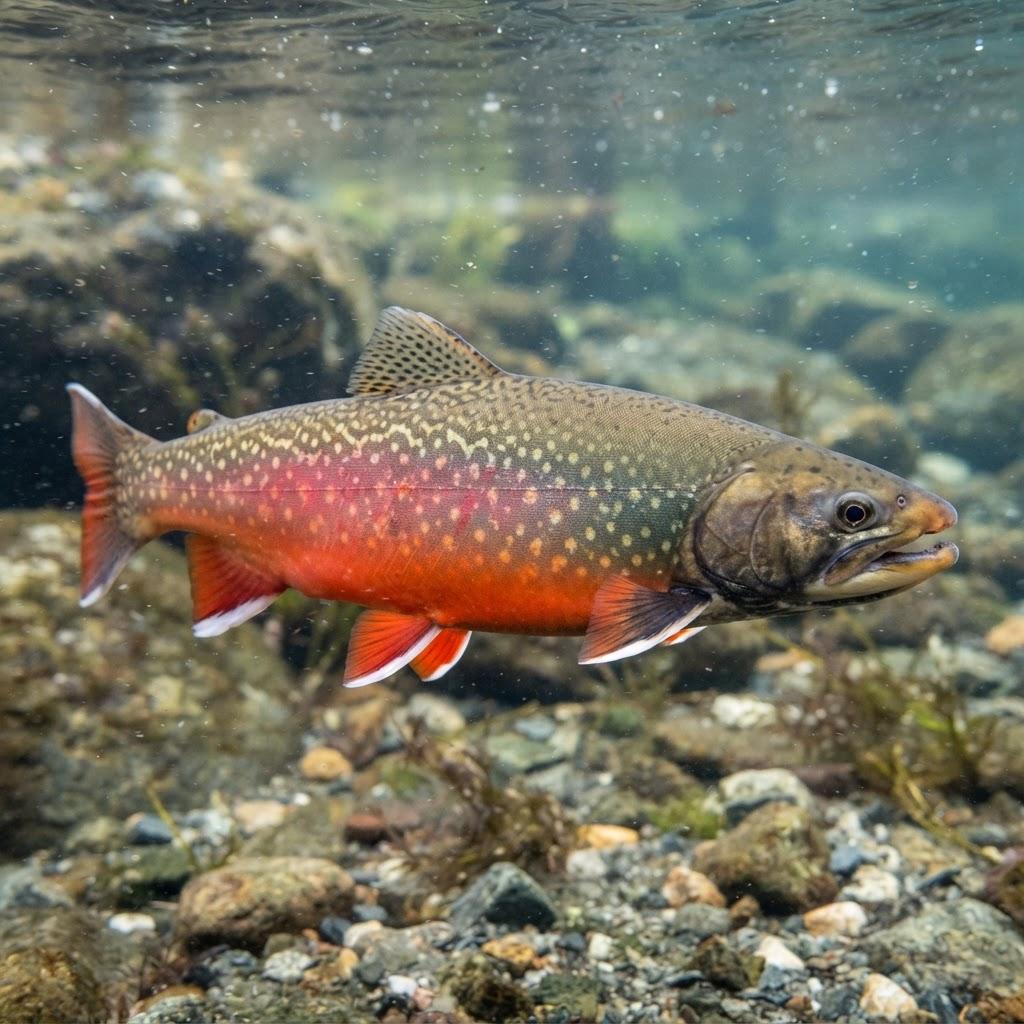
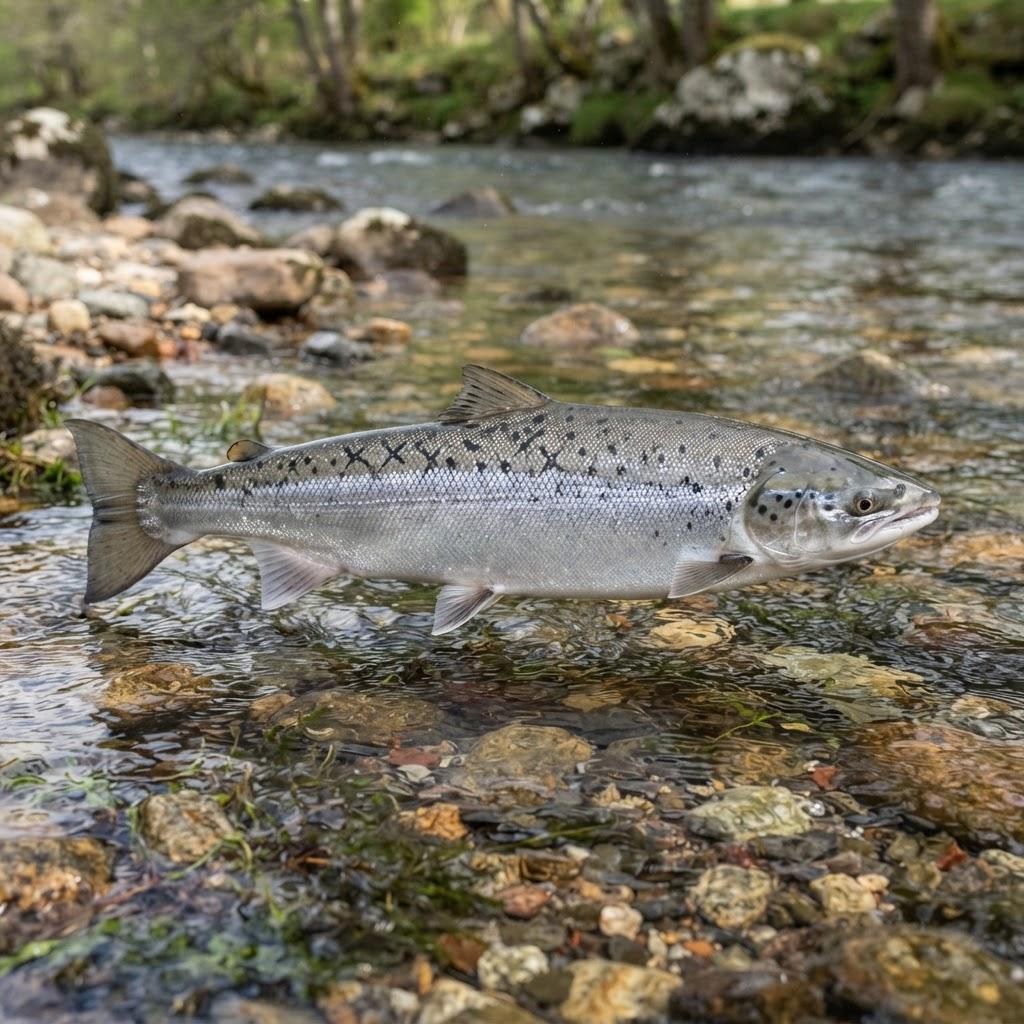
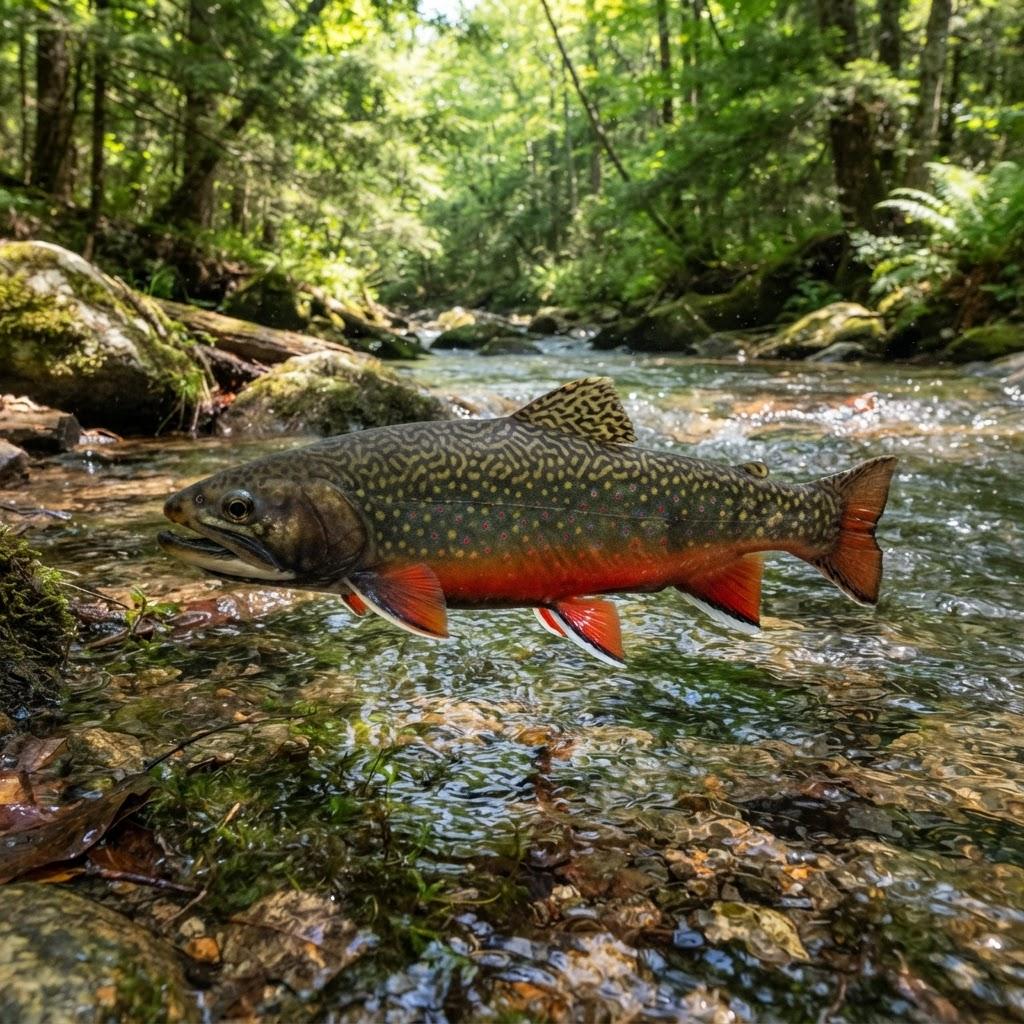
Imagine a fish that wakes up one morning and decides that staying in its childhood home is just way too boring. That is the Steelhead Trout in a nutshell—the ultimate wanderer of the salmonid world. While its cousin, the common Rainbow Trout, is content to hang out in a peaceful mountain stream for its entire life playing board games and eating insects, the Steelhead is the adrenaline junkie of the family. It starts its journey in a quiet, crystal-clear river, but once it reaches a certain age, it hears the siren call of the open ocean. It undergoes a radical makeover, morphing from a colorful, speckled river-dweller into a sleek, chrome-plated machine built for high-speed travel through the turbulent Pacific. This fish is not just a trout; it is a traveler, a nomad, and a survivor that defies expectations. With its metallic sheen, powerful body, and a wanderlust that would make a backpacker jealous, the Steelhead is essentially the James Dean of the salmonids—cool, mysterious, and always ready to head out on the open road. When it finally decides to return to its home stream, it does so with a level of determination that would put most marathon runners to shame, battling through rapids and over obstacles just to reach the exact spot where it was born.
Weird Biological Superpowers Explained Simply
The Steelhead possesses a biological magic trick that would baffle any human scientist: it is a master of osmotic shapeshifting. Think of it like a human being able to walk into a desert, magically change their internal plumbing, and then decide to go for a deep-sea dive without a submarine. When a Steelhead migrates from fresh water to salt water, it undergoes a process called smoltification. This is not just a light tan; it is a complete cellular renovation. The fish essentially recalibrates its gills and kidneys to process salt instead of just freshwater minerals. Imagine if you could drink a cup of ocean water and stay hydrated instead of getting thirsty; that is basically what the Steelhead does. Beyond this internal plumbing overhaul, these fish have a biological GPS that puts modern smartphones to shame. They navigate by sensing the magnetic field of the Earth and rely on an incredible sense of smell—like a bloodhound—to detect the specific chemical signature of their home stream from hundreds of miles away. It is essentially living, swimming, high-tech navigational equipment wrapped in a shiny, metallic, fishy package that navigates the vast, featureless blue of the Pacific like a pro.
Absurd Self-Defense Mechanisms
If you are a Steelhead, life is essentially a non-stop action movie where every predator from grizzly bears to sea lions is trying to audition for the role of your ultimate demise. So, how does this chrome-plated warrior survive? It relies on the classic 'speed and stealth' combo. First off, they are built like a torpedo. If things get dicey, a Steelhead can turn on a burst of speed that would leave most other river creatures choking on its bubbles. They use their camouflage to blend in with the sun-dappled surface of the water, making them nearly invisible from below. When they are in the ocean, that shiny, silver finish acts as a mirror, reflecting the blue-green environment and making them blend into the horizon line. If a predator does get close, the Steelhead has a nasty habit of jumping high out of the water, a move known as breaching. It is not just for show; it is a total panic button move that disorients predators and lets the fish reset its position. It is like being a master of parkour in a liquid environment, jumping over rocks and obstacles to turn the predator’s own momentum against them.
Fish Drama and Gossip
If you think your family Thanksgiving is intense, you have not seen the social drama that goes down on a Steelhead spawning ground. When these fish return to their home rivers, the mood shifts from 'relaxed vacationer' to 'intense competitive sports tournament.' The males show up with one goal in mind: to look as tough as possible and chase away any other guy who looks at their chosen female. You will see these fish posturing, flaring their gills, and darting around like they are trying to start a bar fight. It is a constant game of 'who is the biggest and baddest?' in the river. Females are not just bystanders, either; they are the true bosses, choosing their spots with extreme pickiness while the guys fight it out in the background. It is a high-stakes, underwater soap opera where the prize is not a trophy, but the survival of the next generation. There is constant jostling, frantic swimming, and the occasional 'sneaky' male trying to dart in and steal the spotlight. It is chaotic, it is loud in a fishy sort of way, and it happens every single year without fail.
The "Wait, That's Real?!" Deep-Sea Oddities
The Steelhead might hang out in the Pacific, but it stays relatively close to the surface compared to the absolute aliens living in the deep-sea abyss. While our hero, the Steelhead, keeps its eyes peeled for flies and crustaceans in the sunlit zone, its distant cousins—the ones that live in the midnight zone—are doing things that would make a sci-fi director weep with envy. Think about the Fangtooth fish, which has teeth so long they have to have custom sockets in their own brains to keep from stabbing themselves in the skull. Or the Barreleye fish, which has a transparent head so you can see its entire internal anatomy, including its bright green, upward-facing eyes. Steelhead are the 'normal' kids compared to these deep-sea weirdos. They do not need to create their own light with glow-in-the-dark bacteria or hunt in total, crushing darkness. Instead, the Steelhead relies on the reliable, old-fashioned power of the sun and clear, running water. It is a reminder that while the ocean has monsters, sometimes the most impressive creature is the one that has mastered the balance between the river and the sea.
Myth Busting
There is a long-standing rumor that the Steelhead is just a regular Rainbow Trout that went to the gym, had a protein shake, and decided to start a fight. While they are technically the same species, saying they are the same is like saying a house cat is the same as a mountain lion. A Steelhead that stays in freshwater is essentially a suburbanite; the ones that go to the ocean are the hardened, salt-crusted adventurers. Another myth is that they die after spawning, unlike Pacific salmon. Not true! While it is a brutal journey, Steelhead can actually survive the ordeal, spawn, head back out to the ocean to recuperate, and then return to do it all over again. They do not just give up and drop dead the first time they accomplish their mission. They are serial survivors, not one-hit wonders. People also like to think that these fish are just mindless eating machines, but research shows they have excellent memories and can navigate back to the exact gravel patch where they were hatched years prior, which suggests a level of intelligence and spatial memory that we rarely give fish credit for.
Humorous Historical Tales or Folklore
For centuries, people have been scratching their heads trying to figure out where these silver fish go when they disappear from the rivers. In the old days, some folklore suggested that these trout simply turned into sea monsters or transformed into different species entirely during their time in the 'great beyond' of the ocean. Indigenous peoples of the Pacific Northwest have long held the Steelhead in high regard, telling stories about these fish as great warriors that bridges the gap between the land and the vast, mysterious spirits of the sea. There were even some strange historical beliefs that if you caught a Steelhead on a certain moon phase, it would grant you good fortune, or that their scales could be used as currency in elaborate bartering games. It is easy to see why they became the stuff of legend; they arrive out of nowhere, looking like polished silver armor, fight like demons, and then vanish back into the depths. They occupy that weird, mystical space in our human imagination where nature meets the inexplicable, making them a constant feature in campfire stories told along the rugged banks of the Pacific coast.
Underwater Love Stories and Bizarre Romances
If you were hoping for a sweet, candle-lit dinner for two, you are looking at the wrong fish. Steelhead romance is basically a high-speed chase. When a female decides she is ready, she starts digging a nest, which is called a 'redd.' She does this by turning on her side and flapping her powerful tail against the gravel, creating a depression. The male, meanwhile, is doing a frantic version of a peacock dance, constantly vibrating and circling the female to prove he is the strongest, fastest, and most energetic candidate for the job. Once she gives the signal—usually by settling into her hand-dug hole—the male dashes in, and they release their eggs and milt (fish sperm) simultaneously. It is a blink-and-you-miss-it moment that looks more like a sudden burst of bubbles than a romantic gesture. After the deed is done, they don’t cuddle or exchange phone numbers; they go their separate ways, often with the female covering up the eggs to keep them safe from hungry intruders. It is efficient, it is functional, and it is entirely focused on the future, rather than the romance.
Underwater Architecture and DIY Nesting
The Steelhead is an accidental master architect. By digging their 'redds,' they are actually doing some impressive underwater landscaping. These nests aren't just holes in the ground; they are carefully engineered gravel pits. The female chooses a spot where the water flow is just right—fast enough to bring fresh, oxygen-rich water over the eggs, but slow enough that they do not get washed away downstream. She uses her tail to move rocks of specific sizes, rearranging the streambed to create a perfect environment for her offspring. It is essentially an underwater renovation project that changes the texture of the entire river bottom. Once the eggs are deposited, she uses her tail again to move gravel over the top, effectively sealing the 'nursery' from sight. This camouflage is vital because hungry critters are everywhere. It is a DIY project that requires incredible physical stamina and precision, turning a pile of loose river stones into a protected, hidden fortress that will guard the next generation through the winter. It is hard manual labor, but for a Steelhead, it is just another day at the office.
The Chaos of Raising Tiny Swimmers
Raising children as a fish is essentially a game of high-stakes Russian Roulette. Once the eggs are hidden in the gravel, the parents basically say, 'good luck!' and swim off. The eggs hatch into tiny, vulnerable things called 'alevins,' which have a yolk sac attached to their bellies like a built-in lunchbox. They hide deep within the gravel, staying out of sight until the lunchbox is empty. Once they emerge, they are 'fry,' and the real chaos begins. They are essentially bite-sized snacks for every other creature in the stream. They have to learn to catch tiny insects, hide from predators, and survive the current all without any parental guidance. It is total trial by fire. Most of them will not make it, which sounds sad, but it is why the fish lay so many eggs in the first place. The few that survive the 'fry' stage turn into 'parr,' and eventually 'smolts'—the adventurous teenagers that finally decide to head out to the big, scary ocean. It is a process of sheer numbers and survival of the fittest, a wild scramble where only the fastest and smartest get to become the silver, ocean-going adults we know today.
How to Spot One & How It Is Doing
Spotting a Steelhead is like trying to catch a glimpse of a ghost. Look for them in fast-flowing, cold water—think rocky, mountainous rivers. They are easiest to spot during their spawning runs, when they make their return from the ocean. You are looking for a fish that is significantly larger than your average trout, with a body that looks like it has been buffed to a mirror shine. They lack the dark spots on their back that many other trout have, and they often have a faint, rose-colored stripe along their sides. As for how they are doing, it is a bit of a mixed bag. Many populations are struggling due to habitat loss, dams that block their migration paths, and changes in the ocean’s temperature. They are currently listed as Near Threatened in many regions, which is a nudge for us to pay attention. You can help by supporting clean water initiatives, protecting river habitats, and being mindful of catch-and-release guidelines. These fish are fighters, but even a champion needs a clean arena to keep up the good work. Let’s keep the rivers clear and the oceans healthy so the Steelhead can keep playing its part in the great, wild, wet story of our planet.