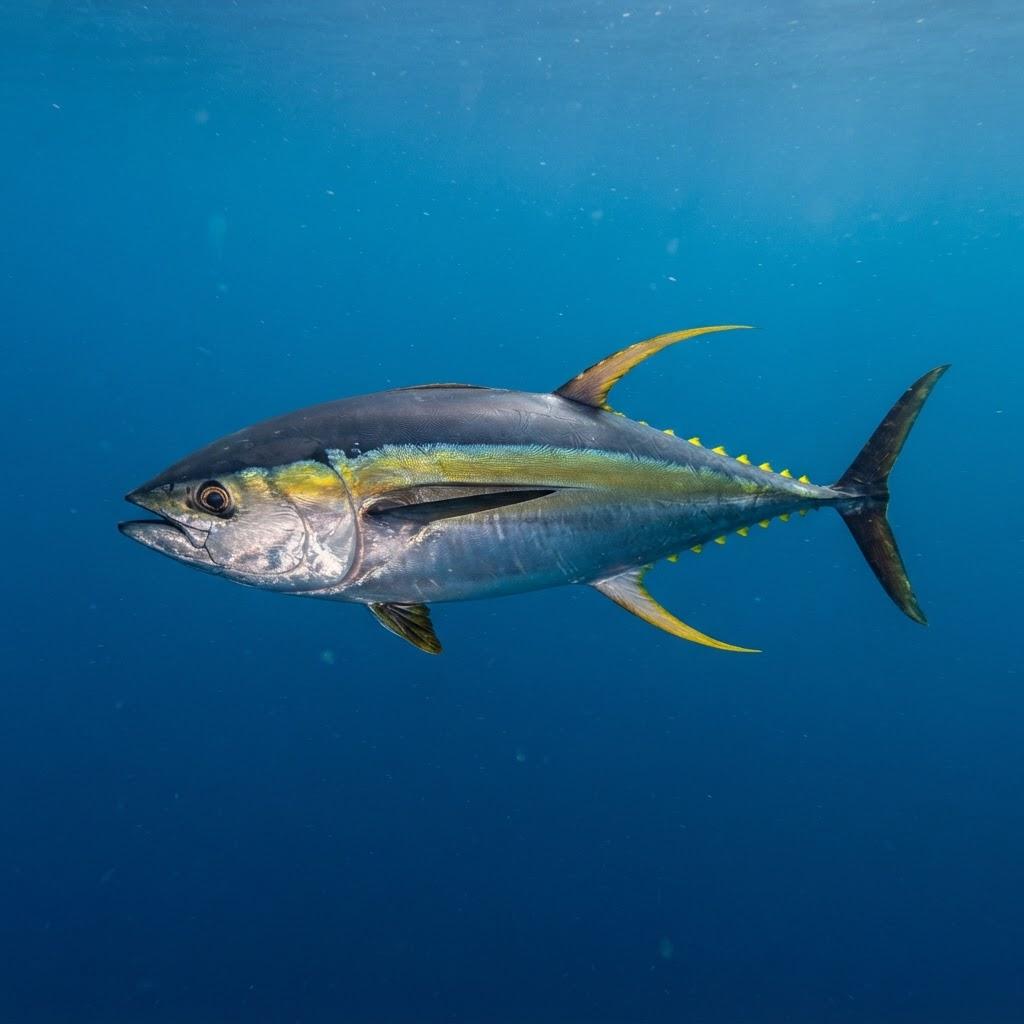
Thunnus albacares
Yellowfin Tuna
Meet the Yellowfin Tuna, the ocean's ultimate speed-demon and a true athlete of the high seas. This torpedo-shaped marvel is not just a tasty catch but a living masterclass in underwater aerodynamics and endurance.
Meet the Fish
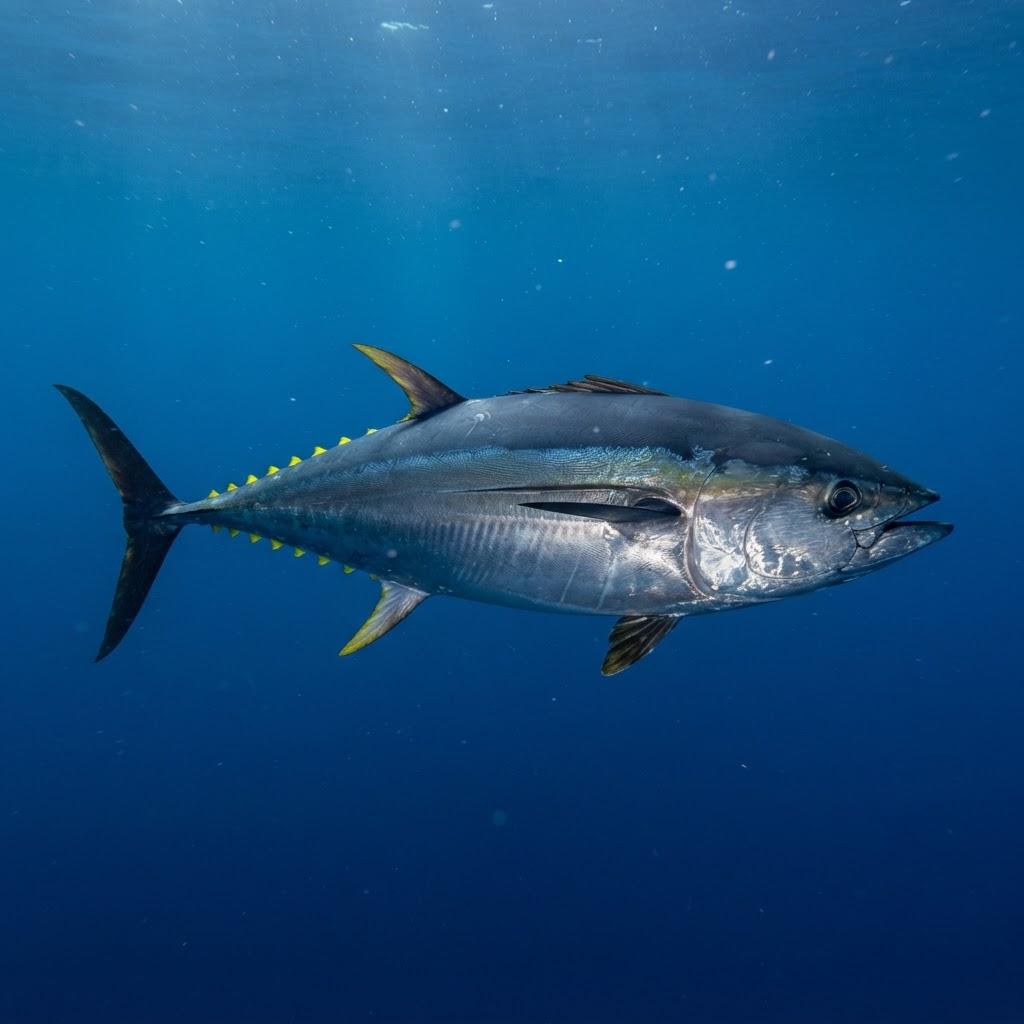
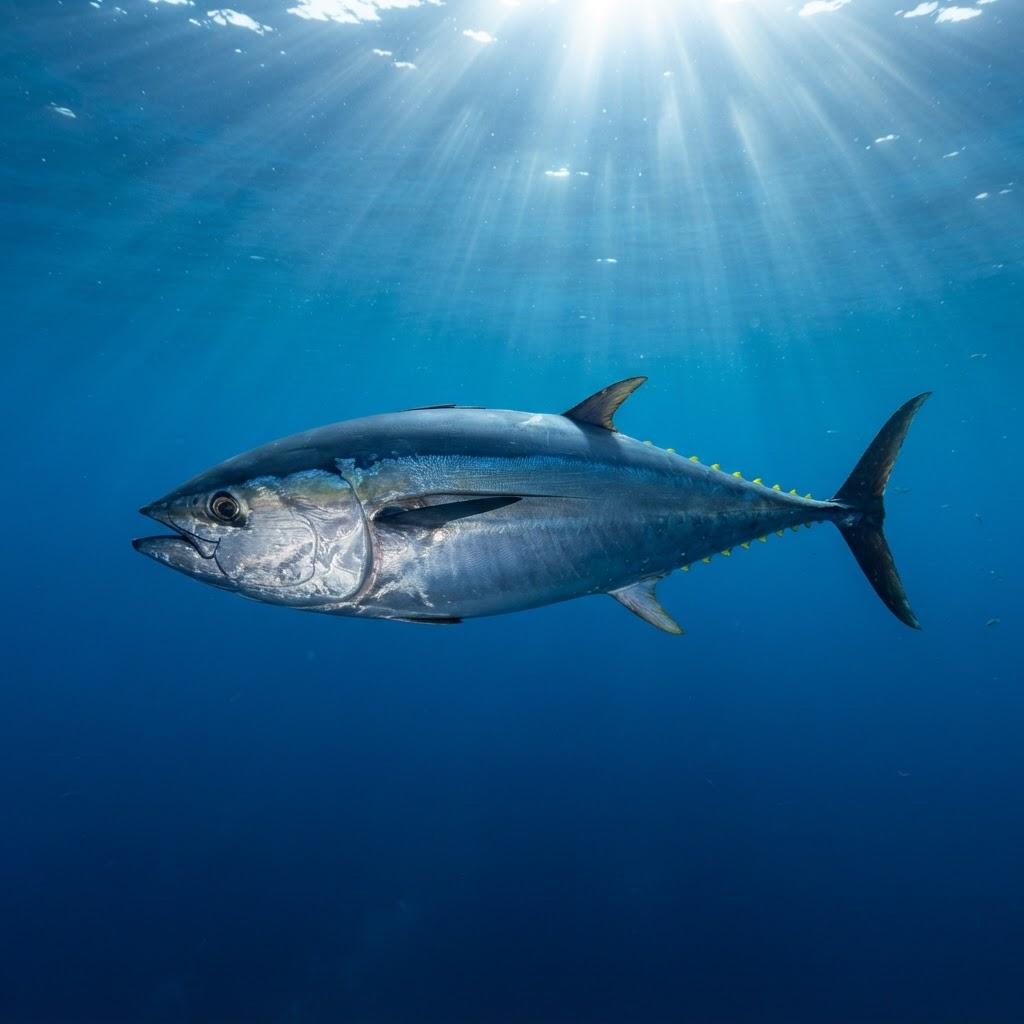
If the ocean held a high-speed chase tournament, the Yellowfin Tuna would absolutely be the guy driving the Ferrari. These aren't your typical lazy goldfish lounging in a bowl; these are the muscle cars of the sea. Named for those striking, bright-yellow finlets that trail along their back like neon racing stripes, these fish possess a streamlined, hydrodynamic body that makes them look like they were designed in a high-tech wind tunnel. They are constantly moving, never pausing to rest, because their biology demands it. They have this restless, high-octane personality that translates to a lifestyle of pure, unadulterated speed. Imagine a creature that is literally incapable of stopping; they have to keep swimming just to breathe. It is a frantic, non-stop marathon from the day they are born until their final lap. They are the quintessential high-achievers of the marine world, cruising thousands of miles across the deep blue without so much as a coffee break to recharge. They are bold, they are fast, and they are incredibly efficient at being exactly what they are: the undisputed champions of the open ocean drag race.
Weird Biological Superpowers Explained Simply
Most fish are cold-blooded, which is a fancy way of saying they are at the mercy of the surrounding water's temperature. If the water gets chilly, they get sluggish. But not the Yellowfin Tuna. These guys are what scientists call 'endothermic,' which basically means they have a secret internal furnace. They can keep their muscles and eyes warmer than the water around them, allowing them to swim in colder currents that would make other fish turn into ice cubes. Think of it like a biological turbocharger; it keeps their muscles primed for explosive speed at a moment's notice. They also possess a specialized heat-exchange system in their blood vessels that prevents them from leaking all that precious heat into the ocean. This internal heating system is the reason they can hunt in deeper, darker, and colder waters while still maintaining the lightning-fast reflexes of a tropical fish. It is essentially nature's version of a built-in space heater, allowing them to dominate vast swaths of the ocean that would otherwise be off-limits to their weaker competitors.
Absurd Self-Defense Mechanisms
When you are a Yellowfin Tuna, you do not have the luxury of hiding in a reef or camouflaging yourself as a boring rock. You are huge, you are shiny, and you live in the wide-open blue desert where there is nowhere to duck. So, what is their defense strategy? It is simple: run away really, really fast. Their primary protection against predators like sharks or billfish is pure, unadulterated acceleration. When a threat appears, they don't bother with defensive posturing or ink clouds; they just shift into an extra gear that most creatures can't even dream of hitting. Their body is shaped like a perfectly tapered torpedo, reducing drag to near zero, which lets them rocket away before a predator can even compute what happened. It is the marine equivalent of a ninja vanishing into a smoke bomb, only the smoke bomb is just raw kinetic energy. If speed fails, they rely on their massive, muscular size to discourage anything that isn't a top-tier apex predator, turning their body shape into a message that says, 'I am too big and fast to be worth the effort.'
Fish Drama and Gossip
If you peeked into the social life of a Yellowfin school, you would find the marine equivalent of a high-stakes, competitive boarding school. These fish are intensely social, often hanging out in massive, tightly knit groups. It is not just about safety in numbers; it is about status. There is a constant, subtle hierarchy where the largest, most vibrant fish set the pace for the entire school. If you aren't keeping up, you are basically falling out of the social loop, which in tuna terms, is a death sentence. There is no time for drama-filled arguments, but there is certainly a hierarchy of 'who gets to feed first' during a bait ball frenzy. Think of it like the lunchroom at a school where everyone is running on a treadmill. The fastest, strongest individuals dictate the direction of the pack, while the younger, smaller ones follow in their wake, hoping to pick up scraps. It is a world of non-stop coordination, constant communication via body language, and a rigorous social order that ensures everyone stays in formation and moving forward, no matter what.
The "Wait, That's Real?!" Deep-Sea Oddities
Yellowfin Tuna are travelers of the upper water layers, but they sometimes dive deep into the 'twilight zone' to snag a snack. While they don't have the bioluminescent glow-sticks that deep-sea dwellers use to throw parties in the pitch black, they share the neighborhood with some absolute weirdos. Compared to the Yellowfin, which is sleek and athletic, the denizens of the deep look like they were put together by a bored child playing with spare parts. You have fish like the barreleye, which has a transparent head so you can see its brain and eyes, or the anglerfish with its terrifying glowing lure. While the tuna relies on perfect vision and speed, these deep-sea oddballs rely on camouflage, luring prey with fake lights, or simply having a massive mouth that can swallow anything that drifts by. It is a stark contrast: the Yellowfin is the high-performance athlete doing sprints on the surface, while the deep-sea fish are the eccentric, spooky hermits living in a basement that never sees the light of day.
Myth Busting
Let’s squash the rumor that tuna are just mindless 'swimming machines' with no brainpower. People often think that because they move so fast, they must be operating on pure instinct, but that is flat-out wrong. Yellowfin Tuna are actually quite observant and display complex problem-solving behaviors when hunting. They don't just mindlessly bump into things; they coordinate their attacks with other school members, effectively 'herding' baitfish into tighter groups to maximize their snack intake. This requires a level of communication and situational awareness that puts them far above the level of a 'mindless' creature. Another myth is that they are all the same size. People see them in pictures and assume they are a standard uniform size, but a juvenile Yellowfin is barely a couple of pounds while a massive adult can weigh as much as a fully grown human. They aren't factory-made units; they are individuals that grow, learn, and adapt to the specific conditions of their home range, proving that 'simple' fish are actually surprisingly complex and capable thinkers.
Humorous Historical Tales or Folklore
Throughout history, humans have been obsessed with the Yellowfin. Because they move in such massive, predictable schools, ancient fishermen considered them a blessing from the sea gods—or sometimes a total headache if they showed up in the wrong place at the wrong time. There are legends from Pacific islander cultures that treat the tuna as a noble warrior of the water, a symbol of strength and endurance. In some folklore, the tuna was believed to be the scout for the ocean's greatest secrets, a fish that traveled so far and wide that it must have seen the edge of the world. Sailors used to tell stories about schools of tuna that would follow ships for days, almost as if they were curious tourists wanting to see where the humans were headed. While the science tells us they were likely just checking to see if we were dropping any food, the sailors’ romantic interpretation gave the Yellowfin a reputation as a mysterious, globe-trotting companion of the sea, a fish that possessed the wisdom of a thousand voyages.
Underwater Love Stories and Bizarre Romances
If you think your Tinder dating life is complicated, wait until you hear about the tuna dating scene. There is no candlelight, no dinner dates, and definitely no small talk. For the Yellowfin, romance is a massive, frantic, and incredibly public affair. When it is time to spawn, they congregate in large groups, releasing millions of eggs and sperm directly into the open current. It is less like a romantic encounter and more like a giant, chaotic underwater party where everyone is invited, and the main goal is just to ensure that the next generation gets started. They don't build nests or write love songs; they rely on the sheer, overwhelming odds of numbers. It is a calculated gamble against the ocean itself. Each individual does its part by dumping its genetic legacy into the water, hoping that enough of those tiny, microscopic eggs will survive the gauntlet of hungry predators to grow into the next generation of speed-demons. It is messy, it is desperate, and it is entirely effective.
Underwater Architecture and DIY Nesting
While some fish spend their lives building elaborate fortresses, digging tunnels, or constructing sand castles, the Yellowfin Tuna are the ultimate minimalists. They are the 'van-lifers' of the ocean. Why build a house when the whole ocean is your home? They don't bother with nesting or territory management because their lifestyle revolves around constant movement. Building a permanent structure would be a massive waste of energy that could be better spent on swimming another five hundred miles. They don't have a 'bedroom' or a 'pantry'; they are constantly on the move, chasing baitballs and surfing the currents. Their 'architecture' is purely social—the way they arrange themselves into a tight, shimmering sphere to confuse predators or to create a synchronized hunting formation. It is a fluid, ever-changing structure that exists only as long as the fish are together. They prove that you don't need fancy walls or a stationary address to be a successful and highly evolved inhabitant of the big blue.
The Chaos of Raising Tiny Swimmers
Raising a baby tuna is essentially a 'good luck and Godspeed' mission. There is no parental guidance, no swimming lessons, and absolutely no protection. Once the eggs are fertilized in the open water, the parents immediately swim off to find their next meal, leaving the tiny, vulnerable larvae to fend for themselves. From the moment they hatch, these tiny swimmers are on the menu for almost everything in the ocean, from jellyfish to tiny shrimp. It is a harsh, brutal introduction to the world, but it is also a numbers game. Because the parents release millions of eggs, all it takes is a tiny fraction of one percent to survive to adulthood for the population to keep thriving. The babies that do survive are the ones that learn to swim, hide, and hunt with lightning-fast instincts right from the start. They are born as tiny, transparent specks and grow rapidly, fueled by a metabolic fire that keeps them constantly moving and constantly eating, destined to follow the same nomadic life as their parents.
How to Spot One & How It Is Doing
So, how do you spot a Yellowfin Tuna without being a professional diver or a commercial fisherman? Look for the 'boils.' When a school of Yellowfin is actively hunting, they hit the baitfish so hard that the surface of the ocean literally starts to bubble and froth as if it were boiling. If you see a frenzy of birds diving into the water in the middle of the deep ocean, that is your clue. They are currently doing quite well, classified as a species of 'Least Concern,' though that doesn't mean we should take them for granted. They are a vital part of the ocean's economy and its ecosystem. To help keep these speed-demons racing for years to come, be a conscious consumer of seafood. Check labels for sustainably caught sources and support organizations that work on global fisheries management. By choosing to support responsible fishing, you are helping to ensure that the ocean’s Ferrari continues to have a clear, safe track to run on for generations of future fish fans to admire.