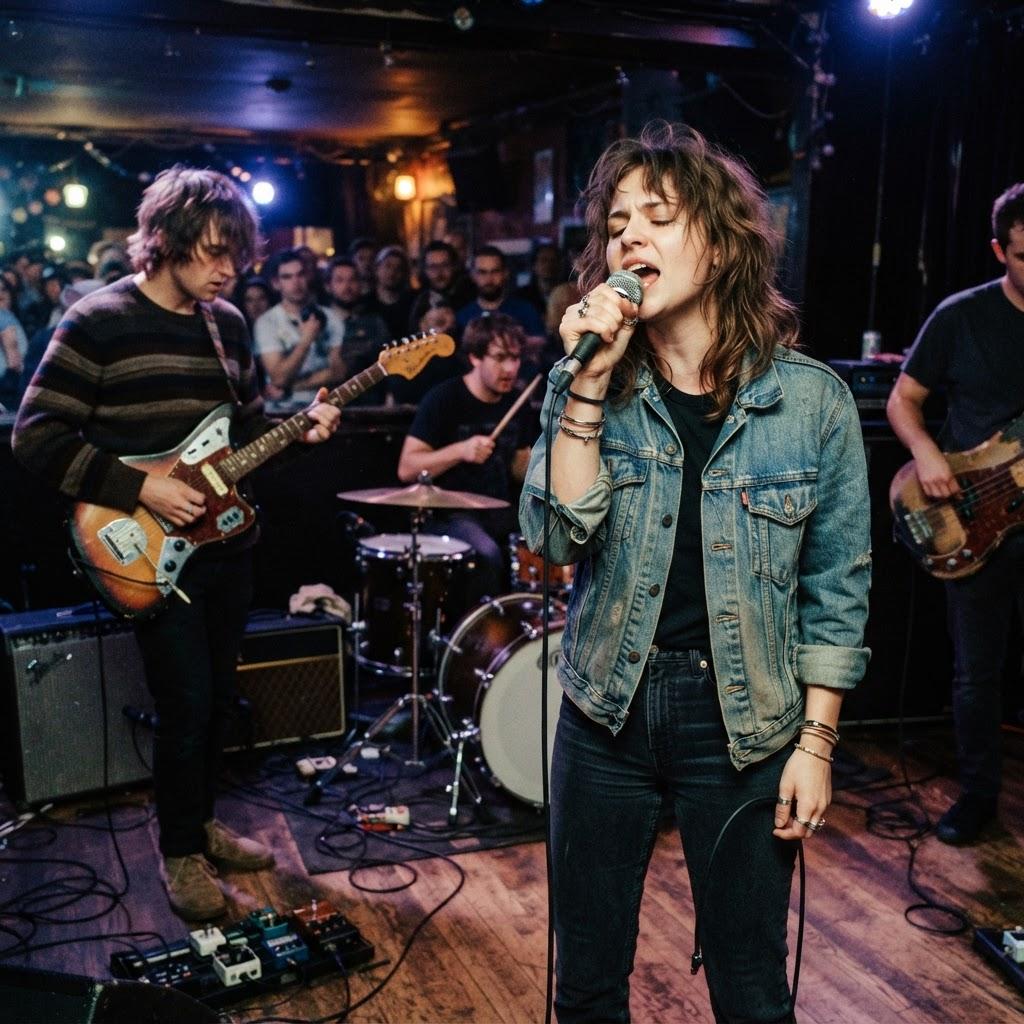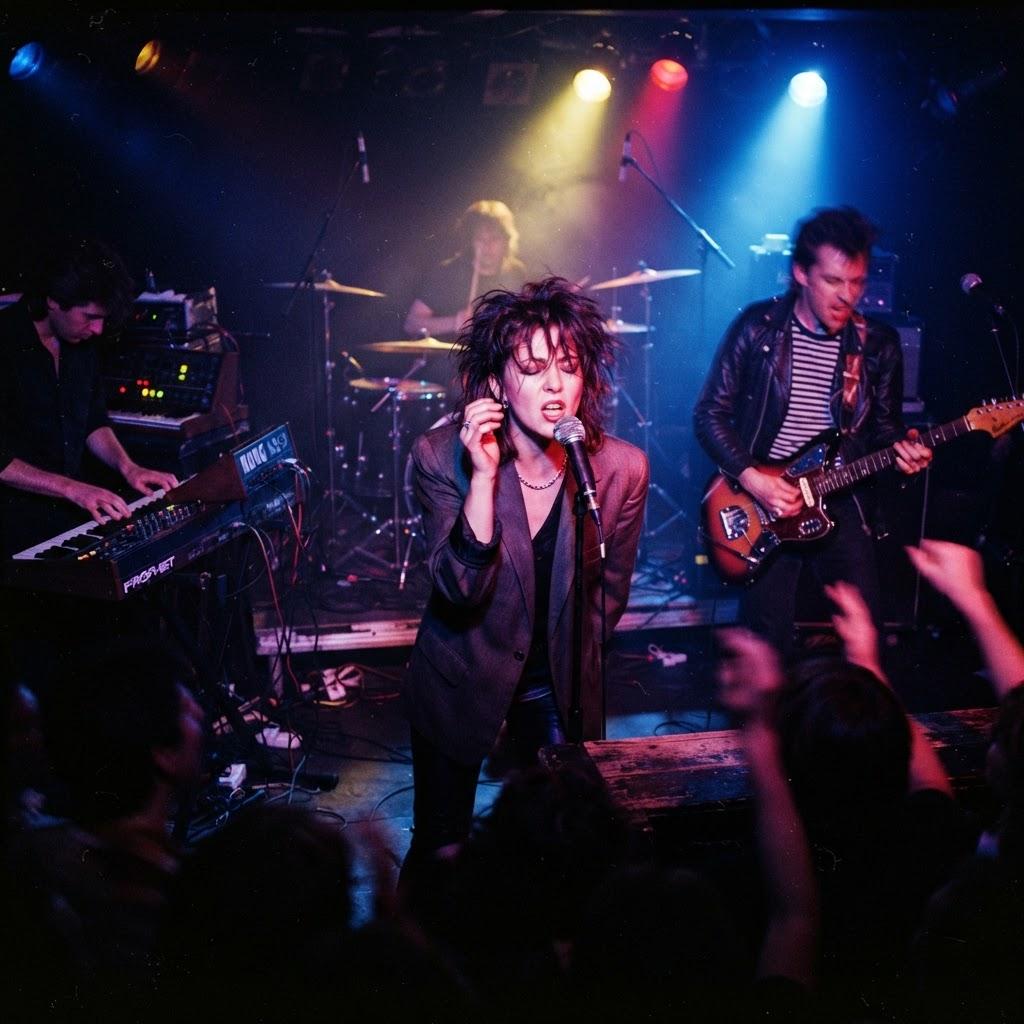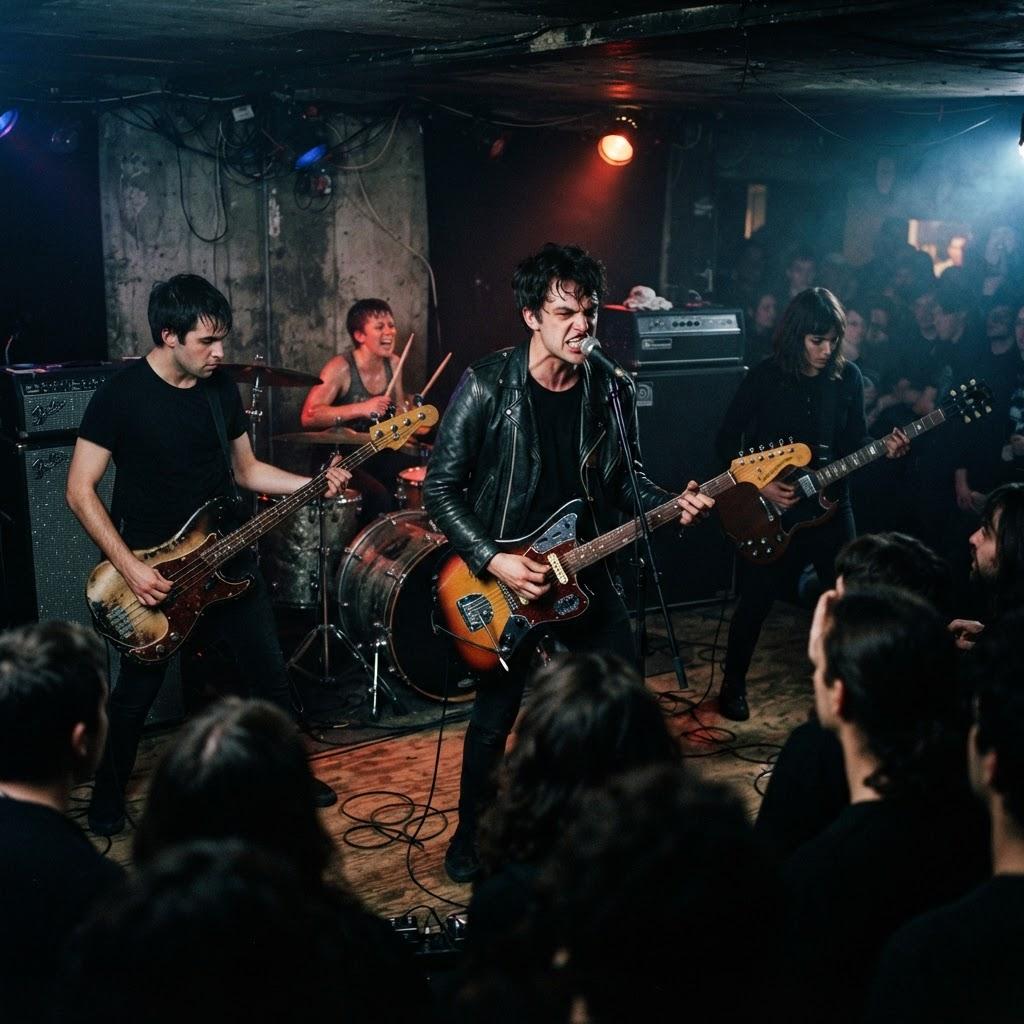
Late 1970s, United Kingdom
Post-Punk
Post-Punk is the brooding, artistic younger sibling of the punk explosion who decided that speed was boring and architecture was cool. It is a sonic landscape where angular guitars meet existential dread for the ultimate midnight dance party.
Meet the Genre
Imagine punk rock was a loud teenager who smashed a guitar and ran out of the house. Post-Punk is the same teenager coming back three months later wearing a black turtleneck, carrying a copy of a Russian existentialist novel, and quietly obsessed with how the acoustics of an empty factory hall sound when you hit a drum. It is the music of urban decay that suddenly discovered it had a brain. Where punk wanted to burn everything down because it was angry at the government, Post-Punk wanted to redecorate the ruins with cold, geometric precision. It is moody, it is twitchy, and it is weirdly danceable if you are the kind of person who likes to stare at your shoes while moving your hips. Think of it as the ultimate soundtrack for people who find sunshine offensive but still want to feel something meaningful while sipping a lukewarm coffee in a room with peeling wallpaper. It is not just music; it is an atmospheric condition, a deliberate choice to favor tension over release, and a masterclass in making minimalism sound like the apocalypse.
The Sound & Signature Elements
If you want to bake a Post-Punk cake, you need a few specific ingredients that don't belong in a normal pantry. First, take the guitar and strip away the crunchy, distorted noise of old-school punk. Replace it with chorus—a studio effect that makes a guitar sound like two instruments playing at once, giving it that watery, shimmering, slightly seasick quality. Next, prioritize the bass. In this genre, the bass guitar is the boss; it often plays the melody while the guitar just plays jagged, rhythmic chirps that sound like a nervous bird trapped in a synthesizer. The drums are the most iconic part, often utilizing 'gated reverb,' a trick where the echo on the snare drum is chopped off abruptly, making the drums sound like they are being hit inside a giant, empty concrete box. The vocals? They should never be too happy. Whether the singer is chanting, deadpanning, or howling with neurotic intensity, the goal is to sound like someone delivering a manifesto from the edge of a nervous breakdown. Everything is angular, precise, and intentionally stripped back to make every single note feel like a direct punch to the ribs.
Origins & Birth of the Sound
The birth of Post-Punk wasn't a sudden explosion; it was more like a slow, chilly morning after a wild party. By 1978, the initial fire of the Sex Pistols and the raw power of the Ramones had started to flicker. Musicians realized that playing three chords at a million miles an hour was fun, but it hit a ceiling pretty quickly. In the damp, rain-slicked streets of Manchester and the hollowed-out post-industrial neighborhoods of London, bands started looking for something else. They were inspired by the repetitive, hypnotic grooves of Jamaican dub reggae and the icy, intellectual reach of German art-rock. It was a time of economic recession in the UK, and that cold, hard economic reality seeped directly into the music. These artists weren't just playing instruments; they were reacting to the brutal, grey architecture surrounding them. They holed up in rehearsal studios that doubled as art spaces, trading in their leather jackets for trench coats, and decided that instead of screaming at the establishment, they would build their own sonic fortresses where the vibe was decidedly 'less is more' and 'more is actually quite frightening.'
The Pioneers & Legends
If you were to gather the founding fathers of Post-Punk in one room, it would probably be a very quiet, very intense gathering. Joy Division stands as the undisputed titan of the genre, with Ian Curtis possessing a voice that sounded like it was coming from the bottom of a deep well. Their ability to turn hopelessness into something structurally beautiful remains the gold standard. Then there is The Cure, who eventually pivoted from dark, claustrophobic soundscapes to pop stardom without losing their edge, showing everyone that you can be gloomy and still have a melody that sticks in your head for weeks. Gang of Four brought a political, rhythmic crunch to the scene, proving that you could write a song about Marxism that was actually fun to dance to. Siouxie and the Banshees added a layer of gothic mysticism, proving that the genre could be theatrical and occult-adjacent. Each of these legends had a unique flavor, but they all shared a commitment to reinventing the wheel by breaking the guitar, slowing down the tempo, and refusing to play by the rules established by the generation before them.
Defining Tracks & Era-Defining Moments
To understand the gravity of this movement, you have to hear the tracks that define it. Joy Division’s 'Disorder' is the perfect entry point; it’s a nervous, twitching creature that perfectly captures the anxiety of living in a world that feels like it’s falling apart at the seams. Then there is 'Damaged Goods' by Gang of Four, which features one of the most iconic, skittering guitar riffs ever recorded—it sounds like it’s trying to escape the song entirely. You cannot ignore 'A Forest' by The Cure, a track that builds a dark, hypnotic woodland of sound and forces you to get lost in its repetitive, spiraling bassline. Each of these tracks acted as a manifesto for the movement. They weren't just songs; they were seismic shifts in how people perceived rock music. They proved that you didn't need to be a virtuoso to be a genius, as long as you had a vision that was strong enough to replace technical proficiency with raw, unwavering, and slightly disturbing emotional resonance. These moments defined the era because they turned the bedroom into a concert hall and the concert hall into a confessional.
Subgenres & Offshoots
Post-Punk is like a sprawling family tree with branches that lead to some very strange places. There is 'Goth Rock,' the dramatic, caped, and heavily eyeliner-clad branch that took the gloom of Post-Punk and added a dash of vampire aesthetic and cathedral-sized echoes. Then there is 'Dance-Punk,' where the rhythmic, bass-driven foundations of the genre were cranked up for the club scene, making the dance floor a place for neurotic, jerky movements rather than graceful waltzes. We also have 'Industrial,' which took the mechanical, factory-like sounds of early Post-Punk and decided to embrace the noise of actual heavy machinery, replacing guitars with scrap metal and synthesizers that sound like they are breaking. You also have 'Cold Wave,' which is essentially Post-Punk's most antisocial cousin, stripped of almost all warmth, favoring drum machines over human drummers and icy, synthesized pulses over human emotion. Each subgenre took a specific part of the original Post-Punk DNA—the darkness, the rhythm, the coldness, or the experimentation—and pushed it to such an extreme that it created entirely new worlds for listeners to inhabit.
Cultural Impact & Influence
Post-Punk didn't just change the music charts; it infected the culture at large like a fashionable, black-clad virus. It changed how people dressed, swapping the loud, chaotic safety pins of punk for the somber, architectural silhouettes of New Wave and Goth fashion. You started seeing oversized trench coats, sharp angles, and hair that looked like it had been styled by a gale-force wind. In film, it inspired directors to move away from bright, happy visuals and toward high-contrast, noir-inspired cinematography that mirrored the moody, sparse sound of the records. It even changed the way people thought about art; the 'DIY' (do-it-yourself) ethos of the genre encouraged a generation to stop waiting for permission and start making their own fanzines, independent labels, and underground art collectives. Politics, too, were handled differently—instead of vague, shouty slogans, Post-Punk lyrics often dealt with the crushing weight of systemic alienation, consumerism, and the slow erosion of the individual. It became a language for the outcasts, providing a soundtrack for anyone who felt that the mainstream world was just a colorful lie designed to keep them from noticing the cracks in the foundation.
Controversies & Drama
No genre is complete without its fair share of backstage shouting and record-store brawls. In the world of Post-Punk, the main controversy was almost always about 'authenticity.' There was a constant, simmering civil war between the purists who thought that if you were signed to a major label, you were essentially a traitor to the revolution, and the bands who were just trying to afford a decent synthesizer. The press, especially the aggressive British music rags, loved to play these bands against each other, crowning one the 'future of music' one week and calling them 'pretentious frauds' the next. You had legendary feuds over who was ripping off whose sound, with bands accusing one another of stealing the 'cold bassline' trope. Then there were the 'sellout' accusations that followed any band that dared to have a melody people could actually hum, or heaven forbid, a song that got played on the radio. It was a scene where looking too cool was seen as a character flaw, and being too accessible was seen as a moral failing. The drama was often as dense and layered as the reverb on the snare drums, creating a scene that was constantly eating itself.
Global Spread & Regional Scenes
While Post-Punk was born in the grey, concrete cradles of Northern England, it traveled faster than a rumor. In New York, it collided with the avant-garde art scene, producing bands that were more focused on the friction between sound and performance art. Australia developed its own distinct flavor, adding a sun-drenched but somehow still haunted, sprawling quality to the music that felt like a desert nightmare. In Berlin, the genre was embraced with a uniquely cold intensity, fueled by the city's own history of division and trauma, leading to some of the most experimental and harsh electronic sounds of the era. Each city remixed the genre to fit its own vibe: the Americans were louder and more rhythmic, the Europeans were more electronic and detached, and the Brits remained the kings of the melancholic, rain-drenched basement aesthetic. It became a global language of alienation, proving that whether you were in Melbourne, New York, or London, the feeling of being a bit weird and not quite fitting in was a universal experience that needed a bassline.
The Modern Landscape
Fast forward to today, and you might think the genre would have been retired to a museum of 20th-century history, but you would be dead wrong. Post-Punk is currently having a massive, unapologetic revival. A whole new generation of bands has rediscovered that there is nothing more powerful than a nervous, high-pitched guitar line and a bass that thumps like a heartbeat. If you hop on TikTok or check out the latest festival lineups, you will see kids wearing thrifted oversized blazers, playing basslines that sound like they were pulled directly from 1979. Modern bands have taken the original blueprint and added modern production, making it punchier and sometimes even more aggressive than the originals. It is no longer just a 'retro' hobby; it is a vital, living, breathing movement that continues to influence everyone from bedroom electronic producers to stadium-filling indie rockers. The reason it refuses to die is simple: the world is still a bit weird, still a bit cold, and still a bit confusing, and Post-Punk remains the perfect sonic companion for navigating the absurdity of modern existence.
How to Dive In
Ready to trade in your sunny pop playlist for something a bit more shadowy and sharp? Start your journey by putting on Joy Division’s 'Unknown Pleasures.' It is the undisputed bible of the genre—listen to it from start to finish without doing anything else, just let the atmosphere sink into your bones. From there, move to Gang of Four’s 'Entertainment!' if you want to hear how a guitar can act like a rhythmic weapon, and then listen to The Cure’s 'Seventeen Seconds' to experience the absolute peak of moody, atmospheric brilliance. Do not be afraid to jump into the weird stuff either; seek out Wire’s 'Pink Flag' for the moment punk decided it needed to get smart, and Siouxsie and the Banshees’ 'Juju' if you want to see how dark and theatrical this music can get. Keep your bass loud, your treble sharp, and your expectations for 'happy' music low. Once you get the bug, you’ll find yourself hunting for those jagged, angular riffs in every new band you hear. Welcome to the club—the coffee is lukewarm, the lighting is dim, and the music is absolutely essential.