1960s
Psychedelic Rock
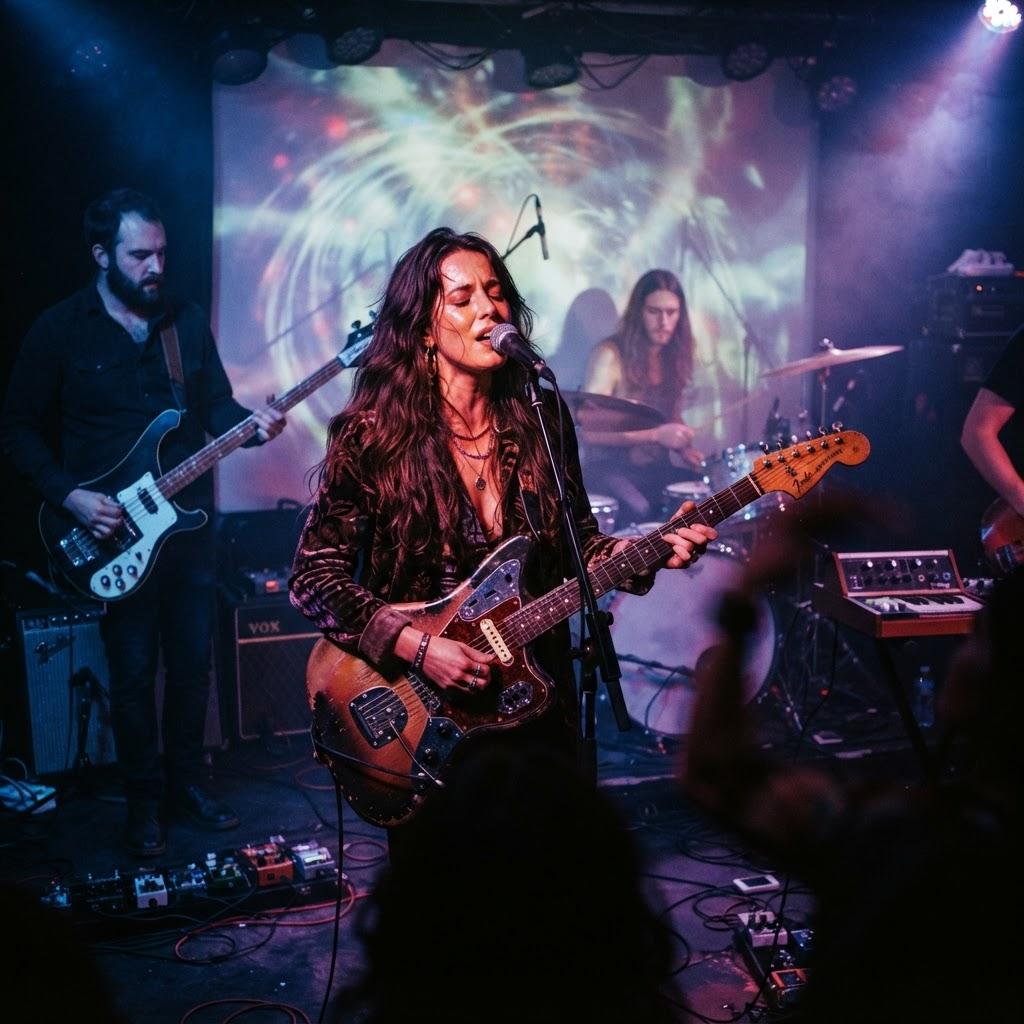
Psychedelic Rock is the musical equivalent of a kaleidoscope spinning inside a lava lamp. It is a colorful, mind-bending journey through reverb-drenched echoes and guitar solos that feel like they are melting into the floorboards.
Meet the Genre
Psychedelic Rock is that friend who shows up to the party wearing a velvet cape, holding a lava lamp, and claiming they can see the color of your thoughts. It is the music that sounds like a sunset melting into a puddle of neon paint. If traditional rock and roll is a firm handshake, Psychedelic Rock is a long, wandering conversation about the geometry of the universe held while staring at a flickering strobe light. It doesn't care about your rigid ideas of song structure or keeping time like a metronome; it prefers to take the scenic route through your subconscious. You don't just listen to this stuff—you sort of inhabit it, letting the reverb wash over you like a warm tide. It is the soundtrack to every weird, wonderful thought you've ever had, wrapped in layers of fuzz and mystery. Forget the rulebook, because this genre shredded that thing years ago to use as confetti for a freak-out session.
The Sound & Signature Elements
At its core, the sound of Psychedelic Rock is defined by the hunt for the 'extra-dimensional' tone. Musicians fell in love with a little device called a fuzz pedal, which turns a clean guitar sound into a snarling, fuzzy beast that sounds like a bee trapped in a blender. They also obsessed over studio tricks like backward recording—literally flipping the tape over so sounds play in reverse—and phasing, which makes instruments sound like they are passing through a spinning fan blade in space. The drums often sound thick and sludgy, while the bass line might wander off on its own adventure, ignoring the melody entirely. Vocals are usually drenched in reverb, which is just an effect that makes it sound like the singer is performing inside a massive, echoing cathedral. Think of it as a sonic playground where the laws of physics are merely suggestions, and the main goal is to make the air itself feel like it’s vibrating with secrets.
Origins & Birth of the Sound
The birth of Psychedelic Rock wasn't in some high-tech skyscraper; it was in the damp, smoke-filled basements and community halls of the mid-1960s, particularly in San Francisco’s Haight-Ashbury district. You had groups of artists, misfits, and poets tired of the radio-friendly three-minute pop songs that told you exactly how to feel. They wanted something that matched the intensity of the rapidly changing world around them. Driven by a hunger for exploration, they started plugging their instruments into whatever strange gear they could find and pushed their amplifiers to the brink of failure. It was a beautiful act of rebellion. They didn't just want to play music; they wanted to create an 'experience.' This was the sound of a generation realizing that reality was negotiable, and if they could make the walls of a basement feel like they were expanding into the cosmos, they had done their job. It was raw, it was messy, and it was absolutely revolutionary.
The Pioneers & Legends
The legends of this era were like musical alchemists. Jimi Hendrix arrived and basically taught the guitar how to speak in tongues, turning a standard electric axe into a weapon of mass cosmic destruction. Then there was The Doors, with Jim Morrison acting as the high priest of the strange, using his baritone voice to lure listeners into dark, poetic tunnels. The Grateful Dead were the masters of the long-form jam, turning every concert into an unpredictable, hours-long improvisational marathon where no two nights sounded the same. Pink Floyd started out as a bunch of experimental London art students making space-age noise before they became the masters of the concept album. These artists were not just musicians; they were sonic explorers who were willing to chase a weird idea down the rabbit hole to see if it turned into gold. Every time they stepped onto a stage, they were trying to build a bridge to somewhere no one else had ever been.
Defining Tracks & Era-Defining Moments
If you want to understand the genre, you need to witness the moments where the ceiling blew off the music industry. Jefferson Airplane’s 'White Rabbit' is the quintessential guide to the sound, creeping along like a velvet shadow until it explodes in a frantic, orchestral finale. It proved that rock music could be deeply literary and weirdly suspenseful. Then there is The Beatles’ 'Tomorrow Never Knows,' a track so far ahead of its time that it still sounds like it’s arriving from the future. By using tape loops and drone-like sounds, they turned a pop song into a meditative mantra. Pink Floyd’s 'Interstellar Overdrive' is another monster, a track that sounds like a spaceship losing its mind while trying to land in a junkyard. These songs were the shockwaves that told every other musician that you didn't have to follow the charts; you just had to follow your curiosity until you found something that sounded like nothing else on earth.
Subgenres & Offshoots
As the genre grew, it started splintering into all sorts of wild directions. You have 'Acid Rock,' which is the harder, louder, and more aggressive sibling that wants to melt your brain with sheer volume. Then there is 'Dream Pop,' a more ethereal, hazy cousin that prefers to float above the clouds rather than stomp through the mud. 'Shoegaze' took the wall-of-sound production and turned it inward, with players creating vast, swirling textures of noise while staring at their guitar pedals. We even saw 'Tropicalia' emerge in Brazil, which took the psychedelic spirit and mixed it with local rhythms and political defiance, creating something entirely fresh. Each of these offshoots took the basic idea—that music should be a transformative trip—and applied it to different moods and textures. Whether it’s heavy, light, fuzzy, or shimmering, the family tree of Psychedelic Rock is a sprawling, chaotic, and beautiful mess that keeps evolving with every new generation of kids who find a fuzz pedal.
Cultural Impact & Influence
Psychedelic Rock didn't just change the charts; it changed the way people decorated their living rooms and their minds. You can trace the lineage of modern festival culture, with its focus on visual art and immersive experiences, directly back to the light shows of the late sixties. Fashion took a sharp turn toward the eccentric, swapping stiff suits for paisley shirts, flowing fabrics, and jewelry that looked like it was scavenged from a mystical forest. The language of the era—words like 'vibe,' 'far out,' and 'tune in'—all spilled out of the speakers and into the street. It challenged the rigid social norms of the decade, encouraging people to look at politics, spirituality, and their own identity through a wider lens. Even modern movies with their dreamlike, surreal visual styles owe a massive debt to the imagery that this music conjured. It was the moment society decided it was okay to be a little bit strange, provided the soundtrack was loud enough.
Controversies & Drama
Oh, the drama was spectacular. The scene was essentially a pressure cooker of huge egos, questionable life choices, and constant 'artistic differences.' You had the purists who thought adding a synthesizer was a crime against humanity, fighting with the experimentalists who wanted to incorporate actual field recordings of whale songs. There was the infamous 'sellout' crisis whenever a band moved from a tiny, sticky-floored club to a stadium, with the original fans crying betrayal as if the band had personally burned their record collections. The backstage stories are the stuff of legend, involving everything from band members walking off stage mid-solo to legendary battles over who got to use the studio space for the longest 'freak-out' jam. It was a volatile world, but honestly, that friction was often the fuel for the best music. If everyone had agreed on everything, the records would have sounded like background music in an elevator, and nobody wants that.
Global Spread & Regional Scenes
While it started in the misty streets of San Francisco and London, Psychedelic Rock was a virus of the best kind—it spread everywhere. In Japan, you had bands blending traditional folk scales with heavy fuzz guitars to create something hauntingly beautiful. The Turkish psychedelic scene of the seventies was arguably the coolest thing to happen to rock music, fusing funky, driving basslines with microtonal melodies that feel like a fever dream in a bazaar. Australia has kept the torch burning in the modern era, creating a thriving scene of bands who can switch from lighthearted pop to chaotic, swirling madness in a single track. Each region took the core idea—that sound is a tool for exploration—and added their own spices. It became a global language, proving that no matter what language you speak, a really great, wobbly guitar riff communicates the same feeling of total wonder.
The Modern Landscape
Today, Psychedelic Rock isn't just alive; it’s shape-shifting into new forms we never saw coming. We are living in a golden age of 'Neo-Psychedelia,' where artists are using high-end computers to recreate that analog, warm, slightly unstable sound of the sixties. You find it everywhere, from TikTok trends where people look for 'trippy' sounds to back their aesthetic videos, to massive festivals where bands are using immersive projections to turn the entire crowd into a living, breathing art installation. Modern bands are proving that the genre doesn't need to be tied to a specific time period. Instead, it’s a mindset. Whether you are using vintage gear or a laptop, the spirit of Psychedelic Rock remains the same: it’s about breaking the wall between the listener and the music. It’s no longer about being 'counterculture'; it’s about being a vital part of the creative spectrum that allows us to dream while we are wide awake.
How to Dive In
If you are ready to take the plunge, start by clearing your calendar and putting on a pair of good headphones. Don't try to multitask; this music demands your undivided attention. Start with The Jimi Hendrix Experience’s 'Are You Experienced'—it is the holy grail, a masterclass in how to melt strings with pure attitude. Follow that up with Pink Floyd’s 'The Piper at the Gates of Dawn' if you want something whimsical and slightly unhinged. If you want a modern taste, check out anything by Tame Impala for that slick, modern, fuzzy production that bridges the gap between old-school cool and new-school pop. Just remember, there is no wrong way to listen to this. If a song makes you feel like you are floating, or if it makes you want to stare at the ceiling for an hour and think about the vastness of the cosmos, you are doing it exactly right. Hit play, turn it up, and let the colors start to swirl around your brain.