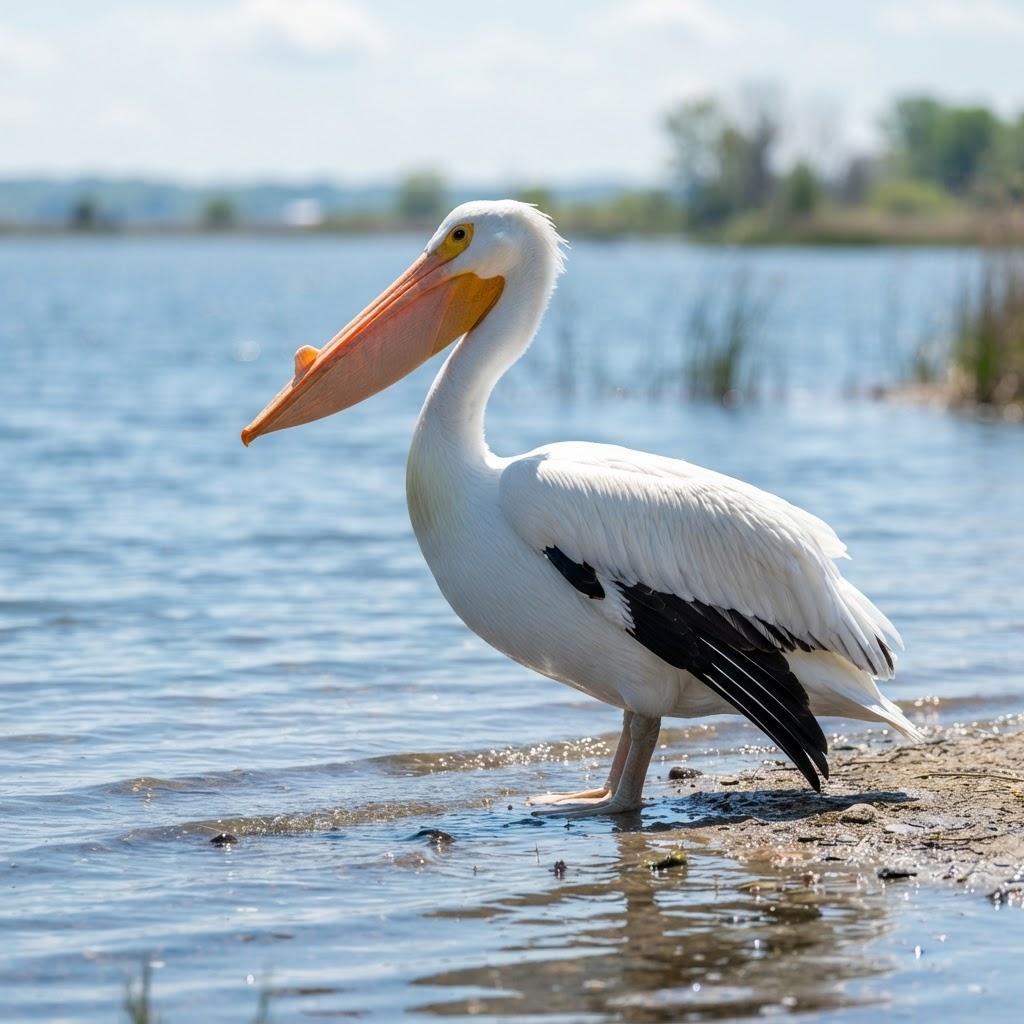
Pelecanus erythrorhynchos
American White Pelican
The American White Pelican is a massive, elegant acrobat that swaps the saltwater life for inland lakes and team-based fishing strategies. With a neon-orange bill and a wingspan like a small airplane, this bird proves that being big and goofy is a winning evolutionary strategy.
Meet the Bird
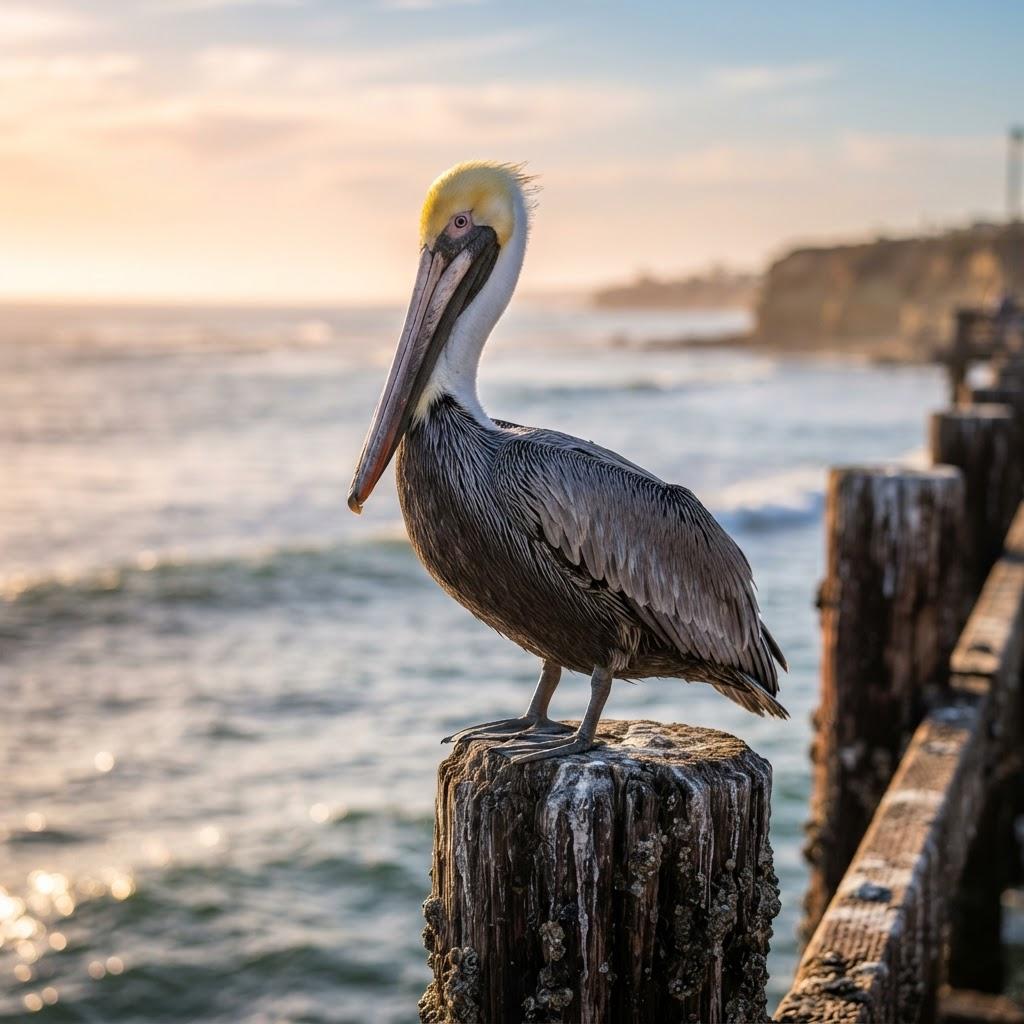
Imagine a majestic, snow-white swan that hit the gym, developed a massive appetite, and decided to wear a prosthetic orange beak for flair. That is the American White Pelican. Unlike their slightly more famous Brown Pelican cousins who enjoy dramatic, high-speed dives into the surf, the White Pelican is a sophisticated socialite that prefers to fish like a tactical military unit. These birds are the largest in North America by wingspan, and when they take to the sky, they look like prehistoric pterodactyls patrolling the horizon. They possess a stoic, almost grumpy elegance while resting on a sandbar, but the moment they hit the water, they become synchronized swimming champions. They are not the loud, obnoxious neighbors of the bird world; they are the quiet, massive, slightly odd athletes that you cannot help but stare at when they glide overhead in a perfect V-formation. Their vibe is strictly 'professional fisherman who occasionally likes to show off by soaring on thermals for hours without flapping a wing.'
Superpowers & Weird Abilities
The true superpower of the American White Pelican is its ability to perform high-altitude gliding that would make a sailplane pilot jealous. By finding pockets of warm, rising air called thermals, these giants can ascend thousands of feet with virtually zero effort, locking their wings in a rigid, impressive glide. It is essentially nature’s version of a free ride on an invisible elevator. Furthermore, they are the masters of the 'gular pouch.' This isn't just a shopping bag for fish; it’s a highly vascularized, flexible tool. While it looks like a giant, flapping rubber glove, it is actually filled with blood vessels that help them regulate their body temperature in the summer heat. If you see a pelican panting with its throat sac flapping, it is effectively using its own body as a giant, fleshy radiator to stay cool. It is biology’s answer to air conditioning, proving that sometimes, being a bit weird-looking is the most efficient design choice.
Drama, Personality & Feathered Chaos
Do not let the stoic face fool you; the American White Pelican is a master of group coordination, but that doesn't mean they don't have their share of workplace drama. When they fish, they do it as a team, paddling in circles to corral schools of fish into tight, frantic clusters. It is like a synchronized swimming routine, except with significantly more biting and swallowing. However, once the buffet is open, the politeness ends. While they are not necessarily bullies to other species, they are opportunistic thieves. If a Double-crested Cormorant manages to catch a fish, the White Pelican is often hovering nearby, watching with a predatory glint in its eye, ready to swoop in and relieve the smaller bird of its dinner. They are the ultimate 'I’ll take that for you' diners of the lake. Within their own ranks, they are fiercely social, preferring the company of their massive colonies over solitary wandering, making their nesting grounds a loud, crowded, and occasionally chaotic metropolis.
Bizarre Rituals & Quirky Habits
Perhaps the most baffling and hilarious physical feature of the White Pelican is the 'nuptial tubercle'—a bizarre, horn-like growth that sprouts right on top of their bill during the breeding season. Imagine going to a dinner party and suddenly growing a decorative keratin horn on your nose just to signal you are ready to date. It serves no function other than being a high-fashion accessory that screams, 'I am a healthy, high-quality partner.' Once the breeding season wraps up, the horn simply falls off, leaving the bird looking like it just went through a confusing cosmetic surgery reversal. They also engage in strange, head-tossing displays where they point their bills toward the sky as if asking the universe for a better fishing spot. It is a ritual that looks entirely ridiculous to humans but is clearly a secret language of prestige and dominance for a bird that takes its grooming and its nose-horns very seriously.
Legends, Folklore & Human Stories
While they lack the massive mythology of the raven or the eagle, the American White Pelican has long held a place in the hearts of Indigenous peoples of the Great Plains and the West. In many oral traditions, the pelican is viewed as a clever provider and a navigator of the inland waters. Because they often disappear from northern lakes in the winter, their arrival in the spring was frequently seen as a harbinger of warmer weather and a sign that the lakes would soon be teeming with life again. Early European settlers were often baffled by these birds, as they were used to the marine pelicans of the Atlantic; finding these massive, white, inland-dwelling birds seemed like a strange twist of nature. They were often referred to as 'rough-billed pelicans' in older journals, and their ability to thrive in remote, alkaline desert lakes made them seem like the mysterious nomads of the American landscape, perfectly adapted to environments where most other waterbirds would struggle to find a decent meal.
Mating: The Ridiculous World of Avian Dating
In the world of the White Pelican, courtship is essentially a high-stakes, group-choreographed performance. A single male will attempt to woo a female, but the entire colony acts like an audience of critical talent scouts. They partake in synchronized marches, strutting along the shoreline like they are on a runway, showing off their bright orange bills and those temporary, beautiful nose-horns. If the male does not have enough energy or fails to secure a prime nesting spot on a remote island, his chances of finding a partner drop faster than a stone in a lake. The female is incredibly selective; she doesn't care about a romantic song or a gift of jewelry. She wants to see strength, group-participation skills, and the best real estate on the island. If he doesn't perform the group-strut with enough enthusiasm, she simply walks away to find a bird with a better strut, leaving the poor guy to deal with his leftover fish and his shedding nose-horn in solitary shame.
Nesting: Master Architects and Lazy Slumlords
White Pelicans are not exactly the gold-standard of home builders. Their 'nests' are essentially shallow, pathetic depressions in the dirt or gravel, lined with a meager collection of whatever debris is lying around—sticks, grass, or bits of discarded feathers. They aren't trying to build a cozy, insulated cradle; they are looking for a plot of land on a remote, predator-free island where they can drop an egg and pray for the best. The real 'engineering' involved is more about territory management than construction. They crowd together in dense, bustling colonies, and a nest is really just the few square feet of dirt a bird can manage to defend from its neighbor. It is the avian equivalent of an urban high-rise where the walls are made of mud and spite. Despite the lack of structural integrity, these colonies are incredibly successful because they bank on safety in numbers, making it nearly impossible for a predator to sneak into the nursery without being swarmed by hundreds of angry, oversized birds.
Raising Babies: The Screaming Food Disposals
Once the eggs hatch, the parents are thrust into a nightmare of constant feeding. Pelican chicks are essentially naked, shivering, and extremely ugly monsters that demand food every few seconds. Parents feed their young by regurgitating partially digested, mushy fish directly from their pouch into the chick's hungry, gaping maw. It is a messy, unglamorous, and somewhat gross process, but it is incredibly effective at packing on the calories. As the chicks grow, they become aggressive, jostling for space and screaming at their parents with a persistent, high-pitched screech that can be heard for miles. The chaos reaches its peak when the young birds start forming 'crèches'—massive groups of teenagers that wander the nesting grounds like a pack of unruly, gangly youngsters, begging for food from any adult who looks like it might have a full stomach. It is a grueling, exhausting period for the parents, who must spend their days fishing tirelessly to fuel their growing, screeching food disposals.
Bird-Watching Travel & Local Hotspots
If you want to see an American White Pelican, stop looking at the ocean and start looking inland. These birds are absolute stars in the American West. The Great Salt Lake in Utah is a mecca for them, with massive colonies nesting on the islands in the middle of the lake. Another prime location is the Klamath Basin National Wildlife Refuge on the border of Oregon and California, which acts as a major pit stop during migration. If you are in the Midwest, head to the reservoirs of North Dakota or Minnesota during the summer months. The key to spotting them is identifying large, quiet lakes or marshes that have relatively undisturbed islands. Use a spotting scope if you can, as they are often far from the shore. The best time to visit is late spring or early summer when the breeding activity is at its peak and the colonies are buzzing with activity, providing a front-row seat to one of nature’s most spectacular group dynamics.
Food, Feeder Hacks & DIY Projects
Let’s be honest: you aren't going to attract a White Pelican to a bird feeder in your suburban backyard. These are not seed-eaters, and they certainly don't care for your premium sunflower hearts. Their diet consists exclusively of fish. Unless you happen to have a backyard pond stocked with hundreds of live carp or minnows, they aren't coming to visit. However, you can support their habitat by keeping local waterways clean and avoiding the use of pesticides that run off into lakes and poison their food supply. If you want to engage in a DIY project, skip the bird feeder and instead build a 'natural brush pile' or a nesting box for the birds that actually do frequent your area. By supporting the health of your local wetland ecosystem, you are indirectly feeding the White Pelicans by ensuring their hunting grounds remain productive. Bird conservation is about the big picture; keep the local lake clean, and the pelicans will keep the population of invasive fish under control.
Seasonal Guides & "Crisis" Management
White Pelicans are migratory nomads that follow the fish. In the spring, they head north to their inland breeding grounds, and as the cold sets in, they migrate south to the coastlines of the Gulf of Mexico or California. The most common 'crisis' people encounter with these birds is finding a juvenile that looks like it is abandoned or injured. If you find a young pelican sitting on the shore and it isn't clearly tangled in fishing line or bleeding, it is likely just waiting for its parents to return from a fishing trip. Do not attempt to feed it or move it. If the bird is struggling to walk or has an obvious injury, contact your local wildlife rehabilitation center immediately. Never attempt to rescue a giant, wild waterbird yourself—those pouches and bills are designed for grabbing, and they can deliver a very painful pinch to an unsuspecting human hero who gets too close.
Backyard Tech & Gadget Reviews
Since these birds are not backyard visitors, high-tech bird feeders like AI-powered cameras won't help you catch a photo of them. Instead, invest in a quality pair of 10x42 binoculars and a long-range camera lens. If you are serious about capturing their behavior, a motion-activated 'trail camera' can be a great tool if you are monitoring a specific spot on a local lake or protected shoreline, but only if you have permission to place it. For those who want to help these birds remotely, many wildlife refuges use 'nest cams' during the breeding season. These are the best way to get a bird's-eye view of the domestic drama without disturbing their habitat. If you find yourself enjoying birding tech, use an app like eBird to record your sightings; the data you collect helps scientists track migration patterns and population health across the entire continent, making your tech hobby a legitimate contribution to wildlife science.
How to Spot One & How It Is Doing
Spotting an American White Pelican is almost impossible to get wrong. Look for a large, snow-white bird with a black-tipped wingspan—the black edges are only visible when they are flying, contrasting sharply against the white body. On the water, look for the massive, orange, boat-like bill. They are doing quite well these days, with populations largely stable and even increasing in some areas, thanks to improved conservation efforts for their nesting sites. They are classified as Least Concern, which is a rare, happy ending in the world of conservation. To keep them thriving, support public lands and national wildlife refuges where they nest, and be mindful of your own impact on the lakes you frequent. By keeping our waterways healthy and respecting the boundaries of nesting colonies, we ensure that these magnificent, prehistoric, nose-horn-growing giants continue to patrol our skies for generations to come. They are the true ambassadors of the inland wild, and they deserve our protection.