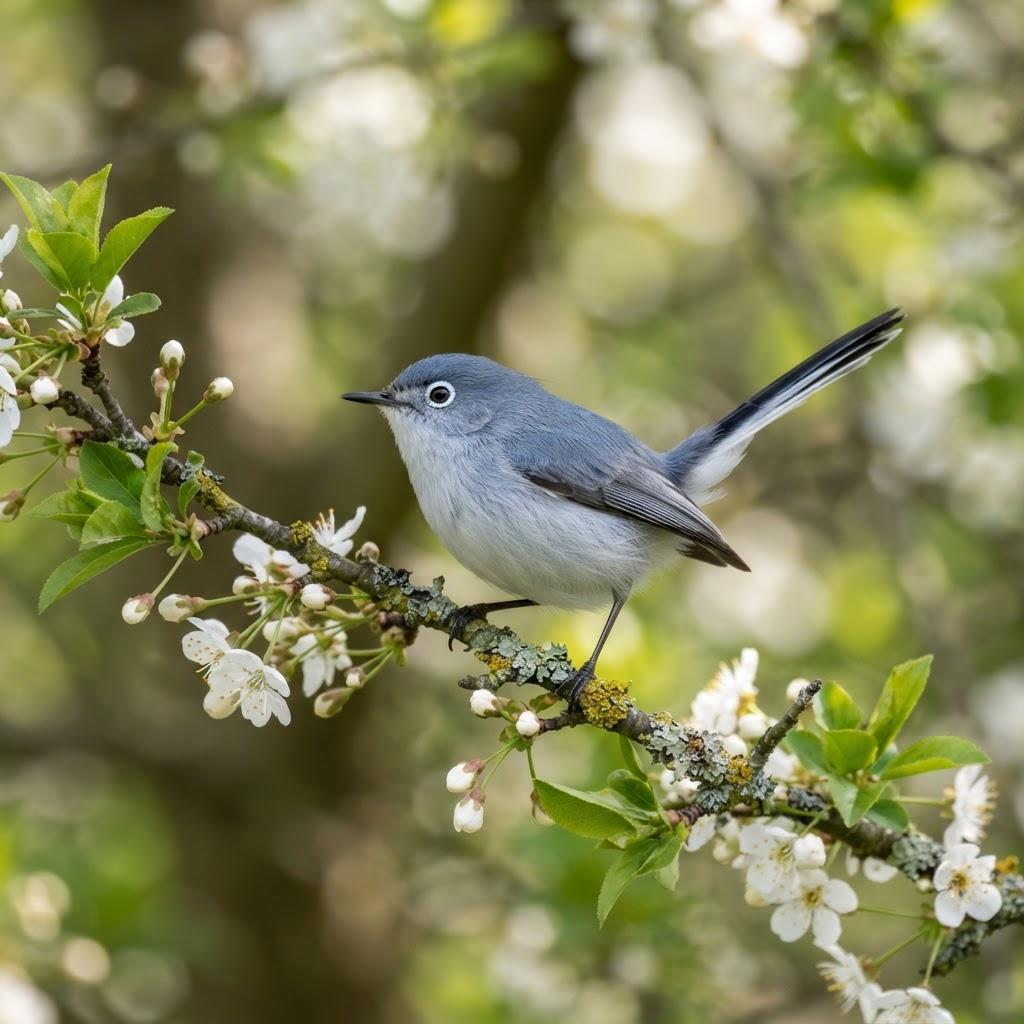
Polioptila caerulea
Blue-gray Gnatcatcher
Meet the Blue-gray Gnatcatcher, a high-octane acrobatic sprite that treats every tree branch like an Olympic balance beam. This tiny powerhouse brings big-bird energy to your backyard, proving that you do not need to be a giant to own the forest canopy.
Meet the Bird
Imagine a bird that has just downed five shots of espresso, realized it is late for a meeting, and decided the best way to travel is by bouncing off every single twig in a ten-mile radius. That is the Blue-gray Gnatcatcher in a nutshell. This is the caffeinated parkour athlete of the avian world. With a slate-blue tuxedo, a white eye-ring that gives it a permanently surprised expression, and a tail that seems to have a mind of its own—constantly cocking and twitching—this bird is the embodiment of nervous energy. It does not just sit on a branch; it vibrates. If you have ever seen a small, bluish-gray ball of fluff darting through the mid-story of a forest, pausing only for a millisecond to snatch a microscopic insect before exploding into motion again, you have met the Gnatcatcher. It is a cinematic scene-stealer, a bird that makes the local cardinals look like sluggish, bored aristocrats by comparison.
Superpowers & Weird Abilities
The Gnatcatcher is a master of what scientists call 'sally-gleaning,' which is fancy talk for 'launching oneself into the air like a feathered torpedo to snag a bug mid-flight.' Because their prey—mostly tiny gnats and spiders—is effectively invisible to the naked human eye, these birds rely on a level of visual processing that would make a fighter pilot weep. They possess incredibly fast neural pathways that allow them to calculate the trajectory of a jumping insect in a split second, change mid-air, and secure the prize. Think of it like watching a tennis player return a serve they cannot actually see, except the tennis ball is a fruit fly. Their agility is made possible by a high metabolic rate that essentially acts as a biological turbocharger. They are constantly moving, effectively turning their entire bodies into one high-speed, insect-seeking heat-seeking missile that never runs out of fuel.
Drama, Personality & Feathered Chaos
In the miniature kingdom of the forest canopy, the Gnatcatcher is the ultimate agitator. Do not let the small size fool you; these birds are scrappy, relentless, and prone to picking fights with birds ten times their size. If a larger intruder wanders too close to their nesting site, the Gnatcatcher does not just fly away; it engages in a frantic, high-pitched verbal assault, essentially swearing at the intruder until they get annoyed and leave. They are the neighborhood watch captains who take their jobs way too seriously. Within their own species, they are equally dramatic, engaging in endless, high-speed chases that look like a cartoon flight sequence where both characters run through the air while ignoring the laws of gravity. They are the feathered equivalent of that one friend who is always in the middle of some sort of bizarre, high-stakes personal crisis involving a spiderweb.
Bizarre Rituals & Quirky Habits
One of the most peculiar habits of the Gnatcatcher is its constant tail-flicking. This is not just a nervous tic; it is a tactical maneuver. By twitching their white-edged tails, they startle hidden insects into moving. It is the avian equivalent of waving a giant flag in a darkened room to see if anything jumps. They are also known to be fastidious cleaners. You will often see them wiping their beaks on branches with the intensity of someone trying to scrub a stubborn stain out of a white carpet. This serves a dual purpose: it keeps their tools clean and helps them scrape off the sticky remains of their most recent snack. They are, in essence, the neat freaks of the canopy, ensuring that their precision equipment remains in tip-top condition, even if they have to fly at breakneck speeds to do it.
Legends, Folklore & Human Stories
While they do not command the same mythological presence as ravens or eagles, Gnatcatchers are often viewed by local birders as the 'jewels of the forest.' In various folklore traditions, the tiny, energetic behavior of small songbirds is often linked to the idea of hidden magic or messengers of the forest spirits. Because they are so hard to spot and even harder to track, seeing a Gnatcatcher is often interpreted by enthusiasts as a sign of a healthy, thriving ecosystem. If you find one, the forest is clearly doing something right. Human stories about these birds usually involve a moment of sudden realization—a birder trekking for hours, seeing nothing but shadows, and then having this tiny, blue flash of genius land just a few feet away. They are the 'blink and you miss it' legends of the woodlands, earning them a cult-like following among those who appreciate the smaller wonders.
Mating: The Ridiculous World of Avian Dating
The courtship of the Gnatcatcher is a high-speed, choreographed dance that makes ballroom dancing look like a funeral procession. The male, desperate to prove he is the most energetic suitor in the woods, performs a series of gravity-defying aerial loops while singing a song that is surprisingly complex for something so small. It is a mix of wheezes, trills, and high-pitched zips. If the female is impressed, she sticks around to watch the show; if not, she simply flies off, leaving the male to continue his audition to an empty branch. It is a brutal, fast-paced dating scene where performance is everything. They also participate in a 'mutual display' where they perch side-by-side, twitching their wings and tails in perfect synchronization, confirming that they are indeed the most coordinated power couple in the canopy.
Nesting: Master Architects and Lazy Slumlords
If you ever wanted to see a masterpiece of engineering, look for a Gnatcatcher nest. They are essentially the Frank Lloyd Wrights of the bird world. They build these tiny, perfectly shaped cups and cover the exterior in lichen and spider silk, making the whole thing look like a natural bump on a tree branch. It is the ultimate camouflage. From the ground, it is virtually invisible. It is a tight, secure little home that blends into the bark perfectly. Compare this to the lazy habits of a mourning dove, which just tosses a few twigs together and prays, and you can see why Gnatcatchers are the elite contractors of the avian community. They take their time, they source the best materials—mostly stolen spider silk—and they make sure the nursery is reinforced against the elements.
Raising Babies: The Screaming Food Disposals
Once the eggs hatch, the peace and quiet of the forest ends for the parents. The babies are basically tiny, perpetually hungry, featherless blobs with massive beaks. They operate on a simple feedback loop: eat, scream, sleep, and repeat. The parents are essentially exhausted delivery drivers for a restaurant that only serves spiders, gnats, and tiny caterpillars. They spend their entire day in a constant loop of flight, foraging, and return, depositing food into the gaping maws of the chicks. It is a test of endurance. A pair of Gnatcatchers will work themselves ragged for weeks, putting in thousands of miles of travel just to ensure their screaming brood survives. It is an amazing display of parental sacrifice, especially when you realize the chicks offer absolutely zero feedback other than higher-pitched begging.
Bird-Watching Travel & Local Hotspots
If you want to catch a glimpse of these blue dynamos, head to mature deciduous forests. In the eastern United States, hotspots like the Great Smoky Mountains National Park or the various National Wildlife Refuges along the Mississippi River are top-tier locations. During the spring migration, they are widespread, but you should look for areas with lots of oaks and maples. If you are in the southern U.S. or Mexico during winter, keep an eye on the edges of woodlands or even well-wooded suburban parks. The best strategy is to stand in a shaded area and listen. Their high-pitched, thin, buzzy calls are often the first sign of their presence. Once you hear that 'zhee-zhee-zhee,' stop moving, scan the mid-canopy, and look for that telltale flickering tail. It is a hunt, but a rewarding one.
Food, Feeder Hacks & DIY Projects
Here is the honest truth: you are not going to attract a Blue-gray Gnatcatcher with a standard tube feeder filled with cheap sunflower seeds. They are insectivores. They want live protein. To bring them to your yard, you have to create an insect paradise. Focus on native plants like oak trees, viburnums, or dogwoods that attract the native bugs the Gnatcatcher loves. A birdbath with a dripper is also a secret weapon; these birds are obsessed with moving water. For a DIY project, try a 'suet log.' Drill small holes into a piece of natural wood, pack it with high-quality insect-based suet, and hang it near dense shrubbery. It mimics the texture of a tree trunk and provides the kind of fatty, protein-rich diet they crave during the colder months when bugs are harder to find.
Seasonal Guides & "Crisis" Management
Spring is the magic season. As the leaves emerge, the Gnatcatchers return to set up shop. This is the best time to watch their courtship displays. However, spring also brings the 'fledgling panic.' If you see a small, slightly clumsy bird on your patio, do not assume it is abandoned. It is likely a fledgling, a teenager experiencing its first day of work. The parents are usually nearby, watching from a tree, waiting for you to leave. Leave it alone. Do not feed it, do not move it, and keep your pets inside. It will gain its flight feathers and move on in a day or two. Winter is a different story; when the insects vanish, the birds become much more reliant on the supplemental fat you provide in your yard.
Backyard Tech & Gadget Reviews
If you want to document the Gnatcatcher, regular cameras might struggle with their speed, but AI-powered smart feeders are becoming a game-changer. These systems, like those that use motion sensors and high-speed cameras, can actually catch a photo of a Gnatcatcher when it stops for a quick drink or a snack. As for window collisions, simple decals or external screens are the best investment. Birds see reflections, and Gnatcatchers, in their hyper-active state, are prone to 'testing' the air in front of a window. Apply window film or hanging strings to the outside to break up that reflection. It is cheap, easy to install, and saves a bird's life. Think of your windows as the final barrier between a bird and a hard, glass wall—make it visible for them.
How to Spot One & How It Is Doing
To identify the Gnatcatcher, remember the rule of the three T's: Tiny, Twitchy, and Tuxedo-clad. They are significantly smaller than your average sparrow, have a bluish-gray back, a white belly, and a long tail with white outer feathers that they wag like a metronome. If it looks like a miniature mockingbird that drank too much caffeine, you have got the right bird. Currently, the species is doing well, listed as Least Concern, but they are highly sensitive to habitat loss and pesticide use. To help them, stop using pesticides in your yard. Let the bugs thrive; the birds will do the pest control for you. By creating a chemical-free, native-plant-heavy sanctuary, you are ensuring that these feathered acrobats have a place to perform for generations to come.