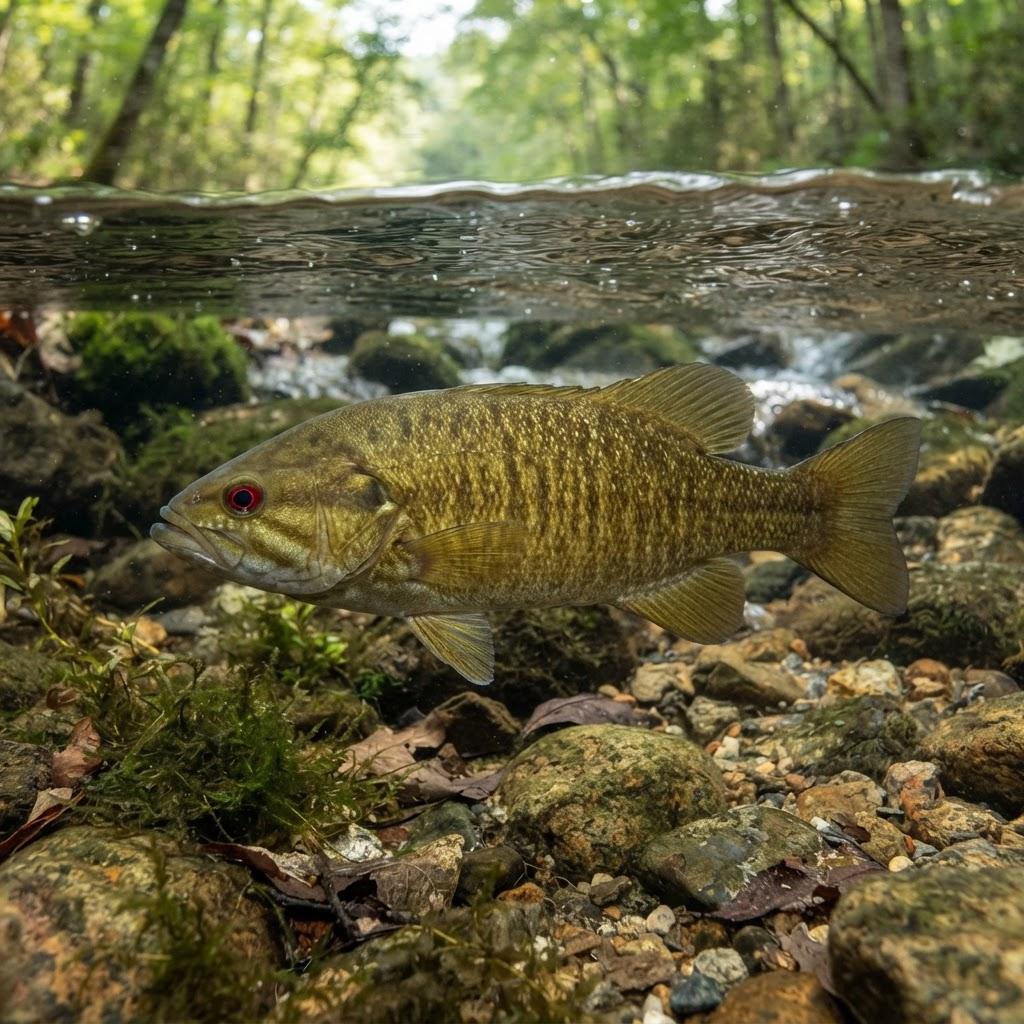
Micropterus coosae
Redeye Bass
Meet the Redeye Bass, the caffeinated punk rocker of the Southern stream circuit. With its signature blood-red eyes and a fighting spirit that defies its pint-sized frame, this fish is the ultimate underdog hero of the Appalachian waterways.
Meet the Fish
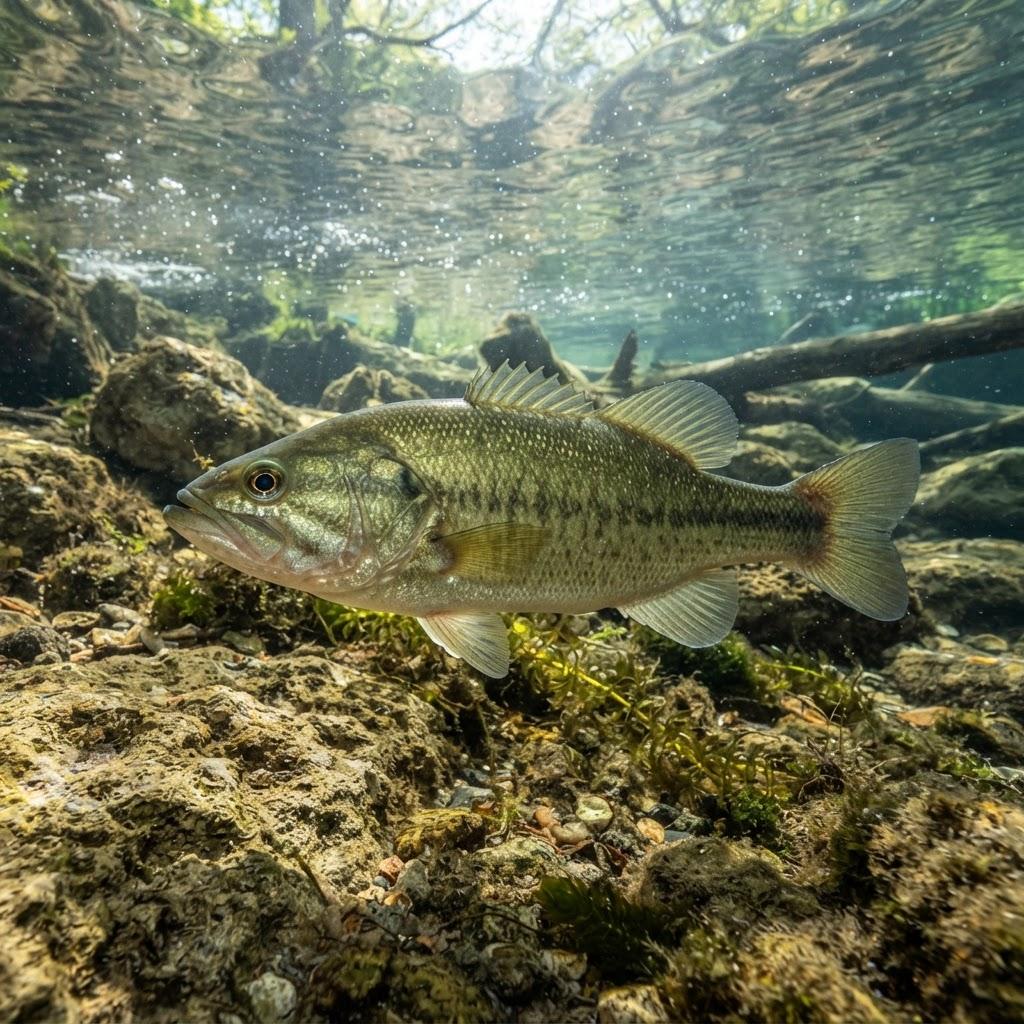
If the world of freshwater fish were a high school, the Redeye Bass would definitely be the kid wearing a leather jacket, listening to loud music in the back of the class, and refusing to follow the dress code. They are not the biggest fish in the pond—or the river, for that matter—but they possess an attitude that screams, Look at me! Native to the rocky, tumbling streams of the southeastern United States, the Redeye Bass is the quintessential scrappy underdog. They look like a regular largemouth bass that decided to get a radical makeover for a heavy metal band photo shoot. Their most striking feature is, predictably, those intense, ruby-red eyes that make them look like they haven’t slept in a week because they have been busy plotting world domination or, more likely, hunting for a crayfish. This fish lives life in the fast lane, preferring the oxygen-rich, rapid-moving water that would make most other fish feel like they are caught in a permanent wind tunnel. They are agile, alert, and possess a level of nervous energy that makes them a favorite among anglers who enjoy a fish that actually wants to put up a decent fight.
Weird Biological Superpowers Explained Simply
How does a fish stay perfectly still in a raging mountain stream without getting swept away like a loose leaf in a hurricane? The Redeye Bass has a secret weapon that is essentially biological 4WD. Their pectoral fins—those are the ones on the sides that act like steering wheels—are positioned in a way that allows them to pivot and adjust to the swirling currents. But the real magic is in their lateral line. Imagine if your entire body was a giant, sensitive touch-screen that could feel the exact speed and direction of the water around you. The lateral line is a canal running down their sides filled with tiny sensory organs that pick up vibrations and pressure changes. It allows them to navigate murky, turbulent water with the precision of a fighter pilot. They aren't just swimming; they are constantly 'reading' the flow of the river to find the perfect micro-currents behind rocks where they can conserve energy while waiting for lunch to float by. It is basically a built-in GPS and proximity sensor system that would make a stealth submarine jealous.
Absurd Self-Defense Mechanisms
When you are a Redeye Bass living in the open, high-energy environment of a river, you don't have the luxury of hiding in thick lily pads like your lazy cousin the Largemouth Bass. You have to be quick, you have to be mean, and you have to know how to disappear in a blink. Their primary defense mechanism is what scientists call 'disruptive coloration.' They have dark, vertical bands that run down their sides, which act like a camouflage suit in the dappled sunlight hitting the riverbed. When a hungry predator, like a river otter or a larger fish, comes prowling, the Redeye Bass knows exactly how to angle its body so it perfectly blends into the shadows cast by rocks and river vegetation. It’s the aquatic equivalent of an invisibility cloak. Furthermore, they are masters of the 'startle response.' With a single, explosive flick of their tail, they can accelerate from zero to sixty in a fraction of a second, leaving a bewildered predator chasing a ghost while the Redeye is already hunkered down ten feet away behind a boulder, probably laughing to itself.
Fish Drama and Gossip
The social life of a Redeye Bass is basically a never-ending episode of a soap opera where every single fish is auditioning for the role of the neighborhood bully. These fish are intensely territorial, and they do not believe in sharing their favorite rock. If a fellow Redeye Bass wanders into a prime feeding spot, the resident fish doesn't just ask them to leave—it starts a high-stakes standoff. They will flare their gills, turn their bodies to look as large and intimidating as possible, and charge at the intruder with the intensity of an NFL linebacker. The gossip in the river is brutal; these fish are constantly watching each other. If one fish finds a particularly delicious crayfish, you can bet that every other fish in the area has noticed and is planning to crash the party. It is a world of constant surveillance and petty grudges, where your social status is determined entirely by how well you can defend a stretch of gravel and how good you are at snatching the best food before your neighbor does.
The "Wait, That's Real?!" Deep-Sea Oddities
While the Redeye Bass is perfectly content living in the bright, sunny shallows of a Southern creek, it is worth comparing them to their deep-sea cousins who live in the dark, pressure-filled abyss. If a Redeye Bass were dropped into the midnight zone, it would be absolutely bewildered. Deep-sea fish, like the Anglerfish, have evolved to literally glow in the dark using chemical reactions to create light, which is something our river-dwelling friend would find completely unnecessary and frankly a bit showy. Deep-sea creatures are often squishy and jelly-like because they don't need strong bones to fight currents, whereas the Redeye is a powerhouse of muscle and bone built for velocity. The deep sea is a place where you wait for food to rain down from above; the river is a place where you have to hunt and hustle. The Redeye Bass is like a rugged mountain climber, while a deep-sea fish is like a space explorer living on an alien planet where the rules of biology have been completely rewritten.
Myth Busting
Let’s take a moment to clear the air regarding some fishy misinformation. There is a common myth that fish are mindless automatons that forget everything the moment they swim past a rock. This is pure hogwash, especially when it comes to the Redeye Bass. These fish are smart enough to memorize the topography of their entire home range. They know exactly where the deep holes are, where the water flows the fastest, and where the most reliable food sources appear at different times of the day. They recognize recurring events and even individual predators. Another myth? That they are just small versions of other bass. While they share the family name, they are a distinct species with their own genetic blueprint and behavioral patterns. They aren't 'failed' or 'stunted' versions of larger fish; they are a highly evolved, perfectly optimized machine for living in high-gradient mountain streams. They are essentially the rally car of the fish world—built small for agility and speed, not to sit in a showroom looking big.
Humorous Historical Tales or Folklore
In the folklore of the Appalachian region, the Redeye Bass has long been whispered about by local mountain folk as the 'fighting spirit of the creek.' Old-timers often claimed that if you could catch a Redeye, you’d be blessed with good luck for the rest of the season, though catching one was famously difficult. There are tall tales from the 1920s about anglers who became obsessed with a particular 'legendary' Redeye that lived under a specific bridge, claiming the fish would mock them by jumping out of the water and splashing them when they failed to land a bite. Whether these stories are true or just the result of too much moonshine and a stubborn fish, they highlight how much respect this species has earned. They were never seen as a food fish to be harvested in bulk; they were viewed as a noble opponent, a clever little devil that kept the men honest and made sure they brought their A-game every time they cast a line into the mountain pools.
Underwater Love Stories and Bizarre Romances
When love is in the air—or rather, in the water—the Redeye Bass undergoes a transformation. The males start acting like they are auditioning for a romantic comedy, though the actual process is more like an intense, choreographed dance. During the spawning season, the male stops being a grumpy loner and starts putting on a show of physical prowess to impress the ladies. He will perform 'nupital displays,' which basically means he swims in tight, rhythmic circles to prove he is the strongest, healthiest, and most vibrant suitor in the stream. It is a high-pressure environment where only the best-looking and most active males get a chance. Once a female is impressed by his dance moves, she will follow him to the nesting site. It’s not exactly a candlelight dinner, but for a fish that lives in a mountain stream, it’s a deeply serious commitment. They spend days navigating the delicate balance of courtship while keeping a watchful eye out for rivals who are just waiting for a chance to ruin the mood.
Underwater Architecture and DIY Nesting
Forget the cozy, mossy beds you might imagine; a Redeye Bass nest is a feat of engineering that requires serious labor. The male is the architect of the operation. He spends hours, sometimes days, painstakingly clearing a patch of gravel on the stream bottom. He uses his tail like a shovel, sweeping away sediment and silt until he hits the clean, hard rocks beneath. The goal is to create a pristine 'pit' where the eggs can be safe from being buried by shifting sand. It is a grueling, repetitive job. He has to guard the site constantly, chasing away any curious crabs, snails, or smaller fish that might try to snack on his future offspring. The precision of these nests is actually quite impressive; they are perfectly circular and cleaned to perfection. When a female arrives, she inspects the site with a critical eye, and if the architecture isn't up to her standards, she will simply leave. The male has to be a master builder to win the prize.
The Chaos of Raising Tiny Swimmers
Once the eggs are laid in the nest, the real chaos begins. The father doesn't just walk away; he becomes a full-time security guard. He hovers over the nest, fanning the eggs with his fins to keep them oxygenated and free of debris. This is a 24/7 job that leaves him exhausted and thin, as he barely has time to hunt for his own meals. When the eggs finally hatch, the tiny fry are like hyperactive sparks floating in the water. They are vulnerable to everything—a single water bug or a passing minnow could wipe out the whole generation. The father keeps a frantic vigil, snapping at anything that comes too close. Watching a father Redeye Bass protect his brood is a lesson in devotion; he is tiny compared to most dangers, yet he acts like he is ten feet tall. It is a chaotic, high-stakes game of survival where the goal is simply to make sure that at least a few of these little swimmers make it to adulthood.
How to Spot One & How It Is Doing
If you want to see a Redeye Bass in the wild, you need to head to the clear, rushing streams of the South. Look for areas with a mix of rock and fast-moving water. You will recognize them by their namesake: the startlingly bright red eyes, the greenish body with darker vertical bars, and that unmistakable 'don't-mess-with-me' expression. As for their status, the Redeye Bass is doing quite well in the grand scheme of things, but they are very sensitive to habitat change. They cannot survive in dirty or overly warm water, so the best way to help them is to advocate for clean water and healthy riverbanks. By protecting the watersheds where they live, we ensure that these scrappy little legends keep swimming. You can help by supporting local conservation groups that work on stream restoration, picking up litter when you are out enjoying the water, and being a voice for our rivers. These fish are a treasure of our wild spaces, and keeping their homes clean is a small price to pay for such a fascinating neighbor.