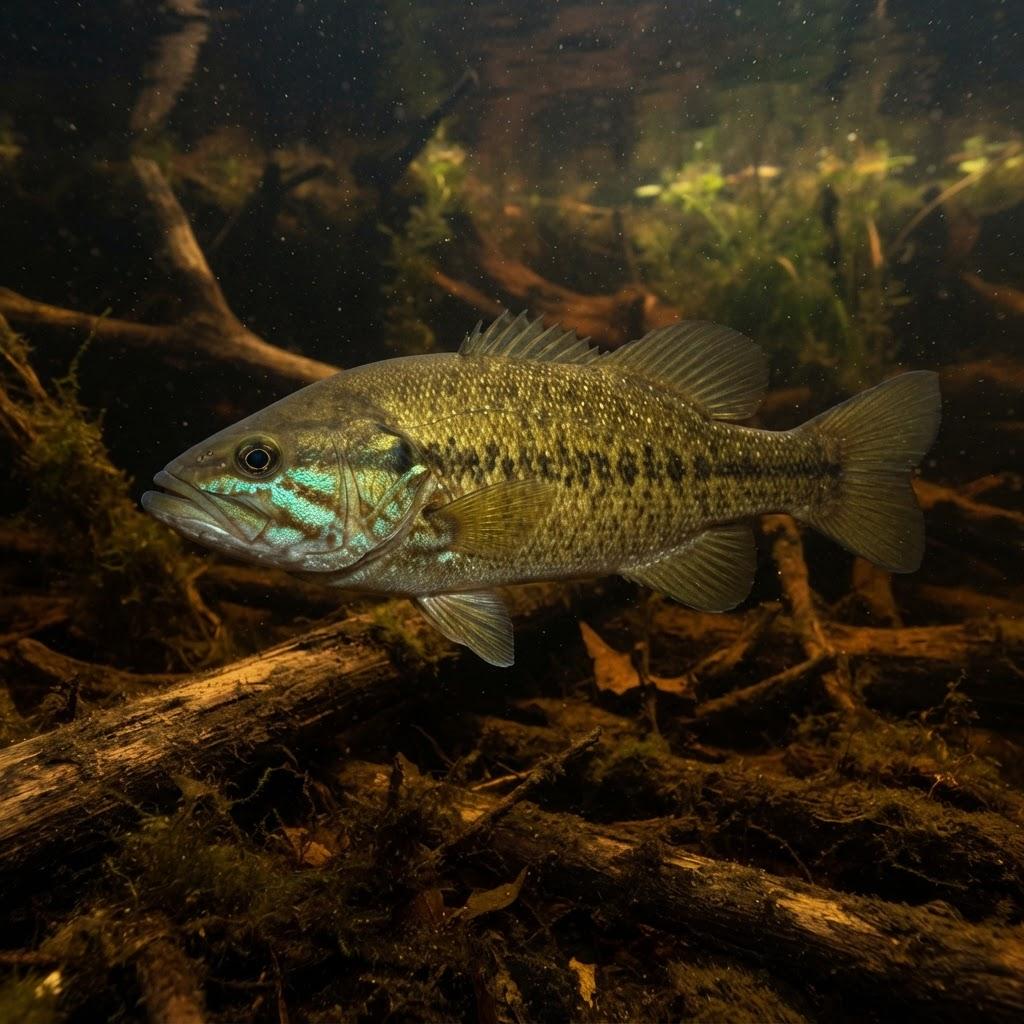
Micropterus notius
Suwannee Bass
Meet the Suwannee Bass, the aquatic equivalent of a professional parkour athlete that refuses to live anywhere but the most exclusive, crystal-clear spring-fed rivers. This flashy river-dweller is small but packs a punch, acting like the undisputed royalty of the Florida panhandle's limestone labyrinths.
Meet the Fish
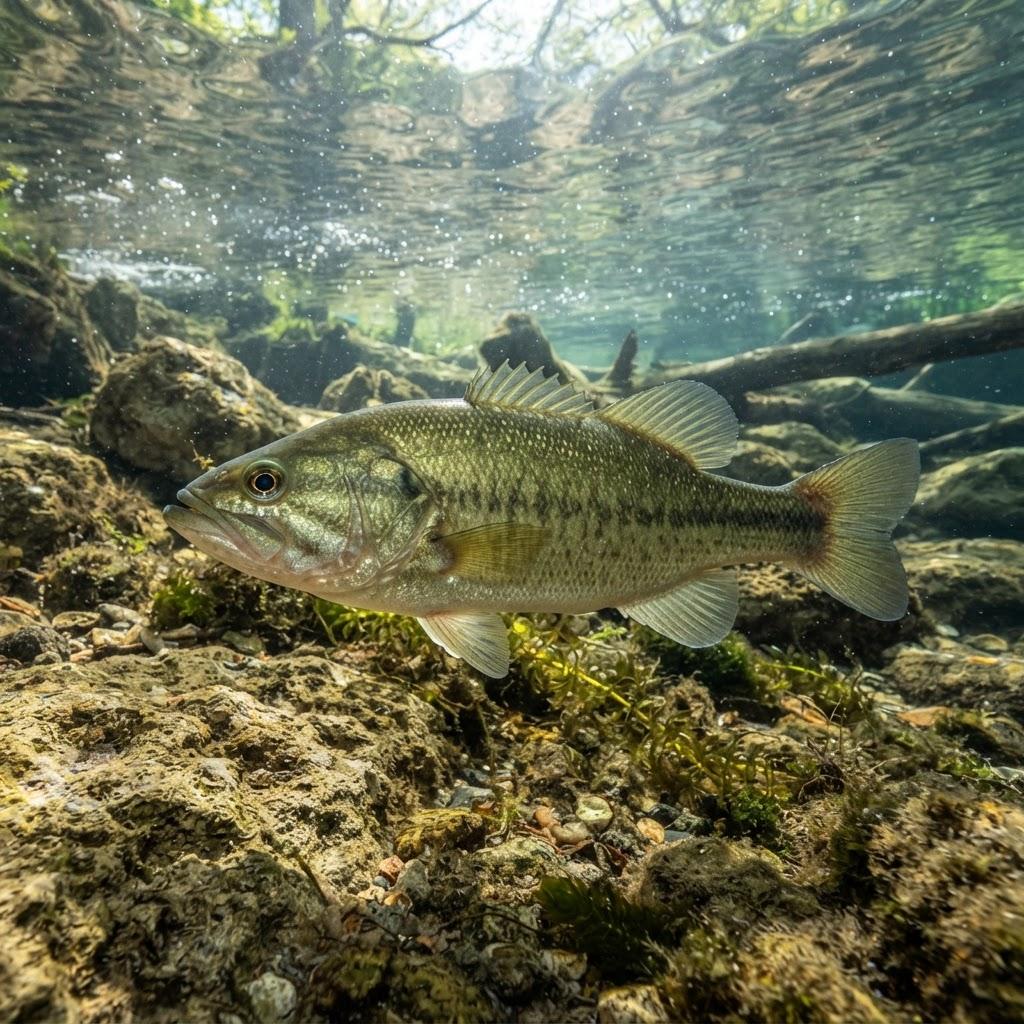
Imagine a fish that went to a high-end fashion school, graduated at the top of its class, and then decided to spend its entire life wearing a camouflage suit that only works in very specific, pristine limestone crevices. That is the Suwannee Bass. While other black bass species are out there being the big, clumsy jocks of the fishing world, the Suwannee Bass is the sleek, hyper-focused hipster of the river system. It possesses a vibe that screams 'exclusivity' because it literally cannot be found just anywhere. It has a greenish-bronze sheen that reflects the dappled light of the Florida sunshine hitting a riverbed, and it has a stubborn, regal personality that says it expects the water to be pristine, cold, and fast-moving, thank you very much. If this fish were a person, it would be the one at the party judging your choice of sparkling water because the mineral content is not sourced from the right spring. It is surprisingly small compared to its gargantuan cousins like the Largemouth Bass, but what it lacks in pure poundage, it makes up for with sheer, unadulterated sass and a territorial attitude that makes it punch way above its weight class.
Weird Biological Superpowers Explained Simply
The Suwannee Bass has a superpower that seems mundane until you actually see it in action: extreme hydrodynamic efficiency in high-velocity environments. Think of it like being a sports car that is perfectly tuned for a curvy, mountain road while all the other fish are stuck driving oversized minivans. Its body is streamlined like a fighter jet, which allows it to hold position in the middle of a literal torrent of water without wasting energy. How does it do this? It utilizes a highly sensitive lateral line—a row of pressure-sensing organs along its side—that acts like a supercomputer, processing the ripples and eddies of the river in real-time. It can detect the tiniest twitch of a crayfish hiding under a rock fifty feet away. While other creatures are struggling to stay put, the Suwannee Bass just hangs in the current, waiting for the perfect moment to execute a high-speed strike. It is essentially a living, breathing interceptor drone that operates on instinct and precision engineering, making it the most formidable hunter in the tight, rocky corridors of its home turf.
Absurd Self-Defense Mechanisms
When you are a pint-sized predator living in a river full of things that might want to eat you, you cannot rely on being the biggest guy in the room. Instead, the Suwannee Bass practices the ancient art of 'I am not here, look over there.' It is a master of camouflage, blending perfectly with the dark, tea-stained, or crystal-clear waters of the riverbeds, utilizing its dark splotches to mimic shadows cast by rocks and vegetation. If a larger predator like a gar or a bigger, moodier bass shows up, the Suwannee Bass uses a burst of speed that defies physics, effectively blinking out of existence before the intruder can blink. It also utilizes a defensive 'stiffening' posture when confronted, raising its sharp dorsal fins—which are essentially built-in jagged daggers—making itself look significantly less appetizing to swallow. It is the aquatic equivalent of an umbrella popping open inside your throat. Most would-be predators take one look at those needle-sharp spines and decide that a much smaller, softer, and less defiant meal is probably a much better idea for their afternoon lunch.
Fish Drama and Gossip
Welcome to 'Real Rivers of the Panhandle,' where the drama is high-stakes and the feuds are legendary. Suwannee Bass are the classic 'get off my lawn' neighbors of the river world. They are intensely territorial, often staking out a specific eddy or a particular cluster of limestone rocks as their private luxury suite. If another fish dares to hover near their favorite hunting spot, the Suwannee Bass transforms from a calm hunter into a raging diva. They engage in complex posturing, flashing their fins and swimming in tight, aggressive circles to signal that they are ready to throw down. There is a whole social hierarchy based on who has the best access to the current, and these fish will fight tooth and nail—or rather, mouth and gill—to maintain their status. The gossip in the river is that if you see a Suwannee Bass acting particularly grumpy, they probably just had their favorite hiding spot infiltrated by an adventurous Bluegill that didn't get the memo about who rules the spring.
The "Wait, That's Real?!" Deep-Sea Oddities
While the Suwannee Bass enjoys the relative shallows of a sunny Florida river, its soul is essentially that of a deep-sea alien. If you were to teleport a Suwannee Bass into the midnight zone, it would be shocked by the lack of current and the terrifying lack of snacks. Deep-sea creatures are masters of bioluminescence, flashing neon colors to attract prey or scare off predators. If the Suwannee Bass had these same powers, it would likely use them for intimidation at bars or to lure in extra-tasty crawdads. Deep-sea fish, like the fangtooth, have monstrous teeth designed to capture anything that touches them because food is so scarce. The Suwannee Bass, conversely, has a jaw perfectly adapted for a precision snatch-and-grab. It is the difference between a high-end sushi chef using tweezers to place a piece of fish and a deep-sea creature trying to inhale everything in a five-foot radius. Comparing the two is like comparing a tactical ninja to a vacuum cleaner with a personality disorder.
Myth Busting
Let’s address the biggest rumor about the Suwannee Bass: that they are 'just a smaller, angrier version' of the Largemouth Bass. This is absolutely not true, and quite frankly, it is insulting to their lineage. While they share a family tree, the Suwannee Bass is an evolutionary master of its specific niche. Another myth is that all fish are basically mindless automatons waiting for a worm to drop in their mouth. Science tells us that these bass have a remarkable ability to learn and remember, especially when it comes to human activity. They have been observed learning to avoid specific types of lures after a bad experience, showing a level of cognitive flexibility that would put a goldfish to shame. They are not mindless; they are tactical geniuses that have adapted to human encroachment and fishing pressure by becoming significantly more cautious. They aren't dumb; they are just very, very good at keeping their secrets hidden from the prying eyes of surface-dwellers like us.
Humorous Historical Tales or Folklore
The history of the Suwannee Bass is tied deeply to the rivers that define the Florida wilderness. For generations, local anglers have told 'tall tales' about 'The King of the Suwannee,' a legendary bass that grew to gargantuan proportions, allegedly large enough to pull a canoe off its moorings. While biologically impossible for the species to hit these record-breaking sizes, the myth persists as part of the cultural fabric. Old-timers used to claim that if you gave a Suwannee Bass a piece of your sandwich, it would lead you to a hidden spring full of treasure—or at least, just lead you to more bass. These stories reflect the deep respect and slight fear people have for a creature that spends its life navigating the dark, mysterious, and often dangerous caverns of the Florida springs. It is a fish that has inspired campfire songs and breathless stories, cementing its status as the unofficial, rugged mascot of the river, even if it is only a few pounds of bronze muscle.
Underwater Love Stories and Bizarre Romances
Love in the river is less about bouquets of flowers and more about intense, high-octane dance battles. When spawning season hits, the Suwannee Bass turns the riverbed into a ballroom of aggression and affection. The male, who is often the one doing the hard work, will clear out a patch of sand or gravel, creating a 'nest' that is more like an architectural masterpiece than a home. He performs a series of intricate displays, vibrating his body and flashing his colors to attract a female who is, quite frankly, very picky about who she chooses. If she likes his floor plan, they engage in a ritual dance that looks like a slow-motion collision. It is a dramatic, high-energy affair that requires perfect timing and a fair amount of swagger. Once the eggs are laid, the romance ends abruptly as the male shifts into his role as a hyper-vigilant security guard, chasing away anything that looks at his potential offspring with bad intentions.
Underwater Architecture and DIY Nesting
Forget the cozy bird nest in a tree; the Suwannee Bass is a master of heavy-duty construction. To prepare for the arrival of eggs, the male uses his tail and fins to fan away silt and debris, exposing the hard gravel or sand underneath. This is not just a pile of rocks; it is a meticulously cleared zone designed for maximum water flow to keep the eggs oxygenated and safe from parasites. He will often build this in an area with a specific flow, treating it like a custom-built nursery that requires constant maintenance. He is essentially the contractor, architect, and site manager of the whole operation. He constantly patrols the perimeter, making sure no loose leaves or wandering pebbles mess up the aesthetic or the structural integrity of his creation. It is a testament to the fact that these fish are not just drifting through life; they are actively shaping their environment to ensure the next generation gets the best possible start in the rocky wilderness.
The Chaos of Raising Tiny Swimmers
Once the eggs hatch, the real insanity begins. The father doesn't just walk away; he becomes an overprotective helicopter parent. The tiny, microscopic fry emerge and are initially so fragile they can barely swim against the current. The male hovers over them, moving them from one spot to another, guarding them from every hungry crawfish and larger fish in the area. Imagine trying to keep track of a thousand hyperactive toddlers in a crowded mall while everyone is trying to eat them. That is the life of a Suwannee Bass father. He is constantly darting about, snapping his jaws at intruders and nudging the fry back into the safety of the nest. It is an exhausting, high-stress job that lasts until the fry are strong enough to venture out on their own. It is a chaotic, noisy, and dangerous business, and it is honestly a miracle that any of them survive to grow up into the bronze beauties we see in the rivers today.
How to Spot One & How It Is Doing
Spotting a Suwannee Bass requires the patience of a saint and the eyes of an eagle. You want to look for areas with clear water, particularly around the outflows of limestone springs. They love structure, so scan the edges of submerged logs, limestone ledges, and rocky outcroppings. If you see a fish that looks like a bronze-colored bass with distinct, dark diamond-shaped markings along its side, you have likely found one. Currently, these fish are listed as 'Vulnerable,' primarily because they are extremely sensitive to habitat destruction and pollution. They are the proverbial canary in the coal mine for Florida’s river health. If the water gets muddy or polluted, they simply vanish. How can you help? Supporting local conservation efforts for Florida’s springs and practicing 'leave no trace' fishing goes a long way. Keeping our rivers clean is the single most effective way to ensure these tiny, sassy, rock-loving superstars continue to rule their limestone kingdoms for generations to come.