1970s, London, United Kingdom
Ambient
Ambient music is the sonic equivalent of a warm hug from a cloud that also happens to be a space station. It is the art of creating vast, beautiful nothingness that fills every corner of your room and your brain simultaneously.
Meet the Genre
Imagine you are floating in a giant vat of lukewarm marshmallow fluff, but instead of being sticky, you are being massaged by the sound of a thousand shimmering stars. That is Ambient. It is the music that refuses to demand your attention, opting instead to hang out in the background like a polite houseguest who just sits on the couch and glows. While most genres are desperate for you to dance, mosh, or sing along, Ambient is the cool, intellectual cousin that would rather show you the rings of Saturn through a telescope. It is the sound of a rainy windowpane, the hum of a refrigerator in an empty house, and the feeling of waking up five minutes before your alarm. Ambient does not care about hooks, choruses, or whether you know how to tap your feet; it cares about texture, space, and the way a single synthesizer chord can feel like an entire emotional landscape. It is less about songs and more about creating a room you can live inside for a while. If you are looking for a beat to work out to, move along. If you want to dissolve into the floorboards and contemplate the nature of existence, welcome home.
The Sound & Signature Elements
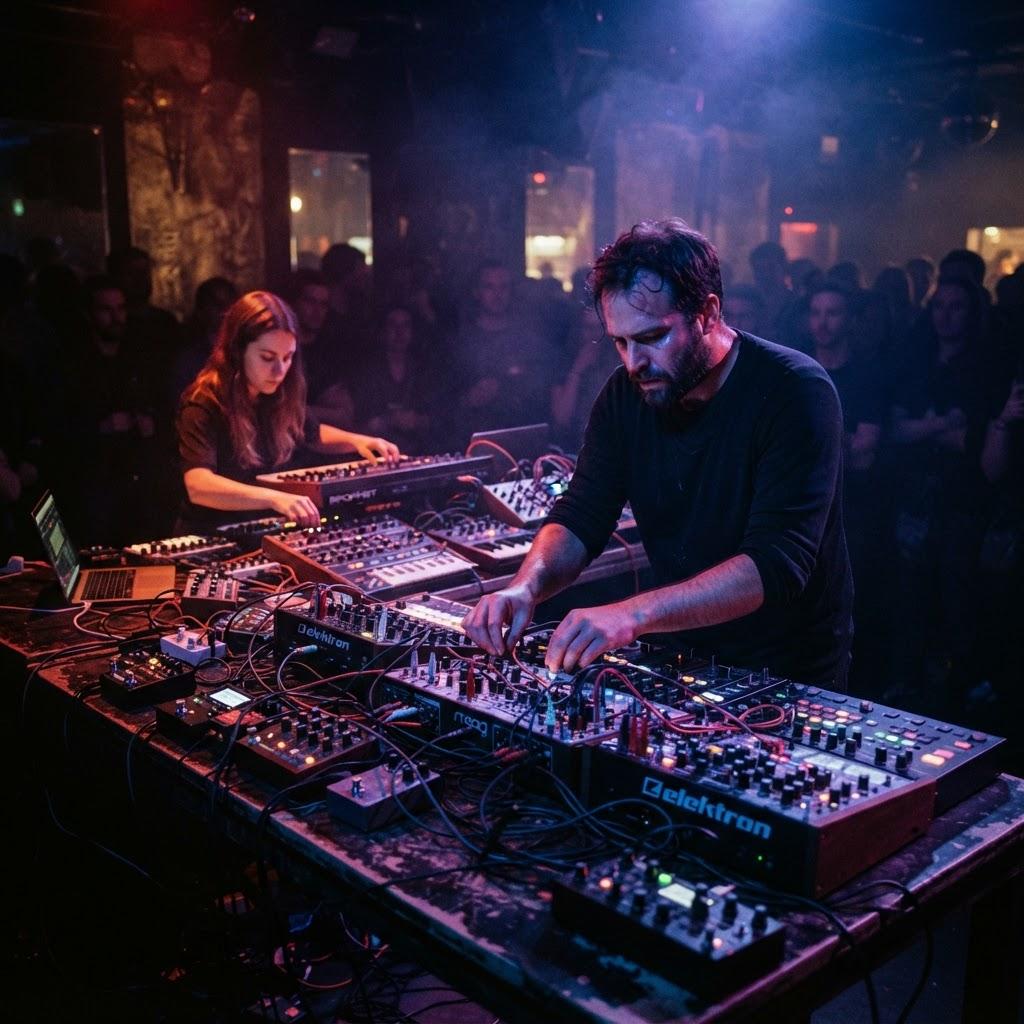
Ambient music is built on the concept of soundscapes, which is just a fancy way of saying the music sounds like a map of a place that does not exist. The most important tool in the toolkit is the synthesizer—an electronic keyboard that can make sounds like a whale singing in an cathedral or a soft, static buzz that tickles your ears. Producers often use something called long-form decay, which is just technical talk for 'letting the note fade out for a really, really long time.' Instead of a drummer keeping time, Ambient uses rhythmic layers that shift and drift like fog. You might hear a 'tape loop,' which is basically taking a tiny sliver of sound, recording it, and playing it over and over again until it turns into a hypnotic, evolving pattern. Think of it like taking a single photograph and letting it slowly transform into a moving painting. Everything is drenched in reverb, which simulates the feeling of listening to music inside a giant, empty concrete bunker. There are no verses or bridges here, just a constant, gentle evolution of sound that grows and shrinks like a living, breathing creature made of electricity.
Origins & Birth of the Sound
The story of Ambient really begins when a legendary British producer named Brian Eno found himself stuck in a hospital bed in the late 1970s. After a car accident left him confined to his room, he was forced to listen to a record playing at such a low volume that he could barely hear it. Because it was raining, the sounds of the city outside blended with the faint melody of the music, and suddenly, a lightbulb went off. He realized that music could be 'as ignorable as it is interesting.' This was a radical break from the world of stadium rock, where everything was cranked to eleven and designed to grab you by the throat. Before this, you had experimental composers in France playing around with 'musique concrète'—taking real-world noises like trains and kitchen clatter and turning them into art—but Eno was the one who packaged it for the home listener. He wanted to design music that could change the atmosphere of a room, acting as a kind of sonic wallpaper. It was a rejection of the 'pop star' ego, turning the focus away from the performer and toward the environment itself, effectively inventing a genre that lives in the quiet spaces of our daily lives.
The Pioneers & Legends
If Ambient had a Mount Rushmore, Brian Eno would certainly be the one with the biggest beard. He is the patron saint of the genre, having written the literal handbook with his album 'Music for Airports,' which was meant to keep people calm while waiting for their flights. Then there is Harold Budd, a man who could make a piano sound like it was weeping underwater, and Steve Roach, an American synth wizard who took the genre into the desert and made it feel as vast and dusty as the horizon. We cannot forget the Japanese masters, either, like Hiroshi Yoshimura, who treated Ambient like a form of architectural design, creating sounds that fit into the Tokyo lifestyle like a perfectly placed piece of furniture. These artists weren't just musicians; they were sonic interior designers. They didn't care about selling out arenas; they cared about finding the perfect frequency to help a listener reach a state of zen. They were the original 'chill' masters, operating in a world of mystery, solitude, and incredible patience. Every time you hear a synth pad that sounds like heaven, you are hearing the echoes of these giants who taught us that sometimes the best thing a song can do is exist.
Defining Tracks & Era-Defining Moments
To understand the genre, you need to hear the tracks that proved 'quiet' could be powerful. Brian Eno’s '1/1' from the album 'Music for Airports' is the undisputed heavyweight champion of Ambient. It is a slow, pulsing sequence of piano notes that repeat and overlap until time seems to stand still. It is the sonic version of a sunrise that lasts for seventeen minutes. Another crucial moment is 'Structures from Silence' by Steve Roach, an album that took the synthesizer to places no one thought possible, creating textures so thick you could practically touch them. These weren't just songs; they were milestones that told the world that electronic music didn't have to be 'Beep Boop' robotic dance music. There was also Aphex Twin’s 'Selected Ambient Works 85-92,' which brought a sort of weird, playful, and sometimes spooky energy to the genre, proving that Ambient could be as quirky as it was beautiful. These records changed the way people listened, transitioning from sitting in a dark room with headphones to using music as a tool to navigate the chaos of modern city living, work, and even the simple act of staring at the ceiling.
Subgenres & Offshoots
Once you peek under the hood of Ambient, you find a whole family tree of weird cousins. There is 'Dark Ambient,' which is like the horror movie version of the genre—think abandoned factories, ghostly echoes, and low, rumbling sounds that make the hair on your arms stand up. Then you have 'Ambient Techno,' which takes the steady, repetitive beat of club music and slows it down to a crawl, creating a 'chilled-out' dance floor vibe that works perfectly at 4:00 AM. There is 'Dungeon Synth,' a bizarre subgenre that sounds like the soundtrack to a low-budget 80s fantasy game, and 'Glitch Ambient,' where artists use errors in digital files to create cool, stuttering, and robotic textures. You also have 'Drone,' where artists play a single, long, sustained note for an hour straight—it is not for the faint of heart, but it is incredibly meditative if you give it time. Each of these subgenres takes that core philosophy of 'space and texture' and pushes it in a different direction, proving that you can find 'Ambient' in almost any corner of the musical universe as long as you strip away the frantic energy.
Cultural Impact & Influence
Ambient has secretly been running the show for decades. Think about the last time you walked into a fancy hotel lobby or a high-end yoga studio and felt instantly relaxed. That is Ambient doing its job. It has become the gold standard for 'focus music' on every streaming platform on Earth. It has even influenced the way films are scored; directors like Denis Villeneuve and Christopher Nolan lean heavily on Ambient textures to build suspense and awe in their big-budget sci-fi movies. It is not just about relaxation, though; it is about the aesthetic of 'the vibe.' Fashion brands use it for runway shows, modern architecture designers use it to explain the feeling of their buildings, and it has practically become the default language of the internet. Whenever you click on a 'Lo-fi beats to study/relax to' stream, you are listening to a direct descendant of Ambient. It is the bedrock of modern calm, a genre that taught us that it is okay to disconnect, slow down, and just exist in the moment without needing a hook or a drum beat to keep our attention focused.
Controversies & Drama
Yes, even a genre built on peace and quiet has its share of drama. The biggest 'beef' in the Ambient world usually stems from the question: 'Is this music, or is this just noise?' For years, traditionalists who loved melody and structure looked at Ambient artists and called them lazy, accusing them of just pressing a button and letting the machine do all the work. It is the classic 'my kid could paint that' argument, but for synthesizers. There is also the snobbery between 'Pure Ambient' purists, who insist that music must be completely beatless to qualify, and the more modern crowds who think adding a light drum loop is fine. Some fans get very heated about whether a soundtrack counts as 'Ambient' or if it is just functional background audio. The whole idea of 'background music' itself is controversial; some artists hate the term, feeling like it devalues their work, while others embrace it as the highest form of flattery. It is a polite, soft-spoken war, fought with long, drawn-out synth pads and very passive-aggressive blog posts about what counts as 'real' sound design.
Global Spread & Regional Scenes
While Ambient started in the rainy streets of London, it quickly found its spiritual home in Japan, where the culture of 'Kankyo Ongaku'—or 'environmental music'—was already thriving. In the 1980s, Japanese artists began creating music specifically for corporate lobbies, parks, and retail stores, treating the sound as a natural element of the environment, like water or light. In Germany, the scene was more tied to the experimental side of technology, with artists pushing the limits of what a synthesizer could do in a lab-like setting. In the United States, particularly on the West Coast, Ambient took on a more 'New Age' vibe, blending with organic sounds of nature, flutes, and chimes to create a sense of wide-open, desert-inspired wonder. Each region brought its own local flavor: the British were moody and atmospheric, the Japanese were precise and minimalist, the Germans were cold and technical, and the Americans were expansive and dreamy. This global mix ensures that no matter where you are, there is an Ambient flavor that matches the local climate, be it a crowded neon city or a lonely mountain ridge.
The Modern Landscape
Today, Ambient is everywhere, though you might not always recognize it by name. It has become the primary language of the 'wellness' industry. With the rise of meditation apps and sleep-tracking technology, Ambient is more popular than ever, providing the soundtrack for millions of people trying to escape the constant buzzing of their smartphones. Artists on TikTok and YouTube are creating 'infinite' tracks that never end, using AI to generate constant, flowing soundscapes that are perfect for reading, coding, or just staring at the wall. The genre has also become a sanctuary for experimental artists who want to move away from the high-pressure world of 'hits' and 'streams.' Modern Ambient is currently experiencing a bit of a renaissance, with younger producers mixing old-school analog hardware with cutting-edge digital software to create sounds that are warmer and more complex than ever before. It is not a genre that 'trends' in the traditional sense; it just quietly grows, adapting to whatever new technology comes our way, acting as a buffer against the noise of a world that never seems to stop screaming.
How to Dive In
Ready to turn your living room into an intergalactic space station? Here is your starter kit. Start with Brian Eno’s 'Music for Airports'—it is the holy grail, and if you can't find peace in that, you might be a robot. Next, put on 'Structures from Silence' by Steve Roach; it is the ultimate 'melt into the carpet' record. If you want something slightly more modern and weird, check out anything by Tim Hecker, specifically his album 'Ravedeath, 1972,' which sounds like a giant organ being played in a storm. For that Japanese classic vibe, dive into Hiroshi Yoshimura’s 'Music for Nine Postcards.' The best way to listen? Do not sit down with the intention of 'studying' the music. Just put it on, walk around, do the dishes, draw a picture, or stare out the window. Let the music become part of your environment. You don't have to listen to every note; just let it exist around you. Once you stop trying to 'get' the music, you will find that it has already gotten you. Turn it up, turn it down, just make sure you let the sound wash over you. Welcome to the infinite, calm, and beautiful world of Ambient.