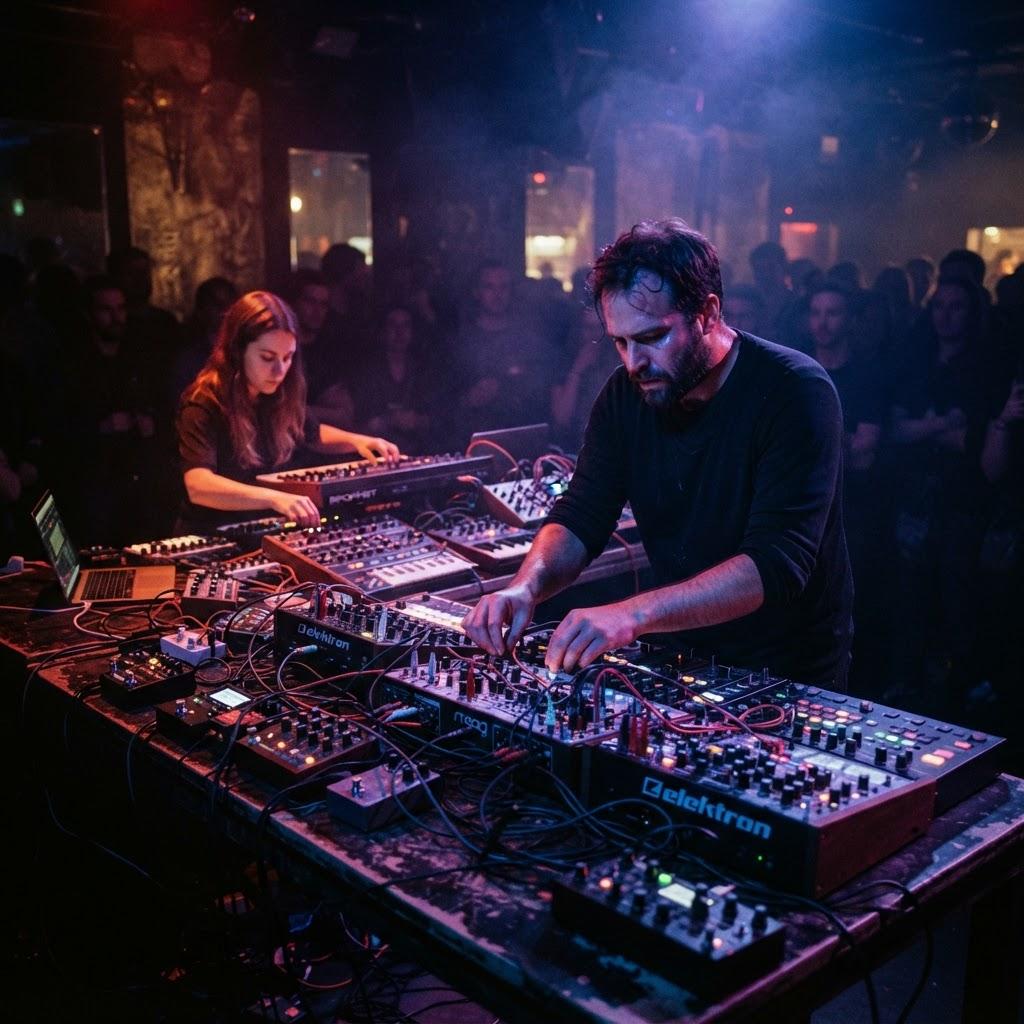
Late 1980s, Kentucky and Chicago, USA
Post-Rock
Post-Rock is the sonic equivalent of a slow-motion thunderstorm captured in a glass bottle. It is the genre that looked at traditional rock, threw the lyrics in the trash, and decided to build cathedrals out of guitar pedals and sheer patience.
Meet the Genre
Imagine your favorite rock band, but someone stole their microphone and then convinced them to take ten minutes to play a single chord. That is essentially the greeting committee for Post-Rock. This genre is the shy kid at the back of the party who doesn’t say a word for three hours, but once they start talking, they drop a poem so life-changing that the entire room goes silent. It is not interested in your standard verse-chorus-verse structure; it wants to take you on an emotional journey that feels like watching a glacier move, if that glacier also happened to be plugged into a Marshall stack turned up to eleven. Post-Rock is the music of big spaces—the kind of stuff you listen to while staring at a rainy horizon or pretending you are the main character in a low-budget indie film about existential dread. It is grandiose, it is patient, and it is unapologetically loud when it finally decides to let its guard down. If rock is the sprint, Post-Rock is the ultramarathon where everyone stops halfway through to look at the sunset.
The Sound & Signature Elements
To understand Post-Rock, you have to understand the 'build.' Think of it like a giant, invisible sculpture being carved out of sound. The song starts with a single, fragile guitar melody—often played with 'clean' tone, which is just guitar-speak for 'not fuzzy or distorted.' Then, layer by layer, the band adds things: a bass line that sounds like an approaching earthquake, a drummer who is treating their symbols like delicate china, and loops—which are just little snippets of sound played on repeat—to create a shimmering wall of noise. We call this 'crescendo-core' because the entire purpose is to reach a massive, earth-shaking peak. Tempo is irrelevant here; it’s more about the pulse. The instruments aren’t used in the traditional way, either. The guitars aren't just for shredding; they are for painting. Producers use reverb, which is basically an echo effect that makes the guitar sound like it’s being played in a giant, empty cathedral. It is a slow, methodical masterclass in how to make a listener feel tiny, then massive, all within the span of fifteen minutes.
Origins & Birth of the Sound
The birth of Post-Rock is less like a loud bang and more like a gentle, stubborn rebellion. By the late 1980s, rock music felt a bit like a script that everyone had already memorized. You had the verse, the chorus, the catchy hook, and the guitar solo. A few brave souls in the basements of Chicago and the creative pockets of Kentucky decided they were bored of the script. They were listening to everything from classical composers like minimalist master Steve Reich to the space-age textures of ambient music. They wanted to create a rock sound that felt like a landscape rather than a pop song. Bands started trading in their bravado for atmospheric exploration. They weren't looking for a radio hit; they were looking for a way to map out the feelings that words just couldn't capture. It was the music of the disenchanted who found more truth in a reverb pedal than in a three-minute lyric about heartbreak. It was pure, unadulterated musical curiosity turning into a full-blown movement.
The Pioneers & Legends
If you are walking into the Post-Rock hall of fame, you have to bow to the gods. First, there is Talk Talk, who essentially invented the blueprint by abandoning their pop roots to make experimental, jazz-tinged masterpieces that sounded like they were recorded in another dimension. Then you have Slint, a group of Kentucky kids who released 'Spiderland,' an album so unsettling and beautiful that it basically created the map for every band that followed. Then came the titans: Mogwai from Scotland, who treated volume like a weapon of mass destruction, and Godspeed You! Black Emperor, a collective from Montreal that sounded like a beautiful, apocalyptic train wreck. These legends didn't want to be rock stars; they wanted to be architects of sound. They were the ones who taught everyone else that you could convey more emotion with a single, repeating guitar phrase than you could with an entire dictionary of lyrics. They were intense, mysterious, and occasionally terrifyingly good at what they did.
Defining Tracks & Era-Defining Moments
History is written by the victors, but music history is written by the tracks that make your brain melt. If you want to understand the genre, you need to listen to 'Good Morning, Captain' by Slint; it is a dark, churning masterpiece that sounds like it’s being whispered by a ghost. Then there is 'Mogwai Fear Satan,' a track that is exactly as menacing and wonderful as it sounds, stretching out into a sprawling, twenty-minute odyssey of pure tension. And you cannot talk about this genre without mentioning Godspeed You! Black Emperor’s 'Storm,' a song that manages to capture the feeling of watching a city collapse and rebuild itself in real-time. These aren't just songs; they are cultural touchstones. They were the moments when the wider world realized that rock music didn't have to be 'rock' in the traditional sense. These tracks changed the trajectory of alternative music, proving that if you take your time, you can build something that lasts longer than a catchy chorus ever could.
Subgenres & Offshoots
The Post-Rock family tree is just as weird as you would expect. On one branch, you have 'Math Rock,' which is Post-Rock’s hyper-caffeinated cousin; it uses weird, complicated time signatures—basically, rhythms that are so confusing they require a calculator—and lots of technical, rapid-fire guitar tapping. Then you have 'Post-Metal,' which takes the slow, building nature of Post-Rock and gives it a heavy, aggressive, metallic punch to the gut. Bands like Isis and Cult of Luna showed that you could use the beauty of ambient sound to make something truly heavy and intense. There is also the 'chamber-rock' scene, which throws violins, cellos, and pianos into the mix to make the music feel more like a soundtrack for an existential crisis in a European art house film. Every offshoot is just another way of saying, 'We like the atmosphere, but we want to change the ingredients.' It is a genre that refuses to stay still, constantly morphing into whatever shape its creators decide to sculpt next.
Cultural Impact & Influence
Post-Rock might not be blasting on top-40 radio, but its DNA is everywhere. Have you noticed how your favorite action movie soundtrack sounds more like a brooding, atmospheric soundscape than a standard rock song? That is Post-Rock influence hiding in plain sight. Its love for 'cinematic' audio has completely changed how film directors think about sound design; they want that epic, slow-burn tension to score their dramatic shots. It also influenced the way independent bands dress and perform—it moved the focus away from the ego-heavy 'rock star' persona to a more collective, humble approach. The genre also bled into indie rock, electronic music, and even hip-hop, where producers often borrow the 'layering' techniques to create moody, complex beats. It taught a whole generation of musicians that the empty space between notes is just as important as the notes themselves. It is the quiet giant of the music world, quietly pushing other genres toward being more thoughtful and expansive.
Controversies & Drama
Ah, the drama. You might think a genre that is mostly instrumental would be peaceful, but you would be wrong. The biggest fight in Post-Rock is the 'authenticity' war. Purists will argue for hours about whether a band is 'Post-Rock enough' or if they are just doing 'emotional rock with too many pedals.' There is also the constant accusation of being 'boring' or 'pretentious'—because heaven forbid a song takes seven minutes to reach its climax. People love to hate on the genre for being a bit too self-important, as if wanting to make beautiful, complex soundscapes is a crime against humanity. And let's not forget the 'selling out' accusations whenever a band adds a vocal track or—god forbid—a catchy melody. The tension between the 'true believers' who want only atmospheric, instrumental compositions and the bands who want to experiment with pop elements is the never-ending soap opera of the scene. It is all very silly, but that is what happens when people take their music as seriously as their religion.
Global Spread & Regional Scenes
While it was born in the basements of the U.S., Post-Rock truly went global once it hit the ears of the world. Japan became an absolute powerhouse, producing bands like Mono, who play with a level of intensity and emotional weight that could move a mountain. Their style is ornate, beautiful, and deeply heavy, showing how different cultures bring their own sense of aesthetics to the sound. In Europe, especially in countries like Iceland and Scandinavia, the cold, vast landscapes seemed to influence a colder, more icy version of the genre. Meanwhile, the post-Soviet scenes added a layer of political, melancholic weight to the music, making it feel like a protest soundtrack for a changing world. It is fascinating to see how the same basic 'build-up' structure gets interpreted differently depending on whether you are in a humid Chicago basement, a freezing Reykjavík studio, or a bustling Tokyo rehearsal space. It proves that the feeling of the 'build' is a universal human experience.
The Modern Landscape
Today, Post-Rock is in a weirdly healthy place. It isn't ruling the charts, but it is thriving in the corners where people actually care about sound quality and emotional depth. We are seeing a new wave of bands who are blending it with electronic music, shoegaze—which is just a wall of blurry, distorted guitar sound—and even ambient pop. It’s no longer just about the classic 'soft-to-loud' dynamic; it’s become a fluid language. You hear traces of it in TikTok trends, where slow-burn cinematic audio is essential for that perfect 'aesthetic' video. It’s also very much alive in the world of video game music, where the need for long, evolving background tracks makes the Post-Rock style the perfect fit. It is no longer a niche, basement-dwelling secret; it is a foundational pillar of modern music production. While the 'purists' might complain about how it has changed, the reality is that the genre is doing exactly what it was designed to do: evolving and infecting everything it touches.
How to Dive In
Ready to lose yourself? Don't start by trying to analyze the time signatures or the pedal boards. Just find a quiet room, put on some decent headphones, and dive in headfirst. Start with the 'Spiderland' album by Slint to get a sense of the gritty, mysterious origins. Then, leap into 'Young Team' by Mogwai for that classic, Scottish-rain-on-a-tin-roof intensity. For the absolute heavyweight experience, cue up 'Lift Your Skinny Fists Like Antennas to Heaven' by Godspeed You! Black Emperor—it is essentially the Bible of the genre. If you want something beautiful and slightly more accessible, check out 'Hymn to the Immortal Wind' by Mono. The trick is to give it space; don't listen while scrolling through your phone. Let the music happen to you. Let it build, let it crash, and let it take you wherever it wants to go. It is a commitment, sure, but once you start hearing the world in 'crescendos,' you will never want to go back to regular old pop music ever again. Go on, press play and let the sonic thunderstorm begin.