Late 1970s to Mid 1980s
Boogie
Boogie is the musical equivalent of a silk-shirt-wearing disco survivor who decided to swap glitter for a state-of-the-art synthesizer. It is the sophisticated, bass-heavy heartbeat of the early eighties that still makes every living room feel like a neon-lit roller rink.
Meet the Genre
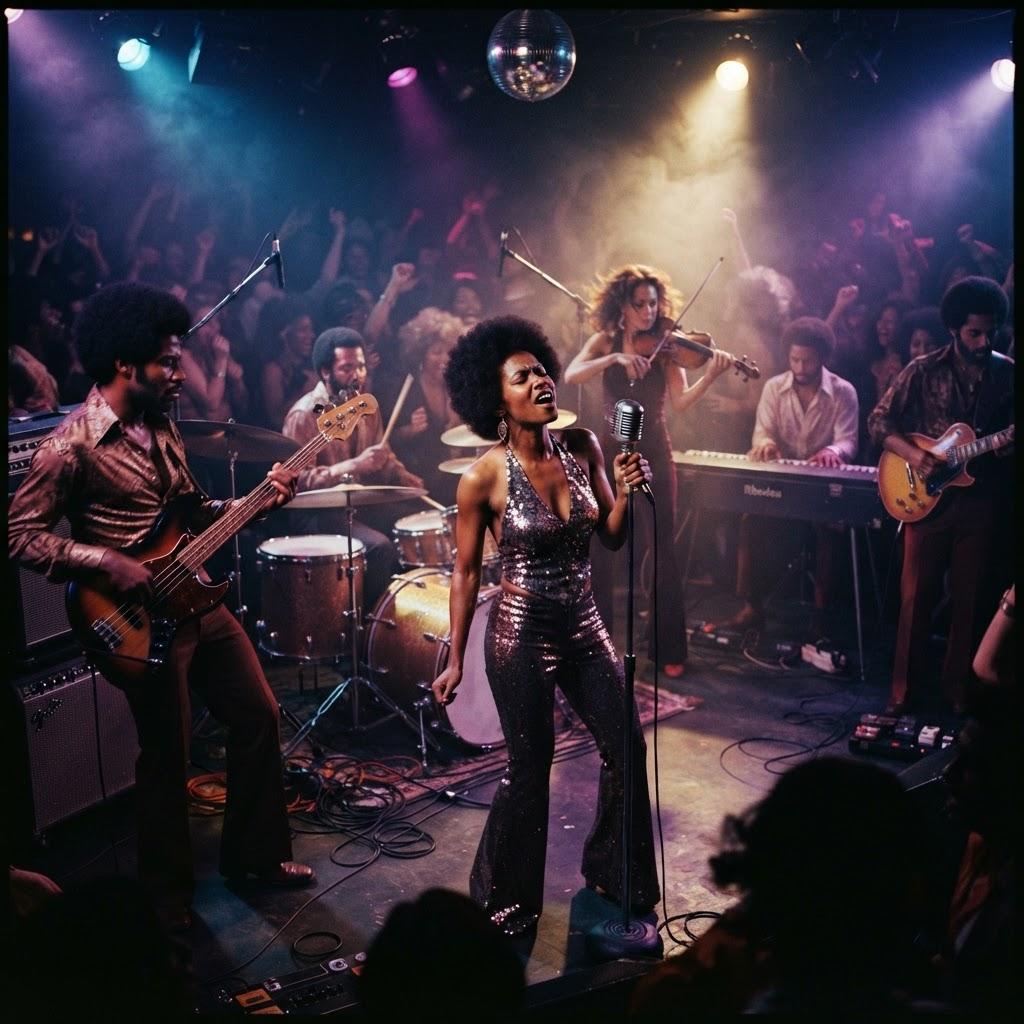
Imagine walking into a club that smells like hairspray and expensive cologne, where the lights are pulsing in shades of magenta and electric blue. You are not at a standard disco; you are in the high-definition future of 1982. Boogie is the cool, slightly mysterious cousin of disco who stopped wearing sequins and started obsessing over the shiny, blinking buttons of a Moog synthesizer. It possesses an attitude that is equal parts smooth operator and robot-inspired party animal. When a track starts, you do not just hear it; you feel the bassline vibrating in your marrow, pulling your hips into a rhythm that feels both human and strangely artificial. It is music that refuses to be ignored, demanding that you move with a calculated swagger. There is a sense of optimism here, a belief that technology is the key to unlocking a better dance floor. It is the sound of the urban night, captured in a bottle of vintage champagne, fizzing with synthesized joy and a bass groove that could power a small city for a week.
The Sound & Signature Elements
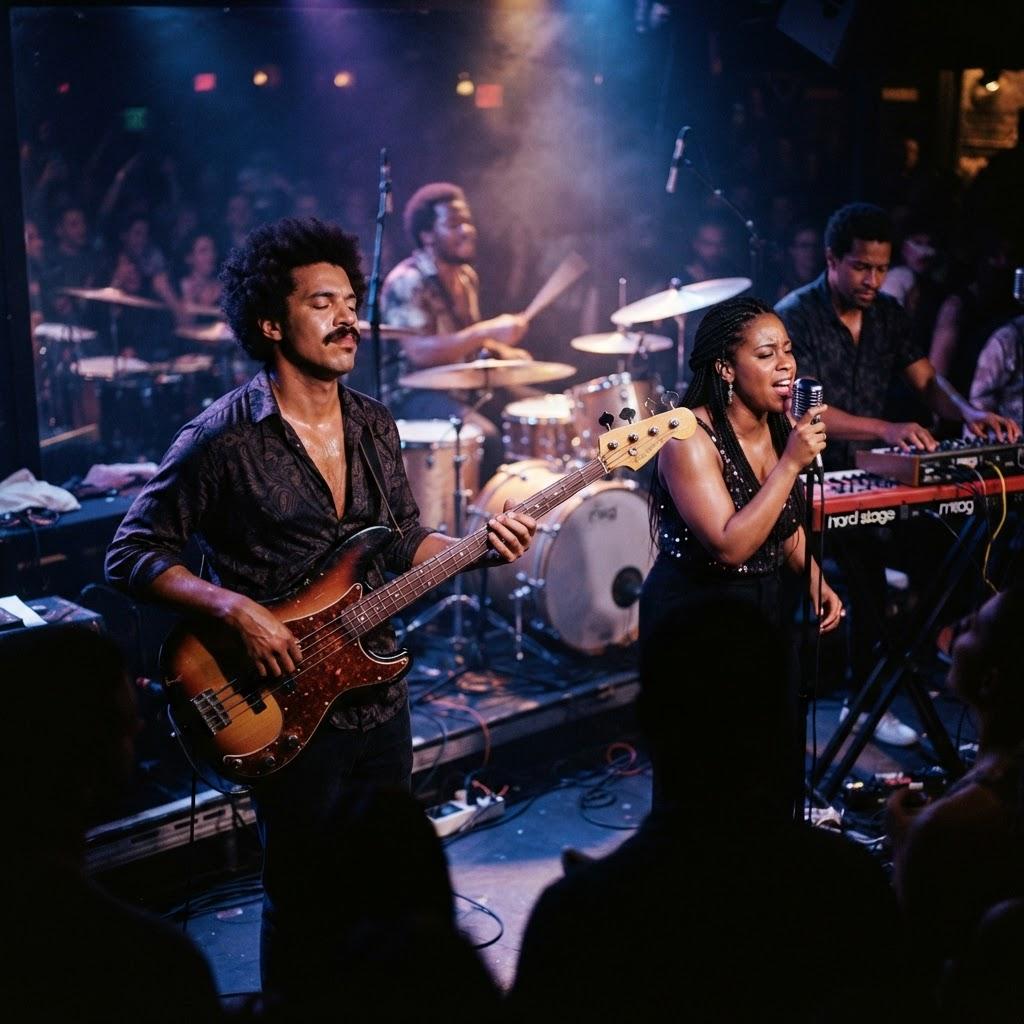
The heartbeat of boogie is the legendary Roland TR-808 drum machine, a box of wires that changed the world by offering sounds that were crisp, punchy, and utterly futuristic. Unlike the live drums of earlier funk, the 808 provided a consistent, clinical precision that producers loved. Then there is the secret weapon: the synth-bass. Instead of using a traditional wooden bass guitar, boogie artists leaned into the Moog, creating fat, squelchy basslines that sound like a rubber band being stretched across a skyscraper. Think of the synth-bass as the anchor, keeping the ship steady while the synthesizers—often the Yamaha DX7—sprinkle stardust over the top in the form of bright, bell-like stabs. You will frequently hear the Vocoder, a gadget that takes a human voice and makes it sound like a space traveler trying to sing a romantic ballad. It is essentially a musical robot voice filter. Everything is tuned to a precise tempo, usually between 110 and 120 beats per minute, which is the perfect speed for sliding across a floor without losing your cool or your balance.
Origins & Birth of the Sound
Boogie did not just pop into existence out of thin air; it was born from a necessary pivot. When the anti-disco movement hit the United States with the intensity of a hurricane, musicians and producers were left wondering what to do with their rhythm sections. Rather than giving up the groove, they retreated to basements and small independent studios, deciding that if the world didn't want 'disco' anymore, they would give them something sleeker, cheaper, and infinitely more electronic. It was a time of creative defiance in cities like New York, Los Angeles, and Detroit. Artists realized they could do more with a single keyboardist than a ten-piece horn section. It was the democratization of funk. Suddenly, a kid in a bedroom with a cheap drum machine could sound like a professional studio wizard. The genre grew out of this 'do-it-yourself' spirit, blending the soul of gospel and R&B with the cold, hard logic of early digital computing. It was the sound of the street meets the laboratory, a marriage of human emotion and cold, hard, synthesized circuits.
The Pioneers & Legends
To understand boogie, you have to bow down to the legends who risked looking like mad scientists in the name of a good groove. D-Train is mandatory listening; James D-Train Williams possessed a voice that could crack glass, paired with production that defined the early synth-heavy era. Then there is Rick James, the flamboyant king of the 'punk-funk' sound, who brought a rock-star intensity to the boogie world that couldn't be tamed. We must also speak of Kashif, a multi-instrumentalist genius who essentially wrote the blueprint for the entire genre, teaching everyone how to layer synthesizers so that they sounded like a lush, electronic orchestra. Don't forget the work of groups like Change and The System, who turned the synth-bassline into a genuine art form. These people weren't just musicians; they were architects of the future. They spent hours hunched over patch cables and oscillators, turning knobs until they found that one specific, crystalline sound that would make a thousand people scream in unison. Their legacy is the very fabric of how modern pop music is structured today.
Defining Tracks & Era-Defining Moments
If you want to know what this genre sounds like in its prime, look no further than D-Train’s 'You're the One for Me.' It is a masterclass in tension and release, featuring a bassline that is so heavy it should probably come with a warning label. Then there is 'Don't Stop' by K.I.D., which acts as a neon-colored sign pointing directly to the dance floor, and Kashif's 'I Just Gotta Have You (Lover Turn Me On),' which showcases exactly how romantic and space-age a synthesizer could feel. A major turning point occurred when labels realized they could put 12-inch extended mixes on vinyl, giving DJs more space to mix and manipulate the songs for crowds that didn't want the party to end. These tracks weren't just hits; they were cultural viruses. Once they hit the radio, they embedded themselves into the collective consciousness of a generation. Every one of these songs functioned as a bridge between the analog past and the digital tomorrow, proving that soul didn't need to be live to be incredibly moving.
Subgenres & Offshoots
Boogie is a generous parent, and its family tree is surprisingly crowded. You have 'Electro-Funk,' which is the harder, faster, and more aggressive cousin of boogie, favoring even more robotic vocals and aggressive drum patterns—think the soundtrack to a breakdancing competition. Then there is 'Modern Funk,' a label used today for artists who are obsessed with capturing the exact warmth of that early eighties sound, using vintage equipment to replicate the vibe without sounding dated. We also see the influence of 'City Pop' in Japan, which took the American boogie sound, polished it until it glowed, and added a unique, sophisticated songwriting sensibility that felt like a vacation in a luxury hotel. There are even tiny, hyper-specific niches like 'Synth-Soul,' where the focus is almost entirely on the ballad-like qualities of the synthesizers, creating a sound that feels like slow-dancing on the moon. Each of these branches shares the same DNA—that undeniable, infectious rhythmic loop that makes your feet move before your brain has a chance to say no.
Cultural Impact & Influence
Boogie didn't just stay on the radio; it infiltrated every corner of culture. It dictated fashion, bringing in an era of oversized shoulder pads, geometric prints, and sunglasses worn indoors as a fashion statement. The aesthetic was 'high-tech chic'—if you looked like you could pilot a spacecraft or operate a mainframe computer, you were doing it right. In terms of music, boogie is the secret grandfather of almost every dance genre that followed. House music wouldn't have its deep, repetitive pulse without the groundwork laid by boogie producers who experimented with looping synth motifs. Hip-hop producers in the nineties scavenged through crate after crate of boogie records, finding the perfect, isolated synth stabs to chop up for rap beats. Even the way we talk about 'vibe' and 'groove' in music today owes a debt to the boogie era's commitment to creating a total sensory experience. It turned the studio into an instrument, forever changing how we perceive the role of a producer in the creative process of making a hit record.
Controversies & Drama
The world of boogie was not without its petty wars and backstage bickering. For the purists, the move from 'real instruments' to 'digital boxes' was an absolute betrayal of music itself. You had crusty critics decrying the use of drum machines as 'the death of soul,' claiming that a computer could never replicate the swing of a human drummer. Meanwhile, inside the studios, there were massive arguments over who owned the copyright to specific synth patches. If you created a sound that was particularly 'buzzy' or 'shimmering' on your Prophet-5 synthesizer, everyone else in the city was trying to steal your settings. Then there were the 'sellout' accusations that followed artists who leaned too far into the commercial, radio-friendly sound, moving away from the gritty, underground funk roots. But looking back, this drama was mostly just the growing pains of a genre that was evolving too fast for the establishment to keep up with. It was an exciting time where the line between 'musician' and 'engineer' finally vanished into the haze of a smoke machine.
Global Spread & Regional Scenes
While New York and LA were the initial engines of the machine, the boogie virus traveled fast. It landed hard in London, where the club scene adopted the sound as the official anthem for the 'Modernist' youth culture, blending it with local soul flavors. Across the Atlantic, the Netherlands developed a surprisingly robust obsession with the genre, treating it with a reverence that turned Dutch DJs into international tastemakers. However, the most fascinating regional expansion was in Japan. Japanese producers fell in love with the technical precision of boogie and created 'City Pop,' a genre that took the American sound and refined it with incredibly complex arrangements and a polished, urban atmosphere that became a massive phenomenon. Each region took the basic boogie template and added their own local spice—some made it darker and moodier, while others made it sunnier and more pop-oriented. It became a universal language, proving that a solid synth-bassline and a crisp 808 beat are things that everyone, regardless of nationality, wants to move to.
The Modern Landscape
Today, boogie is experiencing a massive renaissance that is being fueled by an army of crate-digging enthusiasts and tech-savvy producers. You can hear it everywhere, from high-profile pop hits that lean into that retro-futuristic sound to obscure bedroom-pop projects that worship at the altar of the Roland 808. TikTok has been a huge driver here, with a new generation rediscovering the aesthetic—they call it 'vaporwave' or 'chill-wave' depending on which day it is—often unaware that they are essentially listening to re-packaged boogie. There is a genuine hunger for this sound because it hits that perfect sweet spot between nostalgia and innovation. Modern artists like Dam-Funk have dedicated their entire careers to keeping the spirit of the genre alive, making sure that the art of the 'synth-soul' movement doesn't get lost in the noise of modern digital over-saturation. Boogie is no longer just a trend; it is a permanent pillar of musical vocabulary, a timeless style that feels as fresh in a contemporary playlist as it did in the back of a 1982 disco club.
How to Dive In
Ready to turn your living room into an eighties space station? The best way to start is by hunting down the 'Modern Love' compilations or anything by the label Prelude Records, which was essentially the Vatican of the boogie faith. Start with the track 'You're the One for Me' by D-Train, then transition into 'I'm in Love' by Evelyn 'Champagne' King to see how the genre handles a smooth, soulful melody. Once you are comfortable, dive into Kashif’s self-titled album—it is a mandatory masterclass in how to layer keyboards like a god. If you want a bit of an edge, throw on some tracks by The System, specifically 'You Are in My System,' which sounds like it was beamed in from a planet with much better dance parties than ours. Don't worry about trying to analyze it; just let the synthesizers wash over you and find that pocket in the beat where your feet do the thinking. Crank the volume, find the bass, and don't stop—you are officially part of the boogie movement now, and trust me, you are going to love the view from the dance floor.