1990s, Memphis, Tennessee
Crunk
Crunk is the musical equivalent of a double-shot of espresso mixed with a lightning bolt and a bass-heavy subwoofer. It is high-octane, shout-along chaos that turned the early 2000s into one long, sweaty, club-shaking adrenaline rush.
Meet the Genre
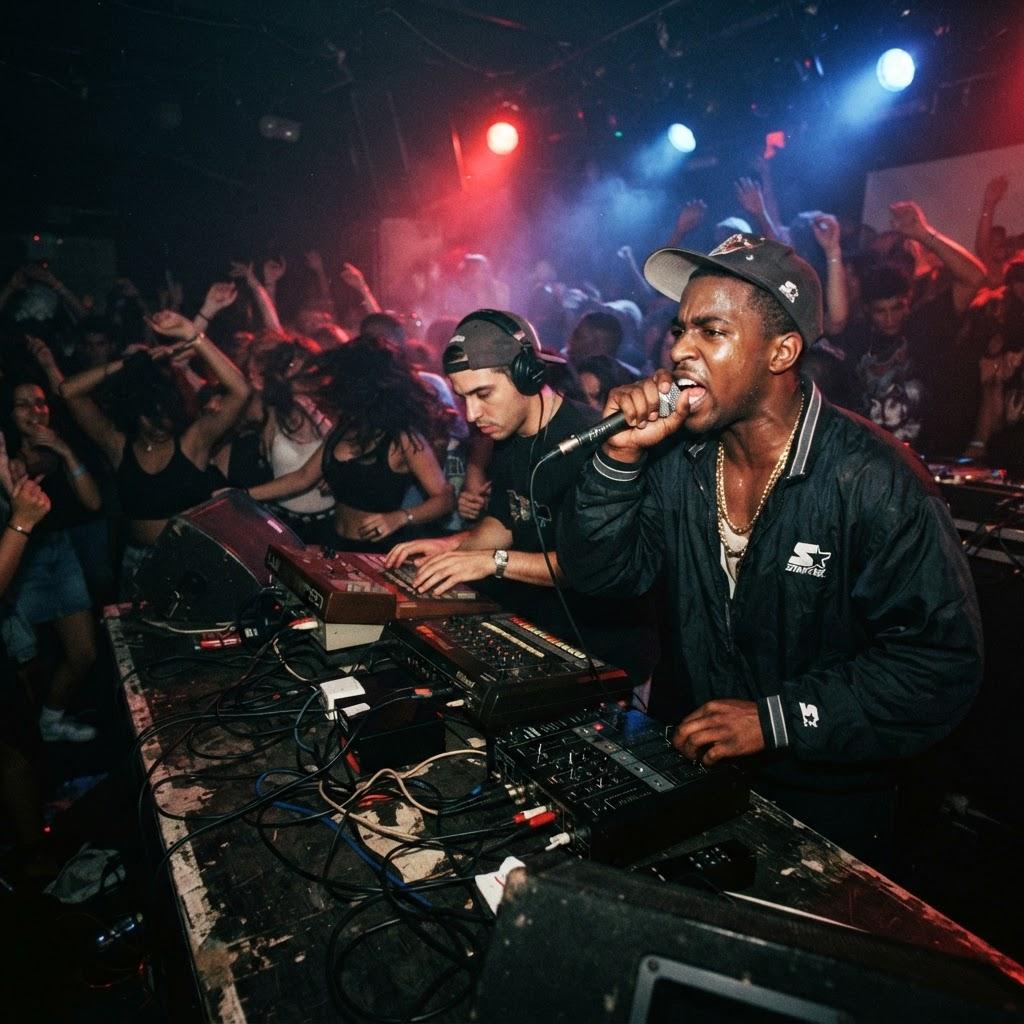
Imagine walking into a club that smells like spilled energy drinks and pure, unfiltered ambition. The walls are vibrating, the floor is sticky, and the person next to you is screaming something unintelligible but undeniably hype-inducing into your ear. That is Crunk. It is not music you listen to while sipping herbal tea and reading a book; it is music that demands you jump up and down until your knees protest. The word itself is a portmanteau of 'cranked' and 'drunk,' and the vibe matches the dictionary definition perfectly. It is loud, it is abrasive, and it has absolutely no interest in being polite. Crunk is the sound of pure, unadulterated adrenaline manifesting as a rhythmic assault on your senses. It took the laid-back, swampy bounce of the South and injected it with enough stimulant energy to wake up a sleeping volcano. If the purpose of music is to change your heartbeat, Crunk does that by grabbing it with both hands and forcing it to match the frantic pace of its relentless drum machines.
The Sound & Signature Elements
At its musical heart, Crunk is surprisingly minimalist. It relies on the 'less is more' philosophy, provided that 'more' means a bass drum so loud it could vibrate a painting off your neighbor's wall. The tempo is usually slow—often between 70 and 85 beats per minute—which gives the music a heavy, plodding weight that feels like a giant marching toward you. The backbone of every Crunk track is the Roland TR-808, an old-school drum machine that provides those iconic, booming kicks that sound like a giant's heartbeat. On top of that, producers layer screeching, erratic synthesizers that sound like a malfunctioning robot in a haunted disco. The vocal style is perhaps the most distinct feature: it is not about complex lyrical acrobatics or smooth flows. Instead, it is about raw, repetitive shouting, chanting, and 'ad-libs'—those little vocal interjections like 'Yeah!' or 'What!'—that function as instructions for the listener to lose their mind. It is a call-and-response engine designed specifically to turn a bored audience into a frenzy.
Origins & Birth of the Sound
Before the glitz of Atlanta took the spotlight, Crunk was brewing in the dark, sweaty basements of Memphis. It was born from a cocktail of necessity and localized chaos. Producers and rappers were looking to translate the energy of the local club scene onto tape. They were influenced by the rhythmic bounce of Miami bass and the gritty, dark storytelling of early Southern hip-hop, but they wanted something faster-feeling and more intense. The birth of Crunk wasn't a formal event; it happened in tiny home studios where guys were obsessing over how to make their drums hit harder and their synthesizers sound more ominous. The scene was hyper-local, with cassette tapes passed around like contraband. These artists were creating a soundtrack for a specific type of late-night environment where the rules of the daytime didn't apply. It was a grassroots uprising of sound that was fueled by a desire to stand out from the polished, radio-friendly sounds coming out of the coasts, opting instead for a gritty, basement-born electricity that felt dangerous.
The Pioneers & Legends
If Crunk were a kingdom, Lil Jon would undoubtedly be its king, sporting the largest crown and the loudest voice in the room. Alongside his cohorts, the East Side Boyz, he transformed what was a regional curiosity into a global phenomenon. Lil Jon wasn't just a rapper; he was a master of ceremony, a hype man who could turn a dead-silent room into a mosh pit with one well-placed 'OKAY!' Then there were the architects of the sound, like Three 6 Mafia from Memphis, who brought a dark, occult-influenced aesthetic to the genre. Their production was shadowy and intimidating, providing the perfect counterbalance to the high-energy party atmosphere of the Atlanta scene. Artists like Ying Yang Twins also played a pivotal role, adding a sense of humor and a playful, rhythmic delivery that made the music accessible to the masses. These pioneers understood that the key to Crunk wasn't technical perfection, but the ability to command an audience's energy. They treated their music like a physical object, something you could mold and swing around until everyone in the vicinity was moving.
Defining Tracks & Era-Defining Moments
To understand the sheer power of the genre, one must experience the seismic impact of tracks like 'Get Low' by Lil Jon & The East Side Boyz. When that song hit the airwaves, it was as if a switch had been flipped in every club in America simultaneously. It didn't just top the charts; it redefined how people danced. Then there is 'Wait (The Whisper Song)' by the Ying Yang Twins, a track that proved Crunk didn't always have to be about screaming—sometimes, the most intense moments were the quiet ones. These tracks weren't just hits; they were cultural milestones that solidified the South as the new epicenter of hip-hop. The crossover appeal was instant and inevitable. You had pop stars lining up to work with Crunk producers because they realized that if they wanted their music played in the club, they needed that specific brand of Southern heat. These songs broke down the barriers between regional rap and mainstream radio, proving that even the most chaotic, underground sounds could conquer the world if they were infectious enough.
Subgenres & Offshoots
Like any successful movement, Crunk eventually splintered off into fascinating, mutated versions of itself. As it traveled, it picked up local flavors, leading to offshoots like 'Snap music,' which took the energy of Crunk and dialed it back into a rhythmic, finger-snapping minimalism that dominated the mid-2000s. You also had 'Trill,' a slowed-down, Texas-influenced variation that leaned more into the heavy, hypnotic bass and introspective, syrupy lyrical themes rather than the pure party shouts of Atlanta. Some artists even began fusing Crunk with elements of rock and heavy metal, leading to a weirdly wonderful collision of distorted guitars and 808 bass kicks. These offshoots showed just how versatile the core formula was; it was a rhythmic skeleton that could be dressed up in any number of outfits. Whether it was the high-energy, frenetic pace of the original Atlanta sound or the darker, moodier variations emerging from other parts of the South, the common denominator was always that signature, earth-shaking bass that demanded your undivided attention.
Cultural Impact & Influence
The influence of Crunk is so deeply embedded in modern pop culture that we hardly notice it anymore, much like the air we breathe or the bass in our cars. Fashion-wise, it ushered in an era of oversized jerseys, excessive jewelry, and a sense of 'more is better' aesthetic that defined the early 2000s. Linguistically, it reshaped how people talked; if you ever heard someone shout 'WHAT!' or 'YEAH!' in a thick Southern drawl, you were hearing the lingering echoes of Crunk. It changed the way movies and commercials used music, shifting from soft melodies to aggressive, high-energy beats meant to grab the viewer by the collar. Even modern trap music, which currently dominates the global charts, is essentially a direct descendant of the Crunk revolution. The DNA of that era—the heavy 808s, the ad-libs, the focus on club-centric beats—is the bedrock upon which almost all modern popular rap is built. It wasn't just a genre; it was a total overhaul of the musical landscape that left no stone unturned.
Controversies & Drama
Oh, the drama! If you think pop stars have it bad, you haven't seen the world of early 2000s Southern rap. There were purists who hated Crunk, calling it 'repetitive' and 'brainless,' claiming that it was the end of lyrical hip-hop. These critics treated the genre like a plague, but their complaints only served to make the genre more popular among those who just wanted to have fun. Then there were the endless beefs over regional pride, where artists from different cities would trade barbs about who had the harder beat or the more 'authentic' sound. Some artists were accused of 'selling out' as soon as their tracks moved from the hood to the Hollywood film soundtrack circuit. It was a soap opera of ego, regional loyalty, and massive checks. The backstage drama at shows was often as explosive as the performances themselves, fueled by high-stakes competition and the pressure to outdo the last record's intensity. It was messy, it was loud, and it kept the gossip columns very, very busy for a solid decade.
Global Spread & Regional Scenes
Crunk didn't just stay in the South; it was a contagion that hopped across oceans. In places like Japan, the UK, and even across parts of Europe, DJs began importing those Memphis and Atlanta tapes, and something magical happened. Local artists started remixing the sound, injecting their own regional flair into the mix. You had European producers layering those iconic 808s with local street sounds, and Asian club scenes embracing the shout-heavy energy with a fervor that rivaled the original Atlanta basement parties. It was fascinating to see how a sound so specifically rooted in the humidity of the American South could translate so perfectly to a club in London or Tokyo. The universal language of the bass-heavy beat and the simple, shouted instruction is apparently a dialect that everyone speaks fluently. Wherever there was a dance floor and a sound system that could handle the low-end frequency, Crunk found a home, proving that you don't need a map to find where a party is happening.
The Modern Landscape
Today, Crunk is like a ghost that haunts every Top 40 chart. While the golden age of the genre has passed, its DNA is thriving in the form of Trap, which has essentially become the global default sound for hip-hop and pop music alike. You can still hear the influence of those early pioneers in the way modern artists prioritize the beat over the lyrics and how they use ad-libs to create a sense of manic energy. On platforms like TikTok, we see constant resurgences of the genre's aesthetic, with younger generations discovering these tracks and using them to soundtrack everything from dance challenges to chaotic comedy skits. It has evolved from a specific, regional genre into a foundational element of modern musical grammar. It is no longer just a 'genre' in the traditional sense; it is a permanent fixture in the toolkit of every producer who wants to make music that vibrates the floorboards. The energy didn't die; it just went into the bloodstream of popular music.
How to Dive In
Are you ready to blow your speakers and rattle your windows? Diving into Crunk is easy, but you have to be prepared for the sonic impact. Start with 'Kings of Crunk' by Lil Jon & The East Side Boyz; it is the definitive textbook on how to throw a musical party. Then, go deep into the back catalog of Three 6 Mafia for a taste of the darker, grittier Memphis roots that gave the genre its menacing edge. Don't forget to spin some Ying Yang Twins for the lighter, dance-heavy side of the coin. Once you have those down, search for 'Crunk Classics' playlists to find the hidden gems that defined the era. The secret to enjoying it is simple: don't overthink it. This music is designed to be played at maximum volume in a car, in a club, or at a party where you want to feel the bass in your chest cavity. Grab your favorite headphones, turn the bass up until your ears are buzzing, and let the chaos take over. Welcome to the party—try not to jump too hard!