1970s, New York City, USA
Noise Rock
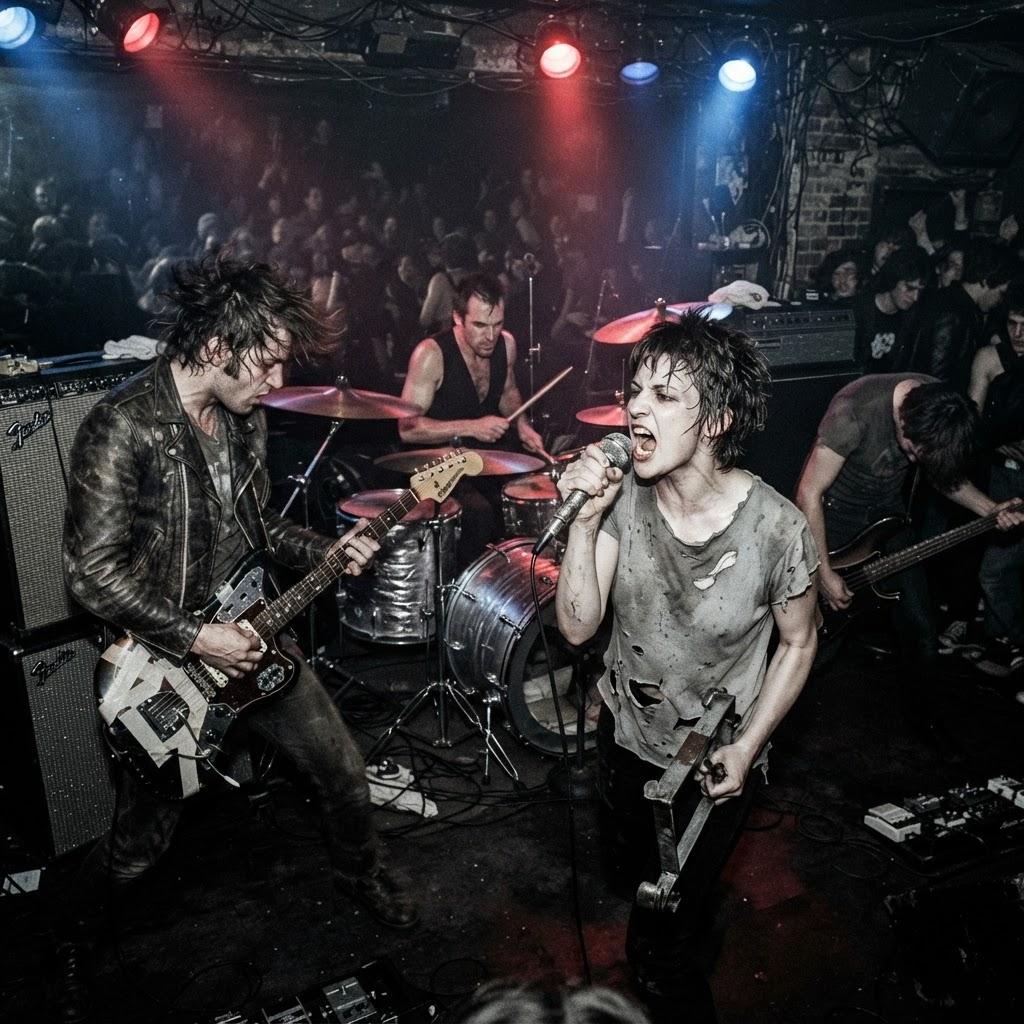
Noise Rock is the musical equivalent of a chainsaw fighting a garbage disposal inside a velvet-lined room. It is loud, messy, and absolutely brilliant for anyone tired of music that plays it safe.
Meet the Genre
Imagine walking into a hardware store, tripping over a rack of rusty pipes, and deciding that the sound of those pipes hitting the floor is actually the best thing you have ever heard. That is the initial greeting of Noise Rock. It is not just music; it is an organized riot. If pop music is a polite handshake, Noise Rock is a friendly tackle from a giant dog that hasn't seen you in years. It rejects the idea that a song needs a pretty melody or a catchy chorus. Instead, it invites the listener into a world of grinding guitar feedback, jarring rhythms, and vocals that often sound like someone screaming for help from the bottom of a well. It is a genre for the curious, the bored, and the people who think that a perfectly tuned guitar is a wasted opportunity for chaos. It’s the sonic equivalent of a neon sign flickering in the rain: gritty, beautiful, and slightly dangerous.
The Sound & Signature Elements
At its heart, Noise Rock is all about texture. Musicians in this genre treat the guitar not just as an instrument, but as a weapon. They use distortion—which is just a fancy way of saying they take the signal from the guitar and crunch it until it sounds like an angry bee trapped in a tin can—and they lean heavily into feedback. Feedback happens when the sound coming out of the amplifier loops back into the guitar strings, creating that piercing, uncontrollable screech. The drums in Noise Rock usually don't care about being smooth; they are often heavy, tribal, and played with the intensity of a blacksmith hitting an anvil. The time signatures might shift unexpectedly, making you feel like you are walking down a flight of stairs in the dark, wondering where the next step actually is. It is not about playing fast; it is about playing with maximum impact, volume, and an utter disregard for what a 'normal' song is supposed to sound like.
Origins & Birth of the Sound
The story begins in the late 1970s in the grimy, art-soaked basements of New York City, specifically within the No Wave scene. The city was broke, the streets were chaotic, and musicians were tired of the simplicity of standard punk. They didn't want to just play three chords; they wanted to deconstruct the very idea of what music could be. It was born in art lofts where the rent was cheap and the creative ambition was massive. There was a deliberate sense of defiance, a 'we don't want your rules' attitude that saw guitarists attacking their instruments with drumsticks or using screwdrivers to create bizarre scrapes and stabs of sound. It was the sound of a city that felt like it was falling apart, captured on reel-to-reel tape. The pioneers here were less like professional musicians and more like sound-sculptors who decided that their chisel should be a wall of ear-splitting amplification.
The Pioneers & Legends
Every legend has a creation myth, and for Noise Rock, the gods are loud and perpetually irritated. Big Black, led by the prickly genius Steve Albini, set the blueprint by using a drum machine that sounded like a mechanical death-march while guitars shrieked like banshees. Then you have Sonic Youth, who treated their guitars like abstract paintings, using bizarre 'alternate tunings'—tinkering with the tension of the strings until the guitar was practically a different instrument—and using household objects like screwdrivers or drumsticks to strum them. The Butthole Surfers brought a chaotic, hallucinogenic circus vibe to the party, while Jesus Lizard became the gold standard for pure, physical, tension-filled aggression. These bands weren't trying to be on the radio; they were trying to dismantle the radio from the inside out. They became legends because they stayed true to the noise, even when the world tried to convince them to pick up an acoustic guitar and write a ballad.
Defining Tracks & Era-Defining Moments
If you want to understand the genre, you need to listen to the moments where the madness clicked. Sonic Youth’s 'Teen Age Riot' is the perfect entry point, showing how you can mix beautiful, haunting melodies with an ocean of noisy, distorted bliss. Then there is the sheer, blunt-force trauma of Big Black’s 'Kerosene,' which sounds like a factory turning into a war zone. When these songs hit the scene, they weren't just tracks; they were gravitational shifts. Suddenly, independent record labels were realizing that there was an audience for music that didn't fit into a tidy box. These songs were the proof that dissonance could be danceable, or at the very least, deeply compelling. It was the era where underground labels like Touch and Go were essentially running a secret resistance movement, distributing these records to kids in small towns who desperately needed to hear something that sounded like the inside of their own overactive, rebellious brains.
Subgenres & Offshoots
The Noise Rock family tree is basically a lightning-struck oak that refuses to stop growing. You have 'Math Rock,' which takes the complexity of the genre and adds logic puzzles; these bands write songs with rhythms so complicated they basically require a calculator to count along. Then there is 'Noise Pop,' which sounds like someone threw a handful of glitter into a woodchipper—it’s sweet and noisy all at once. We also have 'Industrial Noise,' which leans into the mechanical, factory-floor aesthetic, replacing organic drums with clanking metal and white noise. As the genre traveled, it picked up different accents. In Japan, for example, the scene became even more extreme, pushing the boundaries of volume to the point where it becomes a physical endurance test for the audience. Each offshoot takes a small piece of the Noise Rock puzzle—the volume, the structure, the chaos—and rearranges it to see what kind of monster they can create next.
Cultural Impact & Influence
Noise Rock didn't just stay in the rehearsal space; it leaked into the real world like a stubborn oil stain. It influenced fashion by normalizing the 'I just rolled out of a dumpster and I look great' aesthetic—flannel, torn jeans, and vintage band shirts became the uniform of the disaffected. In the realm of film and art, the genre’s DNA is all over the independent, gritty cinema of the 90s, where directors wanted soundtracks that felt as unstable as their characters. Even modern pop stars have borrowed its techniques, using 'glitchy' production tricks or distorted vocals to sound edgy. It taught a whole generation that you didn't need expensive equipment or technical wizardry to be creative. You just needed an idea, a guitar, and enough nerve to make a scene. It essentially paved the way for the grunge explosion and the 'lo-fi' movement, showing the world that flaws were actually features.
Controversies & Drama
You cannot have a genre built on conflict without a little bit of internal fireworks. The biggest drama in the Noise Rock world was always the 'authenticity' trap. Bands would spend years making music that sounded like a car crash, only to have a major record label come knocking with a big contract. Suddenly, the underground is screaming 'sellout!' from the rooftops. There were endless arguments over whether the sound was 'truly' noise or just heavy rock in a fancy coat. And let’s not forget the live shows—this was a genre where the line between a concert and a riot was often blurry. There were stories of bands starting fights with their own audiences just to prove a point, or performers bleeding on their instruments. It was petty, it was dramatic, and it was absolutely essential to the genre’s reputation as something that was never going to bow down to anyone, not even its own fans.
Global Spread & Regional Scenes
While it started in New York, Noise Rock was a virus that spread globally. Chicago became a massive hub, thanks largely to the production wizardry of Steve Albini, who made the city a destination for anyone wanting that signature, dry, pummeling sound. Meanwhile, the UK had its own take, blending the noise with a uniquely British sense of bleakness and political rage. If you look toward Japan, you find the 'Japanoise' explosion, where the genre moved away from traditional rock instruments entirely, focusing on pure, unadulterated soundscapes. Australia produced bands that made the desert heat feel like part of the audio texture, creating a sweltering, psychedelic version of the genre. Every region took the core idea—that music should be a challenge—and filtered it through their own local frustrations and joys, proving that you can make a glorious racket in any language, in any city, anywhere on the planet.
The Modern Landscape
Today, Noise Rock is in a fascinating place. It’s not necessarily dominating the charts, but it is everywhere you look if you know where to listen. In the age of digital music, younger bands are mixing the old-school abrasive sounds with modern electronics, creating a hybrid that sounds like a glitchy, terrifying video game. You will find it in the darker corners of the indie scene, where artists use it as a tool for catharsis. It’s no longer just a bunch of guys in damp basements; it’s a global community of sonic explorers who are constantly finding new ways to make us cover our ears and grin. TikTok might be full of polished pop, but there is an underground surge of kids rediscovering the power of a fuzz pedal and a bad attitude. The genre hasn't gone anywhere; it has just evolved to fit into the pockets of the digital age, still loud, still messy, and still completely unapologetic.
How to Dive In
If you are ready to stop playing it safe and want to get your eardrums properly introduced to the genre, you need a starter pack. Start with Sonic Youth’s 'Daydream Nation'—it’s the perfect bridge between melody and chaos. Then, grab Big Black’s 'Songs About Fucking' to understand the power of a drum machine and pure, unbridled aggression. For something that leans into the weird, check out The Jesus Lizard’s 'Goat,' which is essentially a masterclass in tension and release. Don’t try to understand every note; that’s not the point. The point is to feel the air move and the floor shake. Put on a good pair of headphones—or better yet, turn up your speakers until your neighbors start to worry—and just let the wall of sound wash over you. Dive in, stay curious, and embrace the fact that sometimes, the best music is the kind that sounds like a beautiful disaster. Happy listening, you brave soul!