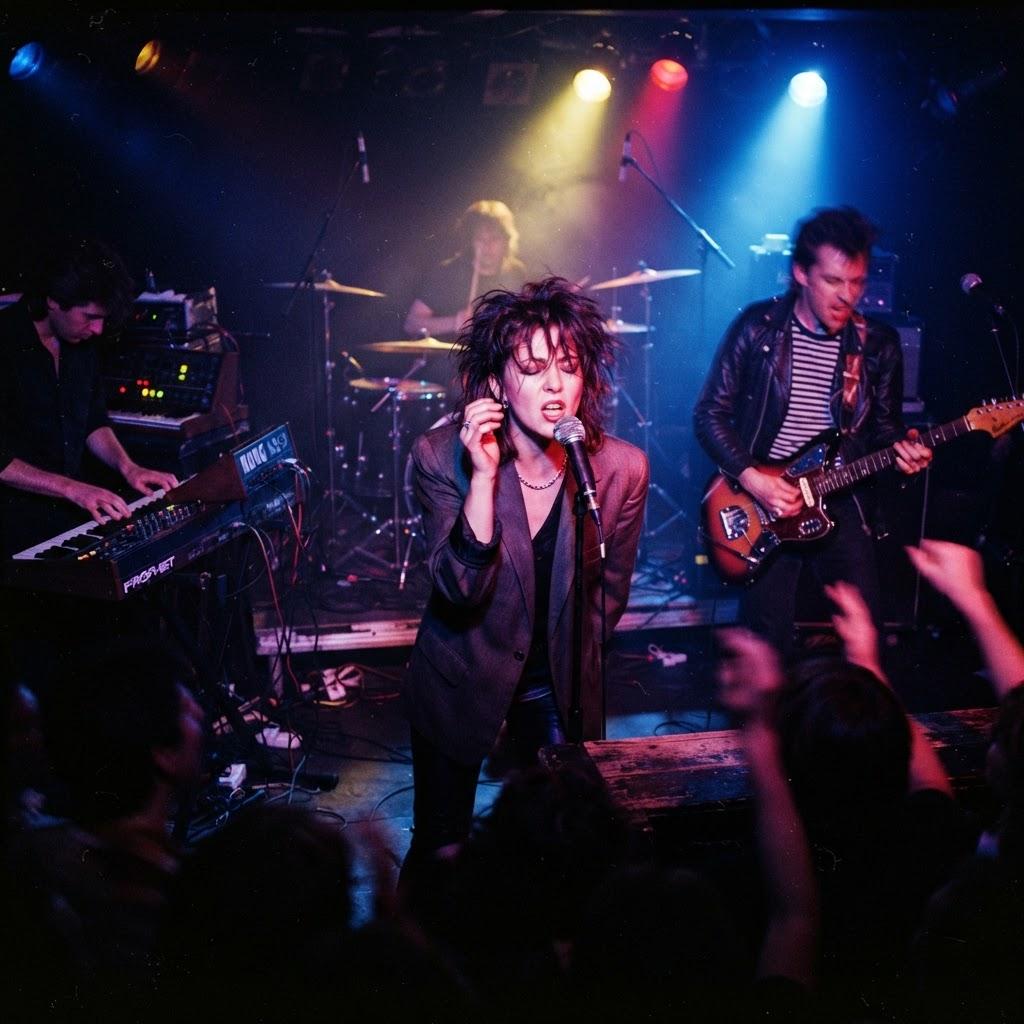
Late 1970s, United Kingdom and Germany
Synthpop
Synthpop is the neon-drenched, robot-fueled soundtrack to your dreams where machines learn to weep and dance at the same time. It is the glorious intersection of cold circuits and warm, fluttering human heartbreak.
Meet the Genre
Imagine you are trapped in a futuristic department store elevator at three in the morning. The lights are flickering, the floor is made of polished chrome, and someone has replaced the conventional band instruments with a collection of hungry, blinking robots. That is Synthpop. It is the genre that decided guitars were just too messy and sweaty, opting instead for the crisp, clean precision of electricity itself. Synthpop isn't just music; it is an attitude that says human emotion is best expressed when filtered through a voltage-controlled oscillator. It is the sound of a cyborg trying to write a love letter while running away from an existential crisis. Whether it is the icy detachment of a cold-war thriller or the glittering, optimistic sparkle of a mall dance party, Synthpop occupies a space that is equal parts melancholic and euphoric. It is fashion-forward, neon-obsessed, and unapologetically artificial, creating a world where the wires hum, the rhythm pulses like a second heartbeat, and the chorus is always big enough to fill a stadium, even if you are just listening to it on a bus with your headphones on.
The Sound & Signature Elements
To build a Synthpop song, you don't need a basement full of amplifiers or a drummer who eats too many cheeseburgers; you need gear that looks like the cockpit of a 1980s space shuttle. The DNA of the genre starts with the monophonic synthesizer, which is just a fancy way of saying it can only play one note at a time—which is why the melodies are so piercing and iconic. You pair that with a drum machine, usually the Roland TR-808 or the LinnDrum, which provides that rock-solid, non-negotiable beat that never gets tired. The rhythm is usually locked in at a steady dance tempo, keeping everything moving like a mechanical heart. Then, you throw in a sequencer, which is essentially a musical robot programmed to play repetitive, hypnotizing patterns while you go make a sandwich. The secret sauce is the vocal production—often using a vocoder, which makes your voice sound like a singing computer, or lots of chorus effects to make the singer sound like they are singing from inside a cathedral of glass. It is all about clean lines, sharp edges, and melodies that stick in your brain like digital chewing gum.
Origins & Birth of the Sound
The birth of Synthpop was less of a lightning strike and more of a slow, beautiful power-up sequence. It started in the crumbling industrial cities of the UK and the experimental laboratories of Germany. Bands like Kraftwerk, the godfathers of the electronic pulse, were busy turning European industrial sounds into futuristic symphonies in their Düsseldorf studio, Kling Klang. They treated machines with the reverence other musicians reserved for guitars, proving that you could be soulful without even touching a string. Meanwhile, in post-industrial Sheffield and London, kids who were tired of the aggression of punk rock decided that if the world was becoming a technological wasteland, they might as well make the soundtrack sound like it. They traded their safety pins for soldering irons and their leather jackets for shoulder-padded blazers. This was the era of the 'Bedroom Producer,' where anyone with a decent synthesizer and a dream of space travel could create a revolution from their parents' spare room. It was creative defiance against the grit and grime, a deliberate choice to embrace the artificial as a way to escape the harsh realities of a decaying urban landscape.
The Pioneers & Legends
If you are looking for the architects of our neon future, look no further than the absolute legends of the scene. Gary Numan was the alien in the room, dropping his seminal album 'The Pleasure Principle' and showing the world that you could be a star while acting completely detached and robotic. Then there was Depeche Mode, who took the chilly synthesizer sound and infused it with enough dark, gothic drama to turn an entire generation into brooding, leather-clad enthusiasts. Yazoo gave us the soaring, gospel-tinged powerhouse vocals of Alison Moyet paired with Vince Clarke’s mechanical genius, creating a contrast that felt like heaven meeting earth. Don't forget The Human League, who managed to turn a breakup into the biggest pop hit of 1981 with 'Don't You Want Me,' essentially defining the way we write pop music to this day. These weren't just musicians; they were the first wave of musical engineers, figuring out how to make knobs and dials scream, cry, and whisper. Each of these legends took the cold, hard logic of hardware and forced it to bleed, turning the 'bleep and bloop' into the chart-topping emotional gold that we still worship.
Defining Tracks & Era-Defining Moments
Certain songs in the Synthpop canon are basically holy relics. You haven't truly lived until you've heard the opening synth-stab of Gary Numan’s 'Cars,' which sounds like a spaceship landing on a freeway. Then there is 'Blue Monday' by New Order, which is the most important 12-inch dance record in history; its drum machine intro is the equivalent of a national anthem for the underground dance floor. When the synth bass kicks in on that track, it is scientifically impossible to sit still. Soft Cell’s version of 'Tainted Love' proved that you could take a classic soul song and give it a synthetic, jittery heart transplant, effectively creating the blueprint for the 'sad disco' vibe. And we have to bow down to Eurythmics’ 'Sweet Dreams (Are Made of This),' which features one of the most recognizable, sinister synthesizer riffs ever committed to tape. These moments were seismic shifts. They signaled to the rest of the world that the synthesizer wasn't just a gimmick or a novelty act for sci-fi movies—it was the future of pop, and it was here to make you dance until your feet gave out.
Subgenres & Offshoots
Synthpop is the gift that keeps on giving, and it has spawned more offspring than a frantic science project. First, there is 'Darkwave,' which is essentially what happens when Synthpop discovers horror movies and black eyeliner. It is moody, spooky, and loves a good minor key. Then there is 'Italo-Disco,' the fabulous, flamboyant Italian cousin who decided to take the robotic beats of Synthpop and sprinkle them with glitter, operatic drama, and slightly broken English lyrics. It is pure, high-octane joy. We also have 'Electro-pop,' which is the cleaner, more polished, and often radio-ready evolution that dominated the late 2000s with artists like Lady Gaga or La Roux, focusing on hooks so sharp they could cut glass. Finally, there is 'Synthwave,' a glorious nostalgic trip that sounds like someone took the soundtrack to a 1984 arcade game and injected it with modern production steroids. Each of these offshoots takes the core premise of 'man meets machine' and twists it into a new shape, proving that as long as there is electricity running through a circuit board, this genre will keep evolving, mutating, and surprising us.
Cultural Impact & Influence
Synthpop didn't just change the charts; it changed the way we look at reality. The aesthetic of the early 80s—the neon colors, the asymmetrical haircuts, the love for all things shiny and plastic—was heavily influenced by the bands that were busy soldering circuit boards on stage. It bled into film, with movies like 'Blade Runner' or the neon-soaked thrillers of the era feeling incomplete without a synthesizer score. It changed the very language of pop music, making the sequencer the backbone of everything from Hip Hop to R&B. Artists like Prince, Madonna, and even the biggest names in modern pop wouldn't have their soundscapes without the path paved by these synthetic pioneers. The genre taught us that technology wasn't something to fear; it was something to play with, to subvert, and to use as a mirror for our own humanity. Even the way we dress today—the obsession with retro-futuristic streetwear—owes a massive debt to the bands who wore silver jumpsuits in 1982. It turned the 'geek' into the 'star,' shifting the cultural power dynamic from the guy with the guitar hero complex to the kid with the biggest wall of oscillators.
Controversies & Drama
Oh, the drama was thick enough to cut with a laser beam. In the early days, the 'Guitar Purists' looked at a band without a drummer and declared that it wasn't 'real music.' They called it soulless, plastic, and lazy. Synthpop fans, in return, looked at the guitar bands and called them dinosaurs who were stuck in the past. It was a proper musical turf war. Then there was the 'Sellout' accusation. As soon as a band like The Human League or Depeche Mode got big on MTV, the underground die-hards would wring their hands and moan about how the soul of the machine had been diluted for the sake of radio play. And don't even get me started on the lip-syncing scandals! Because the technology was so new and often unreliable, some bands would just stand on stage and pretend to play while a tape did all the work. When the tape would inevitably stop or skip, the chaos was beautiful. It was the original 'is it live or is it Memorex' dilemma, and it caused riots, arguments, and endless column inches in the music papers of the day.
Global Spread & Regional Scenes
Synthpop was a virus of the best kind, spreading across borders faster than you could say 'sequencer.' In Japan, the scene went absolutely wild with bands like Yellow Magic Orchestra, who blended the cold, efficient sound of European synths with Japanese pop sensibilities, creating something that sounded like it was beamed in from the year 3000. In the United States, it morphed into the 'New Wave' explosion, where the synthesizers met the frantic energy of the American suburban angst. In Scandinavia, they added a dash of melancholy and crystalline production, creating a 'cold-pop' sound that is still the gold standard for high-end production today. Each region took the 'Synthpop template' and added their local seasoning. The Germans were architectural and precise, the British were moody and theatrical, the Americans were melodic and big, and the Japanese were avant-garde and complex. It was a global conversation held through blinking lights, proving that music doesn't need to be in a shared language to feel universal when the beat is this tight and the synths are this iconic.
The Modern Landscape
If you look at the charts today, Synthpop is essentially the ghost in the machine of all modern music. You can't turn on a radio without hearing a kick drum that sounds like it was snatched from a 1985 drum machine or a synth-bass line that was clearly inspired by the legends of the past. Artists like The Weeknd, Dua Lipa, and Chvrches are carrying the torch, blending the classic, glassy sounds of the 80s with modern, high-definition digital processing. TikTok is practically built on a foundation of sped-up synth melodies and retro-futuristic aesthetic clips. It isn't just a 'retro' sound anymore; it is the default setting for pop music. The gear that used to cost as much as a house is now available as a plugin on a laptop, meaning that every kid in their bedroom has access to the same sonic tools that made the legends famous. We are living in a permanent state of synth-resurgence, where the old and the new have blended so perfectly that you can't tell the difference anymore, and honestly, why would you ever want to?
How to Dive In
So, you are ready to plug into the matrix? Good. Start with the absolute Bible of the genre: Depeche Mode’s 'Violator' album. It is moody, it is industrial, and it is catchy as hell. Next, take a trip to the neon-drenched past with Gary Numan’s 'The Pleasure Principle'—if you don't feel like an android by the end of it, check your pulse. For something a little more pop-tastic, grab Yazoo’s 'Upstairs at Eric’s' and prepare to be floored by those vocals. If you want to understand the experimental roots, Kraftwerk’s 'Computer World' is non-negotiable; it is the foundation upon which all this glory was built. Listen to 'Blue Monday' by New Order on a loud sound system, and then hunt down some modern gems from Chvrches to see how the genre is thriving today. Do not overthink it. Just find a pair of decent headphones, sit back, close your eyes, and let the oscillators do the heavy lifting. The robots are waiting for you, and they’ve got a melody that will change your life. Press play, turn up the gain, and welcome to the digital revolution.