1940s
Cumbia
Cumbia is the musical equivalent of a street party that refuses to end, blending deep ancestral roots with a rhythm so infectious it could make a statue dance. It is the heartbeat of Latin America, evolving from coastal campfires to global dancefloors while keeping its soul firmly planted in the mud.
Meet the Genre
Imagine walking onto a humid, salt-sprayed beach on the Caribbean coast of Colombia. You are not just hearing music; you are hearing a conversation between ghosts, sailors, and the forest itself. Cumbia is that legendary friend who shows up to the party with a bottle of rum in one hand and a drum in the other, instantly making everyone feel like they have known each other for a thousand years. It is a genre that does not care about your bad mood or your two left feet. At its core, Cumbia is a defiant, beautiful, and slightly sweaty embrace of life. It’s the sonic equivalent of a neon-lit street fair where the smell of grilled meat mingles with the sound of a plastic scraper rubbing against a metal rod. It is not polite music, it is not background music, and it certainly isn't music for people who enjoy sitting still. If you are looking for a genre that vibrates with the wisdom of the ancestors while simultaneously feeling like it was born in a dusty basement five minutes ago, you have officially arrived at the church of Cumbia.
The Sound & Signature Elements
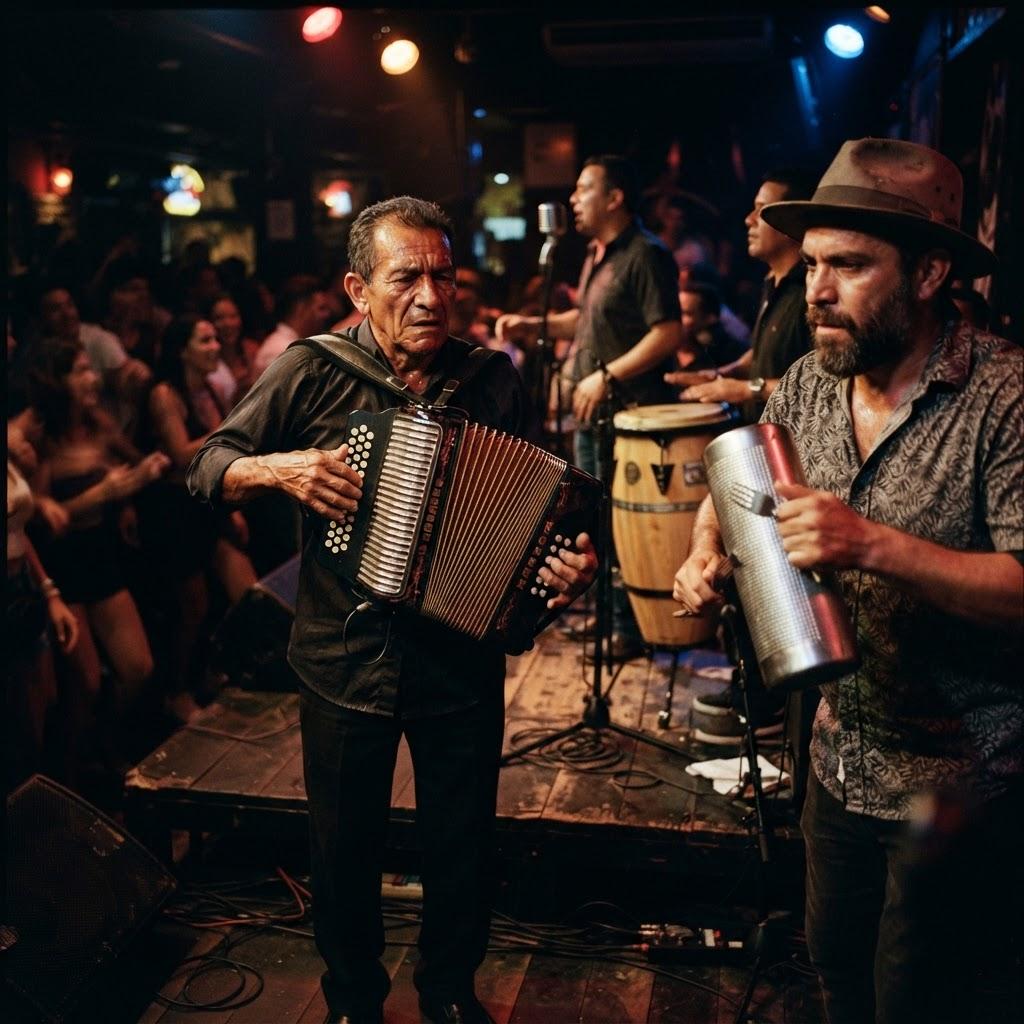
Let’s break down the musical recipe for this rhythmic monster. At the center of the hurricane is the Cumbia rhythm, which is often described as a 'walking' beat. It’s not a frantic sprint like a techno track; it’s a confident, slightly dragging, hip-shaking stride. You have the 'guacharaca,' which is a wooden stick or metal comb scraped against a ridged tube. Think of it like a human-powered version of a record scratch—it provides that constant, rasping, hypnotic texture that tells your brain, 'Do not stop moving.' Then there’s the accordion, which acts as the lead singer even when nobody is opening their mouth. It wheezes, wails, and laughs its way through melodies that are equal parts sweet and melancholic. The drum patterns are built on the 'tambora,' a double-headed drum that anchors the chaos. In layman’s terms, the rhythm is a polyrhythmic puzzle where every layer—the bass, the scraper, the drums—is doing its own thing, yet they all lock into a pocket so deep you’ll need a rescue team to get your groove back. It’s messy, it’s loose, and it’s perfect.
Origins & Birth of the Sound
The story of Cumbia begins in the late colonial period on the Caribbean coast of Colombia, born from a desperate, beautiful collision of cultures. You had the indigenous people playing high-pitched, haunting flute sounds on the gaita—an instrument made from cactus—meeting the enslaved Africans bringing the thunder of their ancestral drumming traditions. Add in the wandering melodies of Spanish influence, and you have a musical melting pot that was arguably the first true 'world music' crossover. This wasn't created in a sterile, air-conditioned boardroom; it was hammered out on dirt floors, under moonlight, and in the shadow of colonial suppression. It was a courtship dance, a way for people from different worlds to communicate when they had no common language other than the beat. For years, this was the sound of the outsiders, the people living on the margins of the coast. They turned their pain and their community pride into a rhythm that refused to be silenced, slowly making its way from the remote rivers to the dance halls of the big cities, eventually conquering the airwaves by the mid-20th century.
The Pioneers & Legends
If Cumbia has a Mount Rushmore, Lucho Bermúdez is definitely the guy with the biggest grin on the mountain. He was the one who took the rural, rustic sounds of the coast and polished them up with the sophisticated arrangements of a Big Band orchestra, proving that Cumbia could dominate fancy ballrooms as easily as a village square. Then you have Andrés Landero, often called the 'King of Cumbia,' who treated his accordion like a holy relic, infusing every note with the gritty, authentic spirit of the countryside. You cannot mention the legends without bowing down to Totó la Momposina, a powerhouse vocalist who kept the traditional, acoustic fires burning while the rest of the world was busy plugging in synthesizers. She is the keeper of the flame, ensuring that the raw, elemental power of the original drums never gets lost in the modern polish. These giants weren't just musicians; they were sonic architects who took a regional folk tradition and built a skyscraper of sound that would eventually touch every corner of the planet.
Defining Tracks & Era-Defining Moments
To understand the gravity of Cumbia, you have to spin 'La Pollera Colorá' by Wilson Choperena. If you play this at a party and people don't start moving, you are at a wake, not a party. It is the unofficial anthem of the genre, a song so iconic that it has become the standard by which all other Cumbias are measured. Another massive pivot point occurred when artists like Aniceto Molina started injecting a faster, more electrified pulse into the classic format. These weren't just songs; they were cultural shifts. The transition from the acoustic, wooden-instrument era of the 40s to the electric, synth-drenched madness of the 70s was a moment of pure musical rebellion. When you hear the fuzz-drenched guitars of Peruvian Chicha—a psychedelic branch of Cumbia—taking over, you realize this isn't just one sound anymore. It’s a liquid genre that changes shape depending on the vessel it’s poured into. Every iconic track is a time capsule, capturing the specific tension and joy of the decade that birthed it.
Subgenres & Offshoots
Cumbia is less of a single genre and more of a massive, sprawling family tree with branches that keep growing in weird directions. You have 'Cumbia Villera' from Argentina, which is the raw, gritty, street-level cousin. It’s dark, it’s cynical, and it uses keyboards to create a menacing, pulsing dancefloor sound that reflects the hardships of life in the slums. Then there is 'Chicha' from Peru, which is Cumbia on a steady diet of surf-rock guitars and psychedelic experimentation—think of it as the hallucinogenic trip you didn't know you needed. Let's not forget 'Tecnocumbia,' where the organic instruments get tossed out the window in favor of glitzy 80s drum machines and space-age synthesizers. It is the shiny, plastic, hyper-pop sibling that loves laser lights and neon spandex. Each of these subgenres takes the 'walking beat' of the original and adds its own local seasoning, proving that Cumbia is the world's most versatile musical chameleon.
Cultural Impact & Influence
Cumbia has done more than just fill dancefloors; it has fundamentally altered the DNA of Latin American identity. In Mexico, the 'Sonideros'—mobile DJ sound systems—turned Cumbia into a communal ritual, where the DJ would shout dedications and play with the pitch of the records, creating a unique, personalized experience for every neighborhood. It’s a genre that has been featured in countless movies, shaped the way people dress—often influenced by the pachuco and cholo subcultures—and even influenced political discourse by being the voice of the working class. When a song like 'Cumbia del Sol' plays, it isn't just music; it’s a signal for a massive, city-wide celebration. It has influenced modern reggaeton, pop, and even indie rock, with bands across the world sampling those iconic guacharaca rhythms to give their tracks that extra bit of soul. It is the rhythmic glue that holds together so many diverse cultures, proving that you don't need to speak the same language to share a heartbeat.
Controversies & Drama
Every family has its drama, and Cumbia is no exception. For decades, there was a bitter war between the 'purists'—who insisted that Cumbia must only be played with acoustic instruments—and the 'modernizers' who wanted to bring in electric guitars and synthesizers. The purists looked at the early synth-Cumbia pioneers like they were trying to ruin Christmas. There were also massive, ego-fueled rivalries between different sound systems in Mexico City, where DJs would literally steal each other’s record crates or sabotage sound rigs just to claim dominance over a neighborhood. And let’s not forget the 'sellout' accusations that followed any band that dared to crossover into the pop charts. But honestly? That conflict is exactly what pushed the music forward. Without that friction, we wouldn't have the incredible diversity of styles that exist today. It turns out that a little bit of petty musical beef is actually the best fertilizer for genius, keeping everyone on their toes and ensuring the sound never gets lazy.
Global Spread & Regional Scenes
While it was born in Colombia, Cumbia clearly had a travel bug. It hitched a ride on radio waves and migrated across borders like a rhythmic virus. In Mexico, it became a national obsession, leading to regional variations that are as distinct as the tacos in each state. In Argentina, it was adopted by the working class as a way to process the chaos of economic turmoil, turning the music into a form of social resistance. Meanwhile, in the United States, particularly in cities like Los Angeles, it found a new home in the Chicano community, where it was blended with hip-hop sensibilities to create a brand new, cross-cultural masterpiece. From the clubs of Paris where hipsters are obsessed with 'Tropical Bass' to the street parties in Tokyo where people are discovering the magic of the guacharaca, Cumbia has proven to be the ultimate traveler. It speaks to the universal human need for rhythm, community, and the simple act of letting loose, no matter where you are on the map.
The Modern Landscape
Today, Cumbia is living its absolute best life. We are currently in the middle of a massive global revival, with producers from Berlin to Bogota remixing the old school classics for the digital age. You can find Cumbia tracks blowing up on TikTok, introduced to a new generation who have no idea how much history is packed into that 110 BPM rhythm. There are 'Folktronica' artists layering ancient flute melodies over bass-heavy electronic beats, creating a sound that feels like a rave in a jungle. The best part? The genre hasn't lost its soul in the transition to streaming. Even the most polished, modern production still keeps that essential, hip-swinging, scraping rhythm that defines the genre. Whether it's playing in a dingy dive bar or a massive summer music festival, Cumbia remains the most reliable party-starter in human history. It is evolving, mutating, and continuing to find new ways to wiggle its way into our collective consciousness, reminding us all that if you have a beat, you have a future.
How to Dive In
So, you want to get into Cumbia? Good for you, your life is about to get significantly more vibrant. First, put down the reading list and head to your favorite streaming service. Search for 'The Golden Age of Colombian Cumbia' to get a taste of the roots, then jump straight into 'Cumbia Villera' playlists to understand the gritty, modern evolution. For specific artists, start your journey with the legendary Los Corraleros de Majagual to hear what a real, tight band sounds like. If you want the psychedelic stuff, look up Los Mirlos; their guitar work will make you feel like you've taken a trip to the Amazon without leaving your living room. Don't try to analyze it too hard—just let the accordion melodies weave their spell and make sure your floor is clear because your feet are going to start moving whether you like it or not. Dive deep, dance hard, and welcome to the family. The party is just getting started, and there is always room for one more person on the dancefloor. Turn it up!