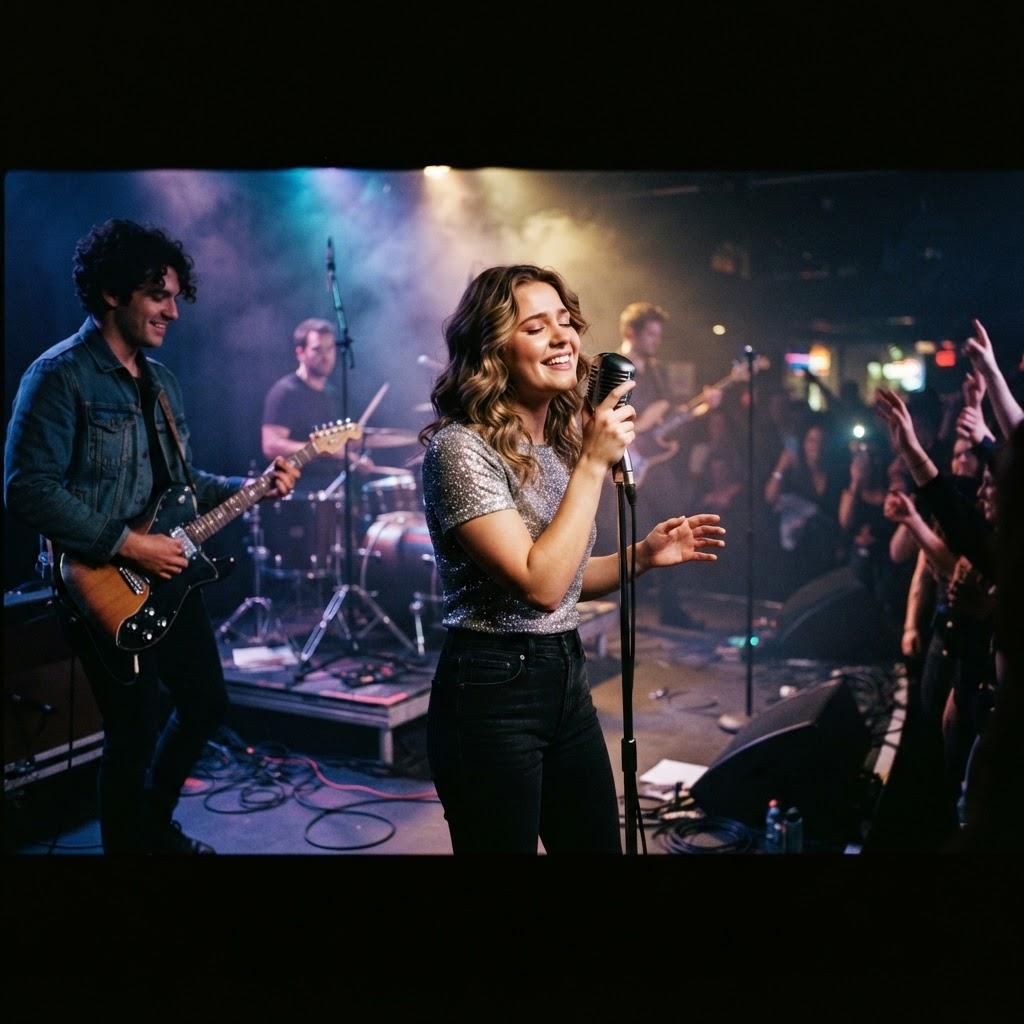
1950s, United States and United Kingdom
Pop
Pop is the musical equivalent of a glittery, high-octane rocket ship that somehow manages to land right in the middle of your emotional living room. It is the inescapable, infectious, and meticulously crafted soundtrack to human existence that keeps the world spinning one chorus at a time.
Meet the Genre
Pop music is that friend who walks into a room and instantly becomes the center of attention, not because they are shouting, but because they have somehow learned to speak in a universal language of joy, heartbreak, and dancing. It is the shapeshifter of the sonic world, a musical chameleon that wears whatever clothes are currently trending but keeps the same sparkling, magnetic personality underneath. You know Pop when you hear it because it hits you like a warm wave of familiarity, even if it is a song you have never encountered before. It is the high-fructose corn syrup of the audio world—engineered to be addictive, perfectly balanced, and impossible to put down. Whether it is playing in a dentist's office, a strobe-lit nightclub, or a grocery store aisle, Pop serves a singular purpose: to connect with the widest number of human brains possible in the shortest amount of time. It does not demand that you study its history or understand its complex chord structures. Instead, it invites you to sing along, tap your foot, and perhaps cry a little bit while you are stuck in traffic. Pop is the art of the perfect moment, crystallized into three minutes of polished perfection.
The Sound & Signature Elements
If you were to open up a Pop song and look inside, you would find an assembly line of precision engineering. At its core, Pop is built on a foundation of brevity and impact. Most tracks follow a verse-chorus-verse-chorus-bridge-chorus structure, a reliable map that ensures your brain always knows exactly where it is going. The tempo usually hovers in the range of 100 to 130 beats per minute, which is the biological sweet spot for walking, dancing, and keeping a steady heart rate. The production is where the magic happens: this involves using fancy computer software to make everything sound larger than life. Vocals are polished until they shine like chrome, often using pitch correction to ensure every note is landing squarely in the center of perfection. Instruments are layered like a high-end lasagna, with synthesizers providing the shimmering top layer, heavy drum machine kicks acting as the foundation, and electric guitars or piano melodies weaving in between to provide the 'hook'—that tiny, ear-worm melody that burrows into your skull and refuses to leave. It is sonic comfort food, expertly seasoned.
Origins & Birth of the Sound
The birth of Pop was not a single 'eureka' moment but rather a collision of technology and changing social tides in the mid-20th century. As post-war prosperity took hold in the 1950s, a new creature emerged: the teenager. With money in their pockets and record players in their bedrooms, these young people needed a sound that belonged to them, something that wasn't the stuffy Jazz their parents listened to or the rugged Blues of the previous generation. In urban centers like New York, London, and Memphis, producers began blending the rhythmic drive of Rock and Roll with the polished, melodic sensibilities of vocal groups and Brill Building songwriters. These writers were like factory workers for hits, churning out songs meant for mass consumption. By the time the 1960s rolled around, radio play and the invention of the portable transistor radio meant that a catchy tune could travel across continents in days. Pop was born from the realization that if you could combine a simple, relatable lyric about love or heartbreak with a melody that felt like a hug, you could capture the world.
The Pioneers & Legends
Every pantheon needs its gods, and Pop is no exception. The history of the genre reads like a movie script full of larger-than-life characters. You have the Fab Four, The Beatles, who effectively invented the modern blueprint by proving that a band could write their own hits and evolve from sweet, mop-topped love singers into psychedelic studio wizards. Then came the King, Elvis Presley, whose hips and voice acted as the bridge between the grit of the American South and the glossy stage of global celebrity. As we moved into the decades that followed, we saw the rise of the true titans of stagecraft. Michael Jackson turned the music video into a high-art form, effectively transforming the genre into a visual spectacle. Madonna challenged the boundaries of what a Pop star could say, do, and wear, turning her image into a constant performance piece. These figures weren't just musicians; they were cultural architects who understood that in the world of Pop, the persona is just as important as the piano key. They pushed the boundaries of what was possible, turning their quirks into icons.
Defining Tracks & Era-Defining Moments
To understand Pop, you have to look at the moments where the map of the world seemed to shift beneath our feet. Think of The Beatles’ 'I Want to Hold Your Hand,' a song so precise in its delivery of joy that it single-handedly launched the British Invasion. Or consider Michael Jackson’s 'Billie Jean,' where the distinct, snapping drum beat served as the 'aha' moment for what a truly tight, modern rhythm track could sound like. Then there is the 90s explosion, epitomized by Britney Spears’ '...Baby One More Time,' a masterclass in tension and release that proved a song could be both hyper-produced and raw with teenage angst. These tracks were not just popular; they were cultural tremors. Every one of them introduced a new technique, a new way of singing, or a new way of looking at a Pop star that changed the trajectory of the entire industry. They were the lightning rods that struck, forcing every artist who came after them to adjust their lightning rods just to stay relevant in the changing climate.
Subgenres & Offshoots
Pop is a sprawling, multi-limbed creature that loves to borrow from its neighbors. Because it is so flexible, it has constantly branched out into wilder territory. You have Synth-Pop, which took the cold, robotic sounds of early electronic music and coated them in sweet melodies, creating a sound that felt like the future. Then there is Power Pop, which takes the crunchy, distorted guitars of Rock and mashes them together with the sugary harmonies of the Beach Boys. Let’s not forget the gargantuan rise of Teen Pop, which prioritized vocal gymnastics and glossy aesthetic perfection. More recently, we have seen the emergence of Hyperpop, a chaotic, distorted, and high-energy version of the genre that sounds like a sugar-induced seizure—in the best way possible. By pulling ingredients from Hip-Hop, R&B, Country, and even classical music, Pop ensures it never stays the same for too long. It is a musical shapeshifter that grows more complicated, or more simple, depending entirely on the mood of the culture at any given second.
Cultural Impact & Influence
Pop music is the invisible wallpaper of our lives; it’s everywhere, even when you aren't paying attention. It dictates the vocabulary of our relationships, providing the lyrical shorthand we use when we fall in love or get our hearts broken. Beyond the radio, it drives the fashion industry—every time a Pop star adopts a new look, the high-street retail shops are scrambling to replicate it within weeks. It has also fundamentally changed how we view celebrity. We no longer just listen to these artists; we follow their every move on social media, consuming their lives as a form of reality television. Pop has also been the vanguard of social change, with artists using their massive platforms to advocate for political causes, challenge gender norms, and bridge cultural divides. Because it is accessible, it acts as a universal bridge. A teenager in Tokyo can feel the exact same heart-wrenching pangs of loneliness as a teenager in Toronto while listening to the same sad ballad. That shared emotional experience is the true power of Pop: it makes the world feel smaller and more connected.
Controversies & Drama
If there is no drama, is it really a Pop career? The genre has been the center of some of the most ridiculous and high-stakes scandals in history. From the 'moral panics' of the 1950s, when people thought Rock and Roll would literally destroy the fabric of Western civilization, to the televised meltdowns of the early 2000s, Pop stars are constantly under the microscope. We have seen beefs between divas that dominated the tabloids for years, leading to fan wars that feel as intense as political revolutions. There is also the constant debate over 'authenticity'—critics love to scream that Pop isn't 'real music' because it's written by teams of songwriters and produced on computers. But here is the secret: Pop has never claimed to be a gritty, dirt-under-the-fingernails art form. It is performance art. The drama, the scandals, and the high-stakes failures are just part of the myth-making. When a Pop star crashes, the world watches, and when they rise again with a comeback album, the world cheers. It is a soap opera that happens to have the world’s best soundtrack.
Global Spread & Regional Scenes
While Pop might have started in the West, it has since become a truly global language, evolving into fascinating regional variants. In the United Kingdom, the sound often leaned into the quirkier, more experimental side of melody. In South Korea, the K-Pop machine perfected the art of the 'total idol,' where music, dance, and fashion are synthesized into a flawless, high-budget spectacle that has captivated the world. Latin Pop, meanwhile, has long brought a rhythmic, fiery passion to the global charts, blending traditional instrumentation with modern studio wizardry. In places like Sweden, which has become a secret factory for the world's biggest hits, songwriters treat Pop melody like a high-level science. Every region adds its own local flavor, whether it’s a specific percussion beat, a unique way of phrasing lyrics, or a local aesthetic that makes the music feel like home. The beauty of modern Pop is that it is no longer just a Western export; it is a collaborative, global effort where an artist in Seoul can work with a producer in Stockholm to create a hit for an audience in Brazil.
The Modern Landscape
Today, the borders of what we call Pop have basically dissolved into thin air. We are living in the 'post-genre' era, where a song can start with a folk guitar, pivot to a trap beat, and end with an orchestral swell, and we just call the whole thing 'Pop.' The barrier to entry has lowered significantly; kids are now producing chart-topping hits in their bedrooms using nothing but a laptop and a dream. The biggest change, however, is the democratization of taste. Thanks to streaming algorithms, we are no longer waiting for the radio to tell us what to like. We are discovering artists from across the globe in seconds. Modern Pop is less about the 'one true star' and more about the 'vibe.' Artists like Billie Eilish, Olivia Rodrigo, and Bad Bunny have shown that you don't need to be a polished, untouchable god to rule the charts. You just need to be honest, creative, and willing to break every rule that was written by the executives of the 1990s. The landscape is weirder, faster, and more personal than ever before.
How to Dive In
Ready to get lost in the glitter? Do not overthink it. Start by building a playlist that hits the main eras. Listen to The Beatles' 'Help!' for that classic, jangly foundation. Move on to Michael Jackson's 'Thriller' to hear the absolute peak of high-production perfection. Then, skip to the 2000s with Robyn’s 'Dancing On My Own,' a song so emotionally devastating yet perfectly danceable that it serves as the modern holy grail of the genre. For a taste of the current era, listen to anything by Dua Lipa, who has mastered the art of the 'future-nostalgia' sound. Pay attention to how the drums drive the song, how the melody hooks into your brain during the chorus, and how the production makes everything feel like it's happening right inside your head. Once you start noticing these little tricks, you will realize that Pop is not just a genre—it is a map of our shared human experiences. So go ahead, turn the volume up, hit that play button, and let the hooks take over. You are now officially part of the most addictive conversation on the planet.