Late 1950s to Early 1960s
Surf Rock
Surf Rock is the sonic equivalent of catching a perfect wave while wearing a leather jacket and drinking a milkshake. It is high-octane instrumental bravado that brings the California beach vibe straight to your speakers.
Meet the Genre
Imagine it is 1962. You are standing on the sun-drenched sands of Huntington Beach, your hair is perfectly pomaded, and your Ford Woody is parked nearby, smelling faintly of gasoline and sea salt. Suddenly, a sound tears through the air—it is not the roar of the ocean, but the stinging, reverb-drenched howl of a guitar that sounds like it is trying to drown you in sonic spray. Surf Rock is the sound of pure, unadulterated adrenaline. It is the music of teenagers who cared more about their next wave and their next drag race than their high school algebra finals. This genre does not need lyrics to tell a story; it speaks in the language of twang, speed, and attitude. It is the soundtrack to every summer you wish you had lived, a neon-colored explosion of instrumental bravado that hits you like a cold splash of saltwater on a sweltering July afternoon. It is brash, it is polished, and it is undeniably, relentlessly cool.
The Sound & Signature Elements
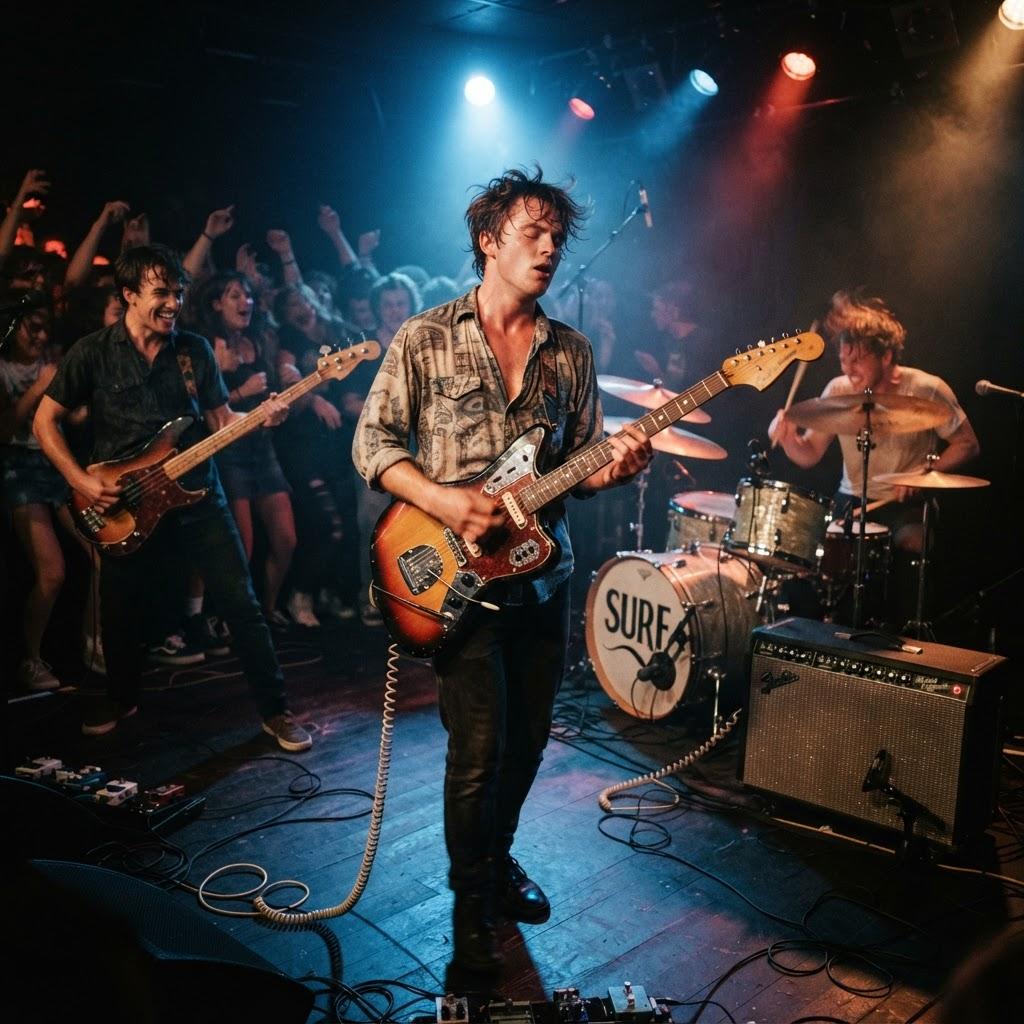
At its heart, Surf Rock is a masterclass in the 'Fender sound.' It relies heavily on specific gear, specifically the Fender Jaguar and Stratocaster, played through heavy tube amplifiers that feature a built-in 'spring reverb.' Think of spring reverb as a sound effect that makes the guitar sound like it is being played inside a giant, echoing metal pipe—it gives the music that deep, cavernous 'wet' quality that mimics the feeling of being underwater. The tempo is usually blistering, often hovering between 120 and 160 beats per minute, creating a frantic, forward-moving energy. You will hear a lot of 'tremolo picking,' which is essentially a guitar technique where the player hits one note extremely fast, like a hummingbird buzzing. The drums are the heartbeat, usually keeping a steady, driving 'surf beat' that feels like a constant, rhythmic pulse. There is no need for deep philosophical lyrics because the guitar lines are doing the talking, crying out in melodies that are equal parts haunting and triumphant, layered over a foundation of tight, punchy percussion.
Origins & Birth of the Sound
Surf Rock did not just appear on a beach; it was forged in the garages and record stores of Southern California by guys who spent their days staring at the Pacific and their nights tinkering with amplifiers. Dick Dale, the man often called the 'King of the Surf Guitar,' was the true architect. He was a surfer who wanted to translate the sensation of riding a massive wave into music. He took the aggressive, fast-paced rhythms of Middle Eastern music—thanks to his Lebanese heritage—and smashed them together with the clean, crisp tones of American rock and roll. He cranked his volume so high that his speakers blew out, forcing him to work with Leo Fender to build the first dedicated 'showman' amplifiers that could handle his insane output. This was not a polished studio project; it was a rough, live, and loud experiment born from the need to be heard over the crashing waves and the roar of hot-rod engines on the Pacific Coast Highway.
The Pioneers & Legends
Dick Dale is the undisputed king, but the kingdom had plenty of princes. The Ventures were the ones who truly took the sound to the masses, turning simple melodies into complex, layered instrumental gold. They were the guys who proved that an instrumental band could top the charts without a single word being sung. Then you have The Chantays, who gave us 'Pipeline,' a song that sounds like the literal audio version of a hollow surf break. Jan and Dean and The Beach Boys also played massive roles, though they eventually moved into the 'Vocal Surf' territory, adding harmonies to the mix. These guys were not just musicians; they were sonic pioneers who treated their guitars like race cars. They lived on the edge of technical possibility, always looking for a cleaner sound, a faster pick, or a deeper reverb setting. They were the ones who dared to say that a song could be a legend even if it didn't have a lead singer to hog the spotlight.
Defining Tracks & Era-Defining Moments
If you want to know where the heart of Surf Rock beats, look no further than 'Misirlou.' When Dick Dale recorded this, he fundamentally changed how people thought about the electric guitar. It is fast, exotic, and dangerous—it sounds like a chase scene in a movie you haven't seen yet. Then there is 'Pipeline' by The Chantays, which is the perfect example of that moody, cavernous surf atmosphere that makes you feel like you are looking at the horizon at dusk. 'Wipe Out' by The Surfaris is another titan of the genre, featuring a drum solo so iconic that it has become the default 'I'm showing off' rhythm for every middle school band kid in history. These tracks were not just hits; they were seismic events. They turned surfing from a niche hobby into a lifestyle that everyone in the country wanted to emulate, transforming the sound of the California coast into the soundtrack for American youth culture.
Subgenres & Offshoots
Surf Rock is a bit like a big, chaotic family tree. You have the 'Hot Rod' subgenre, which is essentially Surf Rock for people who like to go 100 miles per hour. It swaps the beach for the drag strip, focusing on engines, fast cars, and the thrill of the road. Then there is 'Progressive Surf,' which leans into the weird, avant-garde side of things, incorporating jazz chords and complex structures that make you question your reality. Don't forget 'Surf Noir,' a darker, moody cousin of the genre that feels less like a sunny beach day and more like a mysterious detective film shot in black and white. Later on, the 'Surf Revival' movement brought the genre back into the spotlight with bands who realized that even in the age of synthesizers, nothing beats the feeling of a clean guitar and a heavy dose of reverb. Each of these subgenres keeps the core DNA of the reverb-drenched sound while adding a different flavor of attitude.
Cultural Impact & Influence
Surf Rock did not just change music; it changed the very idea of what a 'cool kid' looked like. It brought the beach lifestyle into the living rooms of kids in Kansas who had never even seen an ocean. It inspired the 'Woody' wagon craze and made the Fender brand a household name for decades. Beyond the style, it paved the way for every instrumental rock genre that followed. You can hear the ghosts of Surf Rock in the psych-rock of the 1960s, the punk rock of the 70s, and even the indie rock of today. Whenever you hear a band use heavy reverb or a fast, tremolo-picked guitar line, you are hearing the echo of a Southern California beach in the early 1960s. It turned the guitar into a symbol of rebellion and freedom, proving that you didn't need a soulful vocalist to capture the attention of a nation. It was a cultural virus, and luckily, it was one that made everyone want to go outside and catch a wave.
Controversies & Drama
You might think a genre based on beaches and sunshine would be full of chill vibes, but you would be wrong. There was plenty of drama. One of the biggest 'purist' wars happened when vocal acts like The Beach Boys started dominating the radio. The hardcore instrumentalists felt like the true spirit of the genre—the guitar-driven, reverb-soaked focus—was being diluted by cheesy lyrics about girls and cars. It was the classic 'art vs. commerce' battle played out on the AM radio dial. There were also constant arguments over who actually 'invented' certain techniques. Dick Dale, being the fiery personality he was, often claimed he was the sole inventor of the heavy reverb sound, which ruffled a lot of feathers among other session players who were also experimenting with gear. It was a scene full of competitive ego, with every guitarist trying to play faster, louder, and with more 'drip' than the guy in the band playing down the street.
Global Spread & Regional Scenes
It is fascinating that a genre so tied to California geography managed to explode across the globe. Japan, for instance, developed a massive 'Eleki' scene in the 1960s, where bands like The Ventures were treated like literal gods. They took the surf sound and added their own precise, technical flair, creating a version of the genre that felt both familiar and alien. In the UK, the influence was filtered through the lens of British rock, leading to a grittier, more aggressive take on the sound. Even in Mexico, the surf influence merged with local musical traditions to create a high-energy hybrid that was perfectly suited for the dance floor. It turned out that the feeling of speed, rebellion, and wide-open spaces was a universal language. Whether you were in a basement in Tokyo or a community hall in London, the sound of a Fender Jaguar through a reverb tank resonated with anyone who felt the itch for adventure.
The Modern Landscape
Today, Surf Rock is in a fascinating place. It isn't just a relic of the past; it is being constantly rediscovered by a new generation of musicians who realize that 'retro' sounds are actually timeless. You see it everywhere, from TikTok trends featuring lo-fi surf instrumentals to modern indie-rock bands like La Luz or Thee Oh Sees, who borrow heavily from that 60s reverb aesthetic. The sound is currently undergoing a massive renaissance, blending with dream-pop and garage rock to create something that feels nostalgic yet incredibly fresh. People are tired of the over-produced, digital-heavy music of the current era, and there is a massive hunger for the raw, tactile feeling of strings, wood, and vacuum tubes. Surf Rock is the perfect antidote to the modern world because it is so unapologetically simple and so undeniably physical. It is thriving because at the end of the day, people will always want to feel like they are driving fast with the top down.
How to Dive In
Ready to get your feet wet? Start your journey by listening to 'Surfer's Choice' by The Ventures and 'King of the Surf Guitar' by Dick Dale. These are your foundational texts. Don't just listen in the background; crank the volume and pay attention to how the guitar and the drums interact—that is where the magic lives. Look for playlists that feature early 60s instrumentals and pay attention to the production. Once you have gotten a taste for the classics, start branching out into modern surf revivalists to see how the genre has evolved. If you really want to understand the vibe, find a video of a 1960s surf movie and mute the original audio, then play your favorite tracks over the clips—it will click instantly. The goal is not to study the music; it is to let it possess you. So grab your air guitar, find a spot with plenty of space, and prepare for a sonic ride that will leave you absolutely breathless and craving more.